Infographics and posters
Render information-dense layouts with headings, labels, lists, diagrams, and substantial Chinese or English text.
Independent tool overview
Qwen Image 2.0 is an active Alibaba image-generation and editing model optimized for long, text-heavy instructions, photorealism, and native 2K-class output. It is no longer the newest Qwen image generation after Qwen Image 3.0 launched in July 2026, but 2.0 and 2.0 Pro remain the image models published on Qwen's API platform at $0.035 and $0.075 per successful image internationally.
Visit the official Qwen Image 2.0 site ↗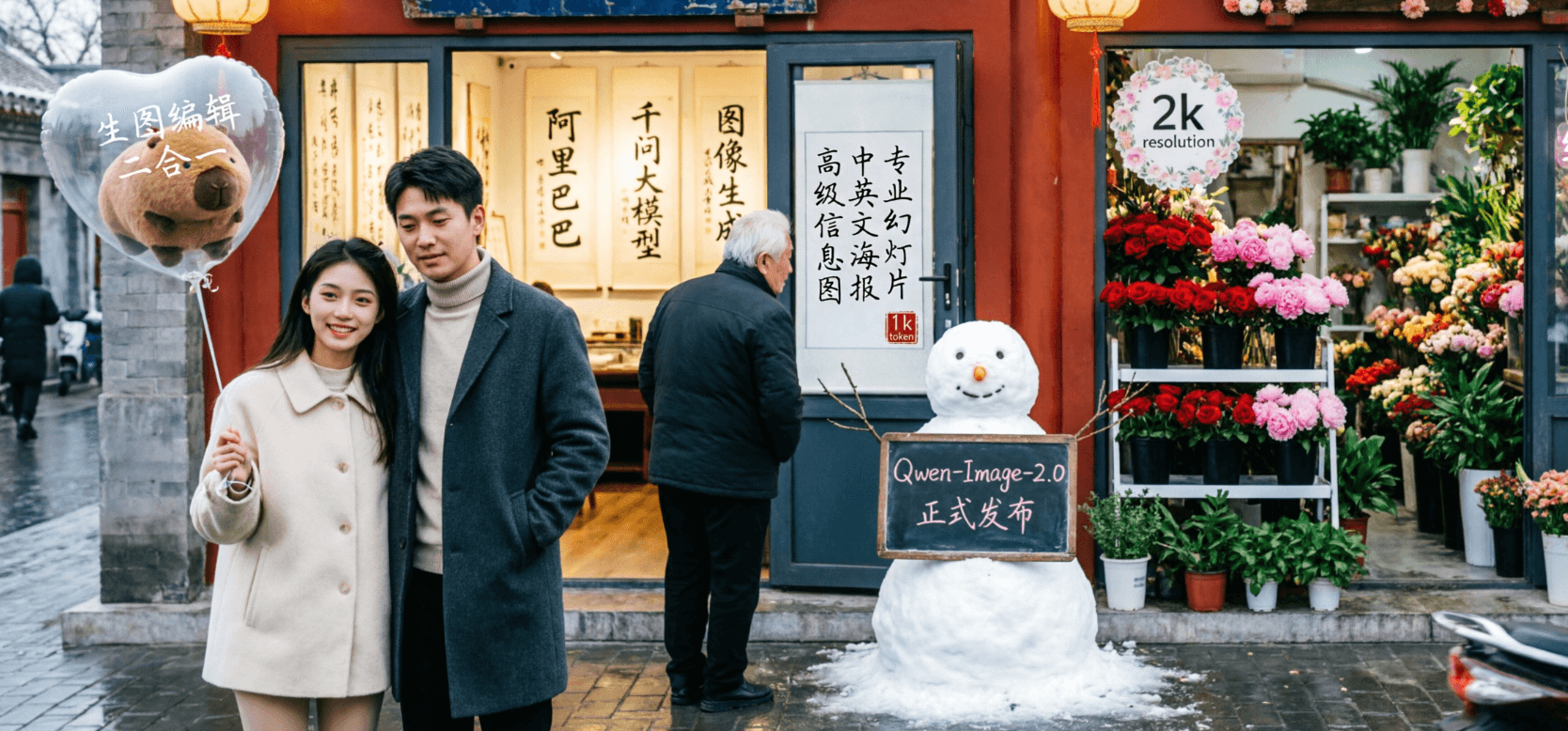
Overview
Qwen Image 2.0 unified text-to-image generation and instruction-based editing in one model family. Its main differentiators are complex Chinese and English typography, long visual briefs, infographic-style layouts, realistic detail, custom 2K-class dimensions, and a choice between a faster standard model and a higher-quality Pro model.
Developers can generate one to six variants per call, provide a negative prompt, choose a seed, control watermarking, and enable or disable automatic prompt rewriting. Editing accepts one to three source images and a single instruction, making the model useful for composition, text replacement, restyling, and multi-image combinations.
Qwen Image 3.0 is now the newer generation and extends instructions to 4.5K tokens with deeper knowledge and native 12-language rendering. However, Qwen's current public API platform still lists Qwen Image 2.0 and 2.0 Pro. That makes 2.0 an active production option rather than a historical model, but new projects should compare it with 3.0 availability and Alibaba's currently recommended Wan 2.7 image family.
Use cases
The strongest fit depends on the job you need the product to complete, not the size of its feature list.
Render information-dense layouts with headings, labels, lists, diagrams, and substantial Chinese or English text.
Generate slide-like compositions, explainer panels, comics, menus, covers, or social graphics from a detailed specification.
Modify an existing image, add or replace text, combine several references, and preserve requested parts of the source.
Generate up to six 2K-class variants per request at a published per-successful-image price.
Capabilities
Uses the same model family for text-to-image creation and image-instruction editing instead of separate generation and edit pipelines.
The launch emphasizes 1K-token visual briefs, while the current API accepts up to 1,300 prompt tokens before truncation.
Supports a pixel budget from 512 × 512 through 2048 × 2048, including recommended landscape and portrait dimensions.
Targets long-form Chinese and English text, aligned layout, multiple font treatments, and text integrated into realistic scenes.
Accepts one to three JPG, PNG, BMP, TIFF, WEBP, or GIF source images and outputs a PNG.
Supports negative prompts, seeds, one to six outputs, watermark toggles, custom size, and optional smart prompt rewriting.
qwen-image-2.0 prioritizes speed and cost, while qwen-image-2.0-pro is positioned for stronger quality and negative-prompt use.
Process
Step 1
Start with the lower-cost standard model; move to Pro only when a representative evaluation shows a useful quality gain.
Step 2
Describe the hierarchy, exact text, position, typography, visual style, subject, camera, lighting, and required exclusions.
Step 3
Leave prompt extension enabled for a short brief, but disable it when exact wording, layout, or visual constraints must not drift.
Step 4
Request a small set of variants, then select the best composition before spending more calls on editing.
Step 5
Proofread text, numbers, labels, logos, anatomy, identities, source rights, and factual content before publication.
Cost
Alibaba Cloud Model Studio bills only successfully returned images. International API users receive a 100-image free quota for supported Qwen Image models during the first 90 days after activating Model Studio. China-region prices differ slightly and no international free quota applies outside the specified deployment scope.
Account access; no per-image price published
Interactive image creation in Qwen's consumer chat interface.
$0.035 per image internationally
The faster, lower-cost unified generation and editing model.
$0.075 per image internationally
The higher-priced 2.0 variant for stronger generation and editing quality.
Pricing checked . Check current pricing at the source ↗
Assessment
Compare
The right alternative depends on the specific output, workflow, controls and budget your project requires.
Design
Choose Seedream 5.0 Pro for another current design-focused model aimed at infographics, typography, and precise edits.
Explore Seedream 5.0 Pro →Design
Consider Nano Banana Pro for strong world knowledge, editing, and text rendering inside Google's ecosystem.
Explore Nano Banana Pro →Design
Use Luma UNI-1.1 when multi-reference creative direction and natural-language iterative editing are the priority.
Explore Uni-1 →Design
Consider Recraft V4.1 for design taste, illustration, photorealism, and production-oriented visual assets.
Explore Recraft V4.1 →Questions
Qwen Image 2.0 is Alibaba's unified image-generation and editing model family for text-heavy graphics, photorealistic scenes, long instructions, and 2K-class output.
It is still an active public API model, but it is no longer the newest Qwen image generation. Qwen Image 3.0 launched in July 2026, while Qwen's API platform continues to list 2.0 and 2.0 Pro.
International API pricing is $0.035 per successful image for qwen-image-2.0 and $0.075 for qwen-image-2.0-pro. Eligible new international Model Studio users receive 100 free images for 90 days.
The standard model is the faster and lower-cost option. Pro costs more and is positioned for stronger generation and editing quality, including negative-prompt workflows.
Yes. The same model family supports generation and editing. An edit request can include one to three source images plus one Chinese or English instruction.
It supports custom dimensions within a total pixel range from 512 × 512 through 2048 × 2048. The default text-to-image output is 2048 × 2048, with recommended landscape and portrait dimensions that use a similar pixel budget.
The launch highlights 1K-token complex instructions. The current Alibaba Cloud API documentation accepts up to 1,300 prompt tokens and truncates anything longer.
Bottom line
Qwen Image 2.0 remains a practical low-cost API when the job combines typography, dense layout, and image editing. The standard model should be the default economic test; Pro should earn its 2.1-times price through measured acceptance rates. For a new platform decision, compare the same briefs against Qwen Image 3.0 where available and Wan 2.7, which Alibaba now recommends for broader 4K and multi-reference workflows.
Visit Qwen Image 2.0 website ↗
Riverflow 2.0 - Sourceful's new SOTA image editing model
FireRed-Image-Edit - Open-source image editing model with SOTA results across style, text, try-on, and photo restoration tasks
Pencil - An infinite design canvas for Claude Code

Recraft V4 - New image model tuned for design taste, typography, and production-ready outputs

Get access to all our AI courses, hundreds of real-world AI use cases, live expert-led workshops, an exclusive network of AI early adopters, and more.
Get unlimited access to all of our current & upcoming industry-specific AI courses for the duration of your subscription.
To keep up with the rapid pace of AI, our team publishes AI implementation guides daily. Our library contains 300+ practical use cases to automate real-world work.
Join weekly, live, interactive sessions with industry leaders who are at the forefront of AI for hands-on implementation guidance and exclusive insights.
Network with an exclusive community of AI-first professionals who are working smarter with AI. Learn how early adopters are using AI in their work and businesses.