Pinned coding agents
Teams that tested Grok 4.5 against their repositories and want a fixed model ID instead of silently changing behavior.
Independent tool overview
Grok 4.5 is an active SpaceXAI reasoning model for coding, agentic engineering and knowledge work, though Grok 4.6 has replaced it as the newer flagship option.
Visit the official Grok 4.5 site ↗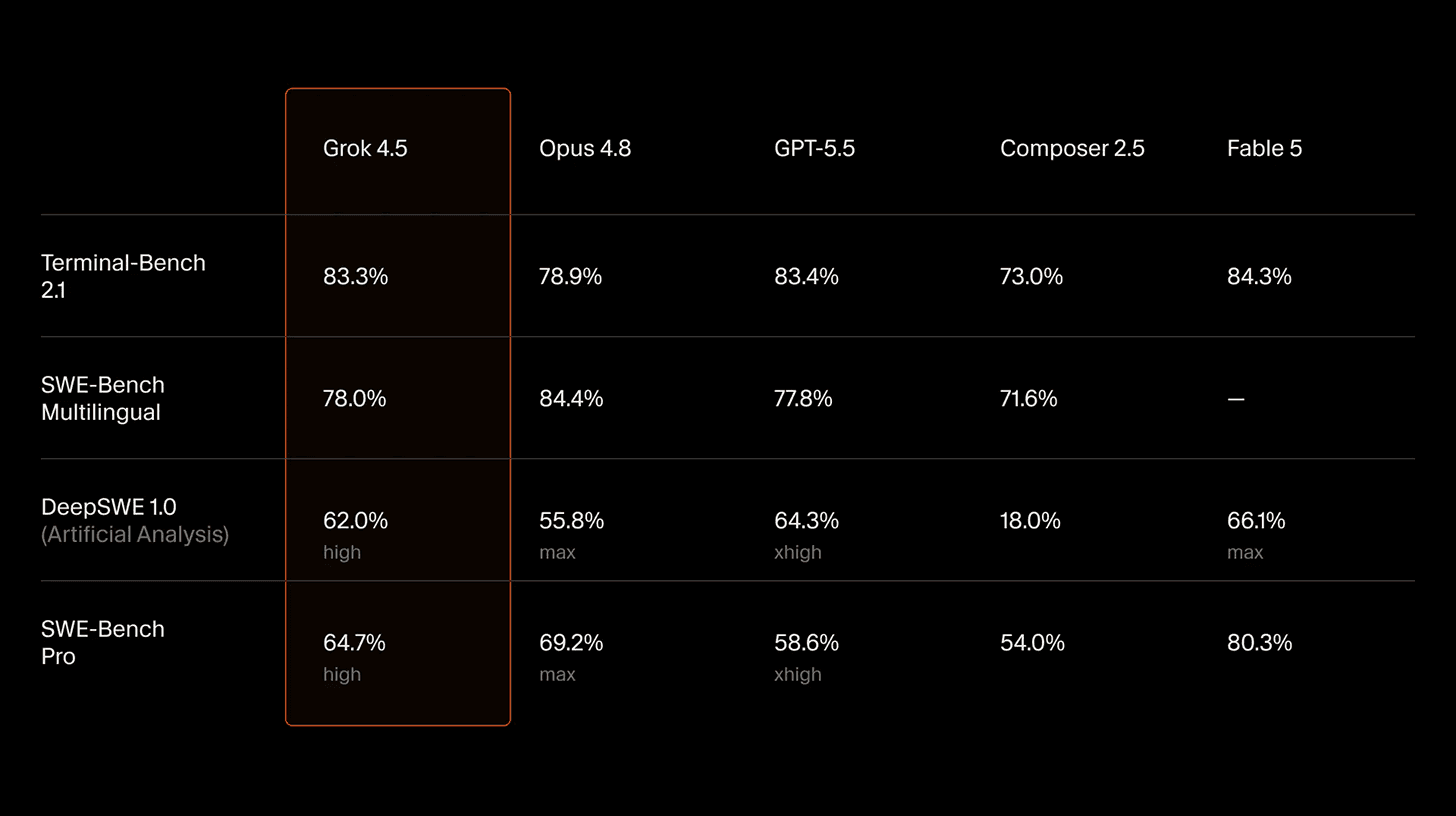
Overview
Grok 4.5 remains listed in the SpaceXAI API with a fixed grok-4.5 model ID, a 500,000-token context window, text and image input, text output, configurable reasoning, function calling and structured outputs. It was built for agentic software engineering and technical knowledge work and is also available through products and partners including Grok Build, Cursor and GitHub Copilot.
It is no longer the newest Grok model. SpaceXAI released Grok 4.6 on August 12, 2026 with stronger long-running agent and visual-work capabilities at the same base $2 input and $6 output rates. Grok 4.5 still makes sense when a team has already validated its behavior or needs a pinned version, but new evaluations should compare 4.6 before standardizing.
Use cases
The strongest fit depends on the job you need the product to complete, not the size of its feature list.
Teams that tested Grok 4.5 against their repositories and want a fixed model ID instead of silently changing behavior.
Engineering workflows using a 500K context window to inspect broad code and documentation sets, while watching the 200K pricing threshold.
Applications combining reasoning with function calls, structured output, web or X search, code execution and private collections.
Prompts that pair source code or logs with screenshots, diagrams or other image input and require a text response.
Teams comparing an established Grok 4.5 evaluation set against Grok 4.6 before switching production traffic.
Capabilities
Designed for multi-step software, engineering and workflow tasks rather than only short conversational answers.
Handles large prompts and histories, with higher token rates applied to the entire request once the prompt reaches 200,000 tokens.
Accepts images alongside text for tasks such as reviewing screenshots, diagrams and visual technical context.
Supports low, medium or high reasoning effort so applications can trade latency and token use against deeper analysis.
Can select and call application-defined functions to retrieve data or take actions under developer-controlled permissions.
Can produce responses constrained to a defined schema for more reliable downstream application handling.
The Responses API can add web search, X search, code execution, file attachments, collections search, image generation and remote MCP tools at separate rates.
Cached input tokens cost less than regular input when repeated prompt prefixes qualify for cache reuse.
Process
Step 1
Use the fixed grok-4.5 ID when preserving evaluated behavior matters; benchmark Grok 4.6 first for a new implementation.
Step 2
Retrieve only the code, documentation and history needed for the task, because crossing 200K prompt tokens doubles all Grok 4.5 token rates.
Step 3
Expose narrow functions, validate arguments, require structured output where useful and keep authorization outside the model.
Step 4
Use lower effort for routine work and reserve higher effort for complex debugging, architecture or multi-step execution.
Step 5
Give coding agents scoped credentials, a disposable branch or sandbox and explicit limits on commands, networks and secrets.
Step 6
Track input, cached, reasoning and output tokens plus every server-side tool call; do not estimate an agent run from headline token rates alone.
Step 7
Require tests, static checks, diff review and human approval for consequential code, infrastructure, financial or business actions.
Cost
Grok 4.5 uses token-based API pricing. Prompts below 200K tokens cost $2 per million input tokens, $0.30 per million cached input tokens and $6 per million output tokens. Once the prompt reaches 200K tokens, those rates double for all tokens in the request. Server-side tools and optional priority processing add separate charges.
$2 input / $0.30 cached / $6 output per 1M tokens
Standard Grok 4.5 pricing for prompts below 200,000 tokens.
$4 input / $0.60 cached / $12 output per 1M tokens
Rates applied to every token in a request when the prompt reaches 200,000 tokens.
From $2.50 to $10 per 1,000 calls, plus tokens
Optional tools are billed per invocation in addition to model token use.
Pricing checked . Check current pricing at the source ↗
Assessment
Compare
The right alternative depends on the specific output, workflow, controls and budget your project requires.
Consumer
Choose Grok 4.6 for SpaceXAI's newer flagship, especially for longer-running agents and interactive or visual application work.
Explore Grok 4.6 →Coding
Choose Grok Build when you want SpaceXAI's ready-made coding agent and workflow environment instead of integrating the model API yourself.
Explore Grok Build →Coding
Choose Claude Code for an established terminal and IDE coding-agent workflow with Anthropic models.
Explore Claude Code →Coding
Choose Cursor for an editor-first coding product that can expose Grok and competing models inside one development workflow.
Explore Cursor →Questions
Yes. SpaceXAI still lists grok-4.5 as an active API model with its own documentation and pricing. It is no longer the newest flagship.
Grok 4.6 is the newer flagship and builds on 4.5, but Grok 4.5 remains available. Existing teams can keep the fixed model while evaluating migration.
Below 200K prompt tokens, the rates are $2 per million input tokens, $0.30 per million cached tokens and $6 per million output tokens. Long-context rates are double.
When the prompt reaches 200,000 tokens, SpaceXAI charges $4 input, $0.60 cached input and $12 output per million tokens for all tokens in that request.
The documented context window is 500,000 tokens. The 200K pricing threshold is lower than the maximum context size.
Yes. The model accepts text and image input and returns text. Image generation is a separate server-side tool and Imagine API product.
Yes. It supports function calling and structured outputs, but developers must validate requests, enforce permissions and confirm consequential actions outside the model.
No. Its model page lists the Batch API as unsupported.
No. Web Search and X Search each cost $5 per 1,000 tool calls in addition to the model tokens used by the request.
Start by evaluating Grok 4.6 because it is newer and has the same base token rates. Keep 4.5 when its behavior is already validated or it performs better on a specific workload.
Bottom line
Grok 4.5 remains a capable, unusually fast API option for coding and tool-using technical agents, with a large context window and straightforward base rates. Its value now is a stable, pinned model rather than the newest Grok experience. New deployments should benchmark Grok 4.6, and every deployment should control the 200K long-context threshold, tool-call amplification and permissions around model-selected actions.
Visit Grok 4.5 website ↗
Willow Frontier Mini - Willow's free, unlimited AI dictation model

GPT-Live - OpenAI's new voice model with more natural conversation abilities
Hy-3 - Tencent's new open-source model built for cheap, reliable agent deployment

Muse Spark 1.1 - Meta's upgraded, cost-effective agentic model with 1M-token memory and computer use

Get access to all our AI courses, hundreds of real-world AI use cases, live expert-led workshops, an exclusive network of AI early adopters, and more.
Get unlimited access to all of our current & upcoming industry-specific AI courses for the duration of your subscription.
To keep up with the rapid pace of AI, our team publishes AI implementation guides daily. Our library contains 300+ practical use cases to automate real-world work.
Join weekly, live, interactive sessions with industry leaders who are at the forefront of AI for hands-on implementation guidance and exclusive insights.
Network with an exclusive community of AI-first professionals who are working smarter with AI. Learn how early adopters are using AI in their work and businesses.