Text-heavy marketing graphics
Generate posters, social cards, and promotional layouts that require multiple pieces of legible text.
Independent tool overview
Z.AI's open-weight image-generation model, designed for dense text, knowledge-heavy graphics, high-resolution generation, and instruction-based image editing.
Visit the official GLM-Image site ↗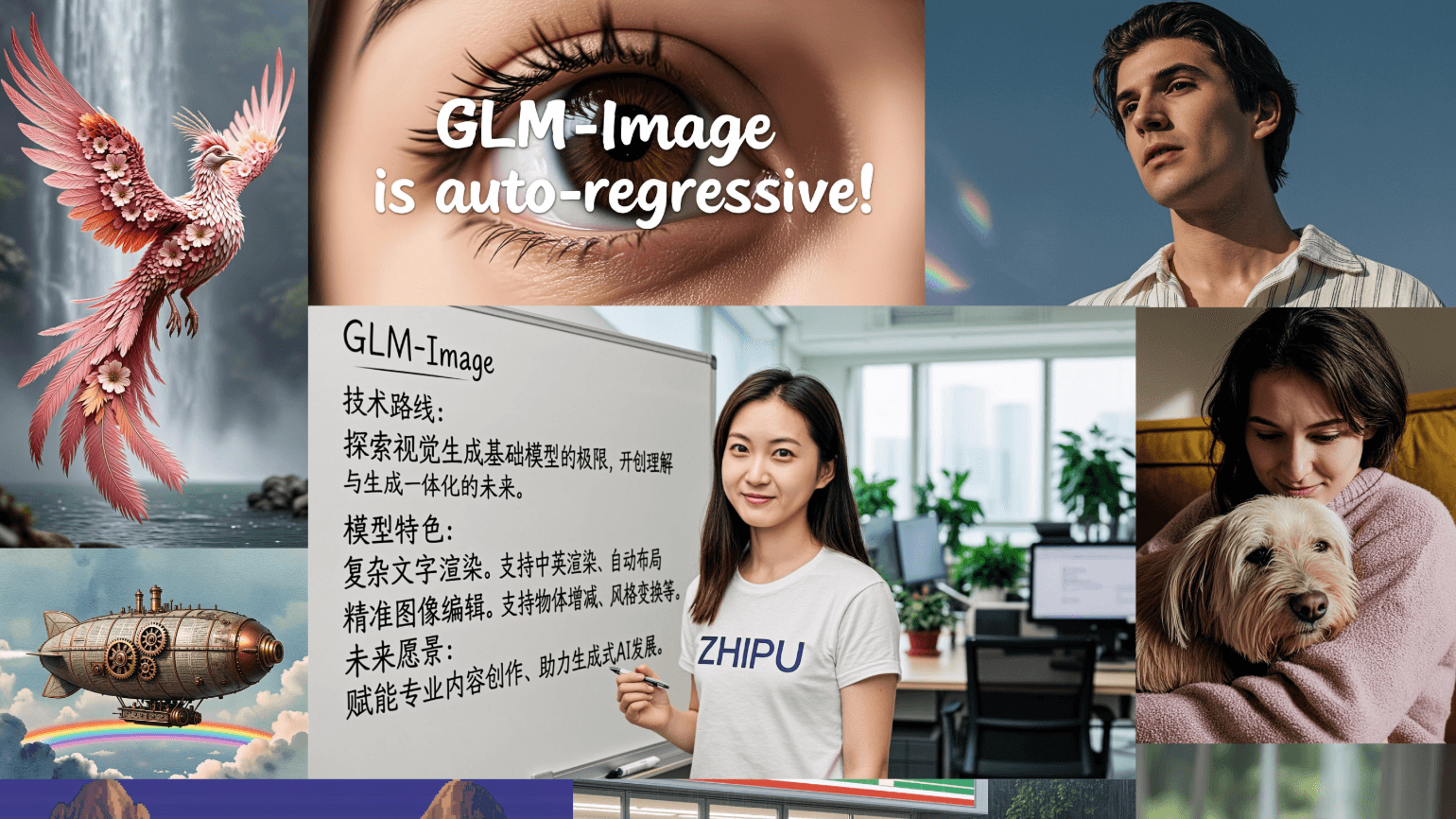
Overview
GLM-Image is Z.AI's flagship open image model for text-to-image and image-to-image work. Its main differentiator is text-heavy composition: posters, presentation graphics, science explainers, multi-panel layouts, and social assets that need words embedded in the image.
The model combines a 9-billion-parameter autoregressive generator with a 7-billion-parameter diffusion decoder. The first component handles instructions and overall composition; the decoder restores image detail and uses a dedicated Glyph Encoder to improve rendered text.
Developers can self-host the published weights through Transformers and Diffusers, serve an OpenAI-style image endpoint with SGLang, or use Z.AI's managed API. Self-hosting gives more control, but the reference implementation remains computationally heavy.
Use cases
The strongest fit depends on the job you need the product to complete, not the size of its feature list.
Generate posters, social cards, and promotional layouts that require multiple pieces of legible text.
Create visually dense educational or scientific graphics with labels, steps, and structured information.
Apply prompt-driven changes, style transfer, identity-preserving edits, and multi-subject composition from reference images.
Run published weights inside a controlled environment when infrastructure, privacy, or model customization justifies the hardware cost.
Add relatively inexpensive text-to-image generation through Z.AI's managed endpoint without operating the model locally.
Capabilities
A Glyph Encoder and targeted post-training focus on spelling, multi-line text, and multiple text regions inside one image.
Targets diagrams, posters, slide-like layouts, and other scenes where semantic structure matters as much as aesthetics.
Supports text-to-image, image editing, style transfer, identity preservation, and multi-subject consistency in one model.
Supports common aspect ratios and custom dimensions from 512 to 2048 pixels per side, with each dimension divisible by 32.
Official examples cover Transformers, Diffusers, and SGLang-based deployment.
Provides an image-generation endpoint that returns a URL for the generated asset.
Process
Step 1
Use the Z.AI API for simple per-image billing, or download the model when deployment control outweighs infrastructure complexity.
Step 2
Describe the layout, subject, style, hierarchy, and exact wording; the official guidance recommends putting intended rendered text in quotation marks.
Step 3
Choose a supported aspect ratio or custom width and height between 512 and 2048 pixels, each divisible by 32.
Step 4
Review spelling, logos, layout, subject identity, and factual diagram content before using the image.
Step 5
Refine the prompt or supply one or more reference images for targeted changes and consistency.
Cost
The downloadable model does not carry a per-image fee, but self-hosting incurs GPU and engineering costs. Z.AI's official managed endpoint is billed per image.
Free to download
Run GLM-Image on your own infrastructure under the applicable repository and model licenses.
$0.015/image
Managed image generation through Z.AI's API.
Varies
Inference providers may offer the model with their own hardware, queue, and billing terms.
Pricing checked . Check current pricing at the source ↗
Assessment
Compare
The right alternative depends on the specific output, workflow, controls and budget your project requires.
Design
Another open image family with strong text rendering, unified editing, and native high-resolution output.
Explore Qwen Image 2.0 →Content Creator
A competing open model family for teams comparing quality, speed, and local deployment requirements.
Explore Z-Image →Design
A polished hosted product for typography-focused design without running model infrastructure.
Explore Ideogram →Design
Consider this when evaluating newer open-weight image models with a strong design and text focus.
Explore Ideogram 4.0 →Questions
GLM-Image is Z.AI's image-generation model for text-to-image and image-to-image tasks, with an emphasis on dense text, structured layouts, and knowledge-heavy graphics.
Z.AI publishes the model weights, implementation, and license files. The official GitHub repository labels the project Apache-2.0, while the Hugging Face model card labels the overall model MIT and notes Apache-2.0 components. Review the exact distribution and component licenses for your use case.
Z.AI's current developer documentation lists the managed API at $0.015 per generated image.
Yes in the downloadable model. Official examples cover prompt-based editing, and the model card describes style transfer, identity-preserving generation, and multi-subject consistency.
Z.AI lists common 1:1, 3:4, 4:3, and 16:9 sizes. Custom width and height must each be between 512 and 2048 pixels and divisible by 32.
It is a heavy model. The repository reports about 37.8 GB peak VRAM for one 1024×1024 generation in its H100 Diffusers test, while the model card describes a slower CPU-offload path around 23 GB. Real requirements depend on resolution, batch size, software, and optimization.
Bottom line
GLM-Image is most compelling when accurate text and structured information inside an image are central requirements. The managed API removes its substantial local compute burden, while the published weights remain valuable for teams that need deployment control and can validate the licensing and hardware tradeoffs.
Visit GLM-Image website ↗
Scribe v2 - ElevenLabs' SOTA transcription model with top accuracy, multi-language support, keyterm prompting, and more

Remotion - Create and edit videos with AI

LTX-2 - Lightricks' open-source foundation video model for long-form, high-fidelity outputs

Qwen3-TTS - Alibaba's new family of open-source, SOTA AI text-to-speech models

Get access to all our AI courses, hundreds of real-world AI use cases, live expert-led workshops, an exclusive network of AI early adopters, and more.
Get unlimited access to all of our current & upcoming industry-specific AI courses for the duration of your subscription.
To keep up with the rapid pace of AI, our team publishes AI implementation guides daily. Our library contains 300+ practical use cases to automate real-world work.
Join weekly, live, interactive sessions with industry leaders who are at the forefront of AI for hands-on implementation guidance and exclusive insights.
Network with an exclusive community of AI-first professionals who are working smarter with AI. Learn how early adopters are using AI in their work and businesses.