Developers who need a modifiable image foundation model
Use the official weights and code as a base for internal pipelines, adapters, fine-tunes, conditioning, and controlled experiments.
Independent tool overview
Z-Image is Tongyi-MAI's 6-billion-parameter undistilled text-to-image foundation model. It emphasizes prompt control, output diversity, negative prompting, and fine-tuning rather than the eight-step speed of Z-Image-Turbo.
Visit the official Z-Image site ↗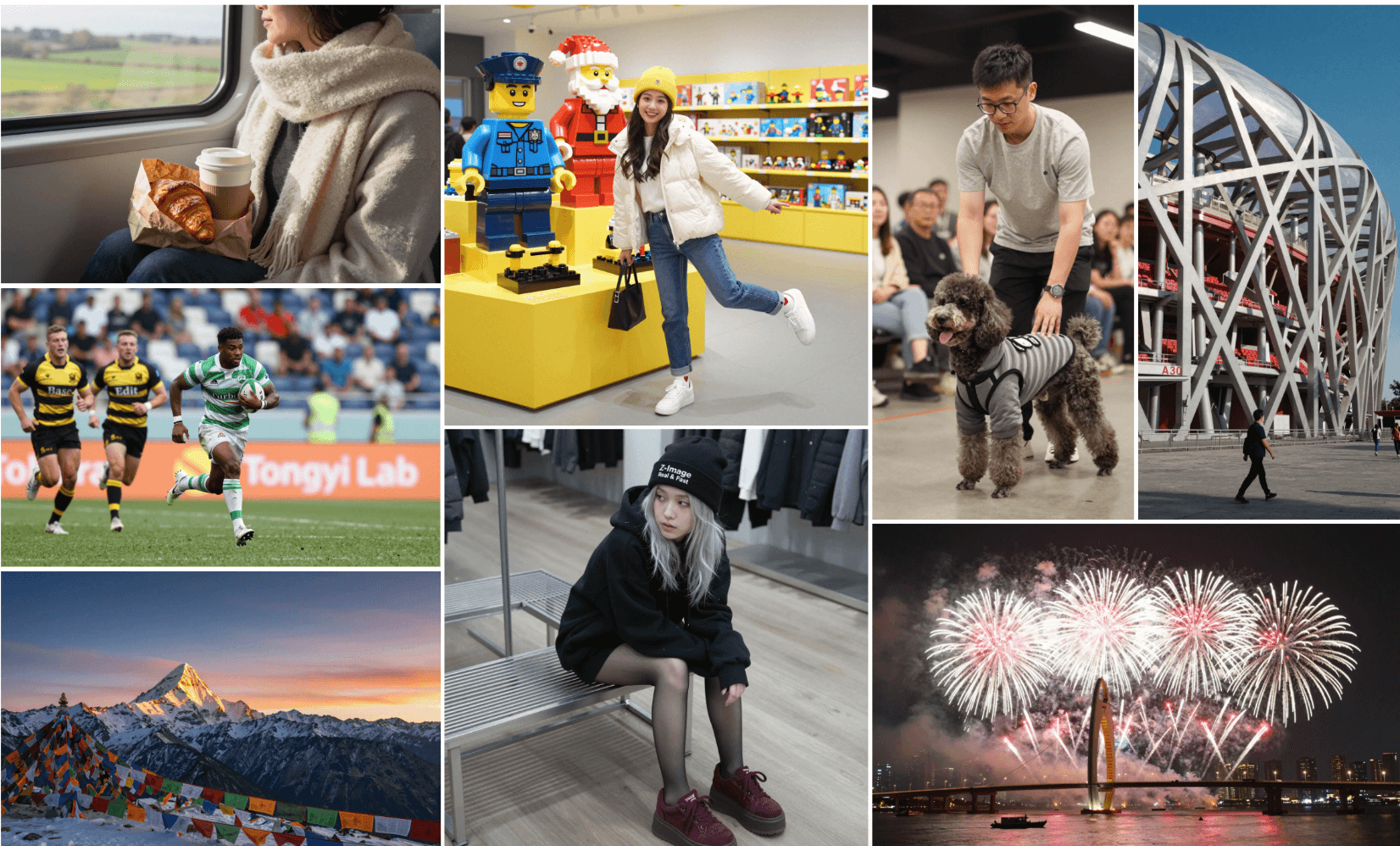
Overview
Z-Image is the full-capacity foundation checkpoint in Tongyi-MAI's Z-Image family. Unlike the distilled Z-Image-Turbo release, the base model retains classifier-free guidance, supports negative prompts, and is intended for creative exploration, fine-tuning, ControlNet-style conditioning, and other downstream development.
The official checkpoint is a 6B-parameter BF16 Safetensors model distributed through Hugging Face and ModelScope under Apache License 2.0. The repository provides native PyTorch and Hugging Face Diffusers examples, while the official Hugging Face page also links notebooks, local apps, hosted inference, and a demo.
The key tradeoff is speed versus control. Tongyi-MAI recommends 28–50 inference steps and a guidance scale of 3–5 for Z-Image, compared with eight model evaluations and no CFG for Turbo. The base model is therefore the better development foundation, but Turbo is the more practical choice when latency or consumer-hardware efficiency dominates.
Do not transfer every Z-Image-Turbo benchmark claim to Z-Image. The repository's December 2025 top open-source leaderboard statement specifically names Turbo. Teams should run their own prompt suite for text accuracy, anatomy, identity diversity, style, safety, and latency on the exact checkpoint and serving stack they plan to deploy.
Use cases
The strongest fit depends on the job you need the product to complete, not the size of its feature list.
Use the official weights and code as a base for internal pipelines, adapters, fine-tunes, conditioning, and controlled experiments.
Explore more diverse identities, poses, compositions, lighting, and styles across seeds than the distilled Turbo workflow is designed to produce.
Use full classifier-free guidance and negative prompts to suppress unwanted elements or steer composition.
Test Chinese and English text-rendering tasks on a controlled brand prompt set before production use.
Work with a published 6B S3-DiT architecture, technical report, code, checkpoints, and related distilled model.
Capabilities
Preserves the full base-model behavior rather than optimizing only for few-step inference.
Supports CFG for stronger prompt steering, with an official recommended guidance scale of 3.0 to 5.0.
Accepts negative prompts to discourage unwanted artifacts, content, or compositional elements.
The model card demonstrates photorealistic, cinematic, anime, illustration, and other visual styles.
Designed to vary identity, pose, composition, and lighting across random seeds.
Official guidance covers total pixel areas from 512×512 through 2048×2048 with different aspect ratios.
Positioned for LoRA training, structural conditioning such as ControlNet, and semantic conditioning.
Runs through ZImagePipeline with official loading and inference examples.
Weights are published on Hugging Face and ModelScope, with demos and community integrations available.
Process
Step 1
Select Z-Image for CFG, negative prompts, diversity, and fine-tuning; choose Turbo when eight-step generation and lower hardware pressure matter more.
Step 2
Document Apache 2.0 obligations and separately assess rights, privacy, safety, disclosure, and permitted-use requirements for your inputs and outputs.
Step 3
Install a current PyTorch stack and Diffusers version with ZImagePipeline support, then validate CUDA, BF16, attention, and memory behavior on the target machine.
Step 4
Use Tongyi-MAI/Z-Image rather than similarly named community copies when establishing a baseline.
Step 5
Test 28–50 steps, guidance scale 3–5, a supported pixel area, and a useful negative prompt before tuning.
Step 6
Include people, hands, multiple subjects, typography, Chinese and English text, varied aspect ratios, complex layouts, and brand-sensitive prompts.
Step 7
Log model revision, prompt, negative prompt, seed, dimensions, steps, CFG settings, runtime, and post-processing for reproducibility.
Step 8
Screen prompts and outputs, protect private inputs, label synthetic media where appropriate, and require human review for publication or high-impact use.
Step 9
Measure cold start, generation time, peak memory, throughput, failure rate, and cost on the exact GPU and concurrency configuration.
Cost
Tongyi-MAI publishes the Z-Image code and checkpoint at no license fee under Apache 2.0. Running it is not cost-free: users supply local GPU hardware or pay a third-party notebook, inference provider, or cloud endpoint. The official page exposes a demo and hosted-provider path, but those services can apply their own quotas and prices.
Free to download
Repository and checkpoint released under Apache License 2.0.
Free access subject to platform limits
Browser-based way to sample the model without a local install.
Usage-dependent
Run on owned hardware or a paid GPU/inference provider.
Pricing checked . Check current pricing at the source ↗
Assessment
Compare
The right alternative depends on the specific output, workflow, controls and budget your project requires.
Design
Consider Qwen Image 2.0 when you want another open-weight Alibaba image model and need to compare prompt adherence, typography, editing, and deployment needs.
Explore Qwen Image 2.0 →Content Creator
Consider FLUX.2 for a different open image-model ecosystem with its own model sizes, serving options, and visual tradeoffs.
Explore FLUX.2 →Design
Consider Ideogram when a managed product and typography-oriented creative workflow matter more than self-hosting an undistilled foundation checkpoint.
Explore Ideogram →Questions
Z-Image is Tongyi-MAI's undistilled 6B text-to-image foundation model. It is the controllable, fine-tunable base behind the faster distilled Z-Image-Turbo variant.
No. Z-Image supports CFG, negative prompts, higher diversity, and fine-tuning with a recommended 28–50 steps. Turbo is distilled for eight-evaluation speed and does not use CFG in the official example.
The official repository says Z-Image-Turbo ranked first among open-source models on an Artificial Analysis snapshot in December 2025. That should not be presented as an automatic ranking for the later base Z-Image checkpoint.
The official repository and checkpoint are publicly downloadable and labeled Apache 2.0. Teams should still review the exact files, notices, dependencies, and license obligations for their distribution.
Apache 2.0 permits broad use of the released work subject to its conditions, but it does not clear rights in prompts, training data, people, brands, reference images, or generated subject matter. Obtain legal review for consequential deployments.
The official code and weights have no download fee. You pay for the hardware, cloud GPU, hosted inference, storage, engineering, and safety controls used to run it.
The current official guidance is a 512×512 to 2048×2048 total pixel area, guidance scale 3.0–5.0, 28–50 inference steps, and negative prompts for added control.
The official under-16GB statement is for Turbo, not the base model. Z-Image's BF16 checkpoint is large and actual peak memory depends on resolution and runtime optimizations, so benchmark your target GPU or use offloading.
Bilingual text rendering is a stated strength of the model family and a focus of the technical report. Exact spelling and layout can still fail, so inspect and typeset critical text separately.
Yes. Tongyi-MAI positions the undistilled checkpoint for LoRA training, structural conditioning, semantic conditioning, and other downstream development.
The released Z-Image checkpoint is listed for generation. The separate Z-Image-Edit and Omni-Base checkpoints are described by the project but remain marked for future release in its current model table.
Yes. Tongyi-MAI links official Hugging Face and ModelScope demos. Public demos can have queues and changing quotas and should not receive confidential prompts or assets.
Test visual quality, prompt adherence, typography, demographic behavior, unsafe outputs, reproducibility, peak memory, latency, throughput, licensing, and moderation on the exact model revision and hardware stack.
Not without strict controls. It generates synthetic pixels and can fabricate people, events, products, documents, and conditions. Require human review, clear disclosure, and domain-specific safeguards.
Bottom line
Z-Image is a strong option for developers who want a compact, permissively released image foundation model with more control and fine-tuning headroom than its Turbo sibling. Its value is the undistilled checkpoint, not the leaderboard headline attached to Turbo. Choose it when CFG, negative prompts, diversity, and customization justify longer generation times—and validate rights, safety, memory, and output quality on your own workload.
Visit Z-Image website ↗
Ray 3.14 - Luma’s upgraded video model for professional creative workflows
Wonda - Wondercraft's AI agent for video editing and creative direction

Qwen3-TTS - Alibaba's new family of open-source, SOTA AI text-to-speech models

Eleven v3 - ElevenLabs’ most expressive AI voice model, now commercially available

Get access to all our AI courses, hundreds of real-world AI use cases, live expert-led workshops, an exclusive network of AI early adopters, and more.
Get unlimited access to all of our current & upcoming industry-specific AI courses for the duration of your subscription.
To keep up with the rapid pace of AI, our team publishes AI implementation guides daily. Our library contains 300+ practical use cases to automate real-world work.
Join weekly, live, interactive sessions with industry leaders who are at the forefront of AI for hands-on implementation guidance and exclusive insights.
Network with an exclusive community of AI-first professionals who are working smarter with AI. Learn how early adopters are using AI in their work and businesses.