Self-hosted speech products
Run an Apache-licensed model inside a controlled environment when data locality, customization, or infrastructure ownership matters.
Independent tool overview
Qwen3-TTS is Alibaba's Apache-2.0 speech-generation family, spanning 0.6B and 1.7B local models for preset voices and voice cloning, a 1.7B voice-design model, and hosted streaming APIs.
Visit the official Qwen3-TTS site ↗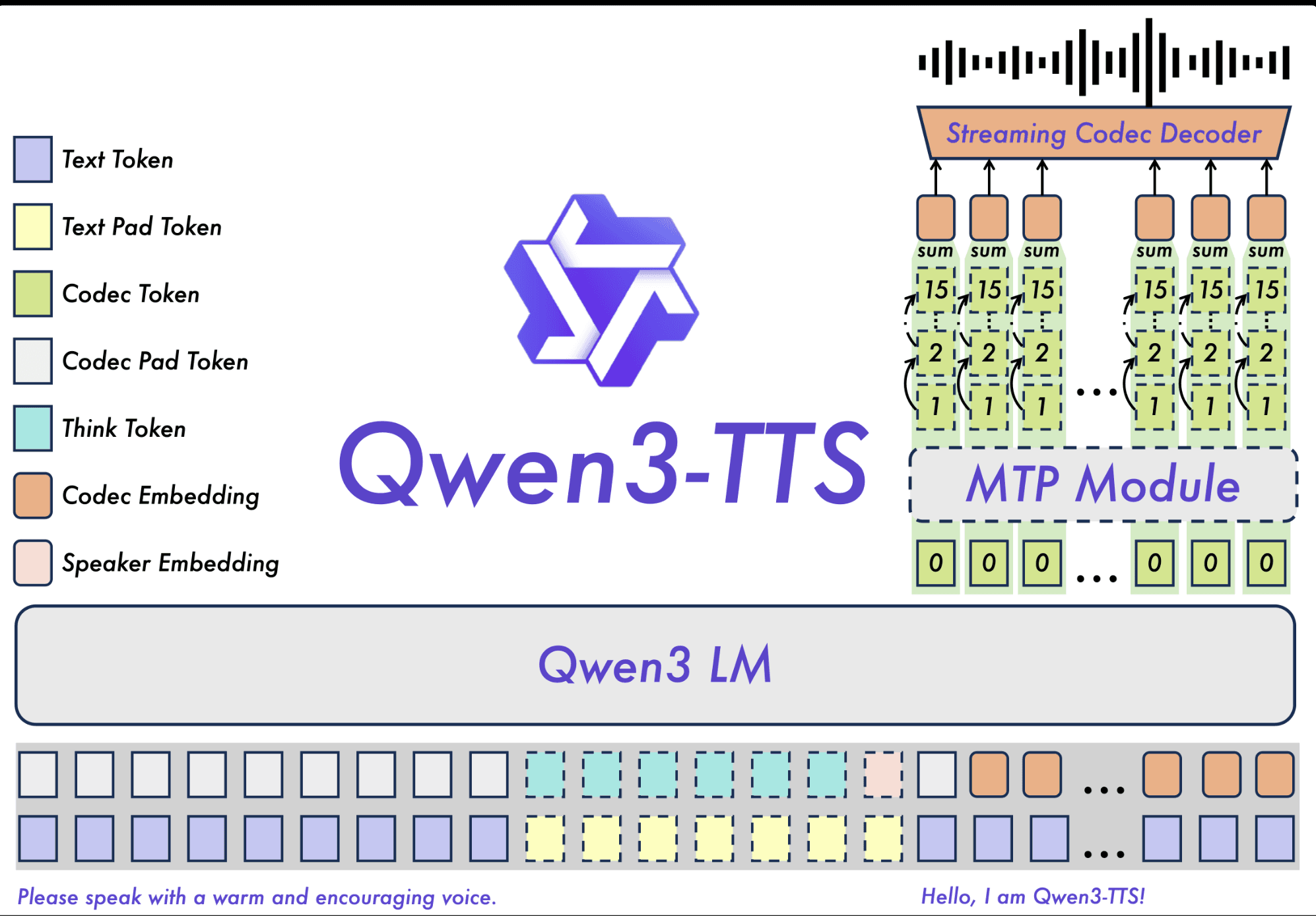
Overview
Qwen3-TTS is a family rather than one text-to-speech model. The open release includes 0.6B and 1.7B Base checkpoints for rapid voice cloning and fine-tuning, 0.6B and 1.7B CustomVoice checkpoints with nine built-in speakers, and a 1.7B VoiceDesign checkpoint that creates a voice from a natural-language description.
All released 12Hz checkpoints support streaming and ten languages: Chinese, English, Japanese, Korean, German, French, Russian, Portuguese, Spanish, and Italian. VoiceDesign and the 1.7B CustomVoice model also accept instructions for qualities such as emotion, pace, tone, and prosody. Alibaba reports first-packet synthesis latency as low as 97 milliseconds in its test conditions; real application latency depends on hardware, networking, text buffering, and the serving stack.
Developers can run the Apache-2.0 weights with the qwen-tts Python package, launch a local demo, use vLLM-Omni for offline inference, or call Alibaba Cloud Model Studio. Voice cloning creates an obvious impersonation risk, so production systems should require documented speaker consent, block protected or deceptive use, label synthetic audio where appropriate, and retain an auditable record of the source voice and authorization.
Use cases
The strongest fit depends on the job you need the product to complete, not the size of its feature list.
Run an Apache-licensed model inside a controlled environment when data locality, customization, or infrastructure ownership matters.
Generate speech across ten supported languages using built-in voices or a designed voice, then test each target language with native listeners.
Describe a new voice with the 1.7B VoiceDesign checkpoint, then create a reusable clone prompt for consistent lines.
Use streaming-capable checkpoints or the hosted realtime API for assistants and interactive experiences that need early audio output.
Capabilities
Choose Base for voice cloning and fine-tuning, CustomVoice for nine built-in speakers, or VoiceDesign for a new timbre described in natural language.
Trade resource use against capability. Base and CustomVoice come in both sizes; the open VoiceDesign checkpoint is 1.7B.
The Base checkpoints can create a voice prompt from roughly three seconds of reference audio, ideally with an accurate transcript. Embedding-only cloning works without a transcript but may reduce quality.
Describe timbre, persona, age, emotion, pace, pitch, and delivery instead of selecting only from a fixed speaker list.
CustomVoice includes Chinese, English, Japanese, Korean, Beijing-dialect, and Sichuan-dialect speaker profiles. Each can speak any supported language, though Qwen recommends the native language for best quality.
Generate Chinese, English, Japanese, Korean, German, French, Russian, Portuguese, Spanish, and Italian speech, with additional dialect-oriented profiles.
Use one checkpoint for streaming or non-streaming generation, launch the included local web demo, or integrate the qwen-tts Python package directly.
Call standard or realtime Qwen3-TTS Flash, Instruct, voice-design, and voice-cloning endpoints without managing the model runtime.
Process
Step 1
Use CustomVoice for a supported preset, VoiceDesign for a novel synthetic persona, or Base only when you have permission to clone a real speaker or need fine-tuning.
Step 2
Compare the 0.6B and 1.7B checkpoints with Model Studio on pronunciation, expressiveness, first-audio latency, throughput, GPU memory, and cost using representative scripts.
Step 3
Normalize numbers and abbreviations, set the target language explicitly when known, and record clean reference audio with an exact transcript for cloning.
Step 4
Store who owns the voice, the permitted uses, expiration and revocation terms, source recordings, and approval evidence before generating a clone.
Step 5
Test names, acronyms, code-switching, dialects, emotion, long passages, and edge cases with people fluent in every production language.
Step 6
Label synthetic audio where appropriate, rate-limit generation, block impersonation abuse, protect reference files, and keep logs that connect every output to an authorized voice profile.
Cost
The open Qwen3-TTS code and released weights are available under Apache 2.0 with no per-character license fee, but self-hosters pay for compute, storage, engineering, and monitoring. Alibaba Cloud Model Studio bills hosted Qwen3-TTS by input characters; output audio is not billed. International free quotas below last 90 days after Model Studio activation and are region-specific.
$0 model license fee
Download and run the 0.6B or 1.7B checkpoints under Apache 2.0.
$0.10 per 10,000 characters
International Singapore-region list price for the standard preset-voice Flash endpoint.
$0.115 per 10,000 characters
International list price for the standard Instruct-Flash, VD, and VC endpoints.
$0.01 per clone or $0.20 per designed voice
Separate Model Studio charges for creating a reusable cloned or designed voice.
Pricing checked . Check current pricing at the source ↗
Assessment
Compare
The right alternative depends on the specific output, workflow, controls and budget your project requires.
Miscellaneous
Choose Fish Audio S1 when its speech model, creator-facing workflow, or hosted ecosystem performs better on your target voices and languages.
Explore Fish Audio S1 →Content Creator
Choose Microsoft's VibeVoice when long-form, multi-speaker synthesis and its smaller real-time model better fit the workload.
Explore VibeVoice →Content Creator
Choose ElevenLabs Voice Design when a polished hosted product and prompt-to-voice workflow matter more than self-hosting the model weights.
Explore ElevenLabs Voice Design V3 →Questions
Qwen3-TTS is Alibaba's speech-generation family for text-to-speech, preset voices, natural-language voice design, and rapid voice cloning. It is available as open 0.6B and 1.7B checkpoints and through Model Studio APIs.
Yes. The official repository and released model cards use the Apache 2.0 license. That removes a per-character model license fee for local use, but not infrastructure cost, consent obligations, or other legal requirements.
Use CustomVoice for one of nine built-in speakers, VoiceDesign to describe a new synthetic voice, and Base for cloning an authorized real voice or fine-tuning. Start with 0.6B when lower resource use matters; use 1.7B when quality and control justify more compute.
Qwen describes the Base checkpoints as capable of rapid cloning from roughly three seconds of reference audio. A clean clip and matching transcript generally provide a better basis than embedding-only mode. Only clone a voice with explicit permission.
The released 12Hz checkpoints support Chinese, English, Japanese, Korean, German, French, Russian, Portuguese, Spanish, and Italian. Some preset profiles also target Beijing and Sichuan Chinese dialects.
Yes. The official qwen-tts Python package loads weights from Hugging Face or a local path and includes a local web demo. Qwen also documents vLLM-Omni offline inference. Hardware needs depend on the model, precision, batch size, and latency target.
For Alibaba Cloud's international Singapore deployment, standard Qwen3-TTS-Flash is currently $0.10 per 10,000 input characters. Instruct, Voice Design, and Voice Clone endpoints are $0.115 per 10,000 characters. Realtime and voice-creation fees differ.
Yes. Qwen marks all released 12Hz checkpoints as streaming-capable, and Model Studio offers realtime endpoints. Actual first-audio latency depends on text buffering, model size, hardware, serving software, and network distance.
Bottom line
Qwen3-TTS is one of the more complete open speech families for teams that want a choice between local control and a managed API. The 0.6B and 1.7B sizes, ten languages, three distinct voice workflows, Apache license, and streaming support make it a strong evaluation candidate. The decision should come from a blind listening and operations benchmark, not Alibaba's leaderboard alone, and voice cloning should not ship without consent records, abuse controls, and synthetic-media disclosure rules.
Visit Qwen3-TTS website ↗
Remotion - Create and edit videos with AI
Ray 3.14 - Luma’s upgraded video model for professional creative workflows

GLM-Image - Z AI's new open-source image generation model

Z-Image - Alibaba Tongyi's full base version of its Z-Image Turbo, which ranked as the top open-source image model in December.

Get access to all our AI courses, hundreds of real-world AI use cases, live expert-led workshops, an exclusive network of AI early adopters, and more.
Get unlimited access to all of our current & upcoming industry-specific AI courses for the duration of your subscription.
To keep up with the rapid pace of AI, our team publishes AI implementation guides daily. Our library contains 300+ practical use cases to automate real-world work.
Join weekly, live, interactive sessions with industry leaders who are at the forefront of AI for hands-on implementation guidance and exclusive insights.
Network with an exclusive community of AI-first professionals who are working smarter with AI. Learn how early adopters are using AI in their work and businesses.