Difficult single-agent changes
Use Max for a tightly scoped but unusually hard implementation, debugging, optimization, review, or reasoning task.
Independent tool overview
Codex Max now means a quality-first reasoning setting that gives the selected current model more time on one difficult task. It is no longer the name of OpenAI's frontier coding model: the original GPT-5.1-Codex-Max model is deprecated and has been succeeded by newer Codex and GPT-5.6 models.
Visit the official Codex Max site ↗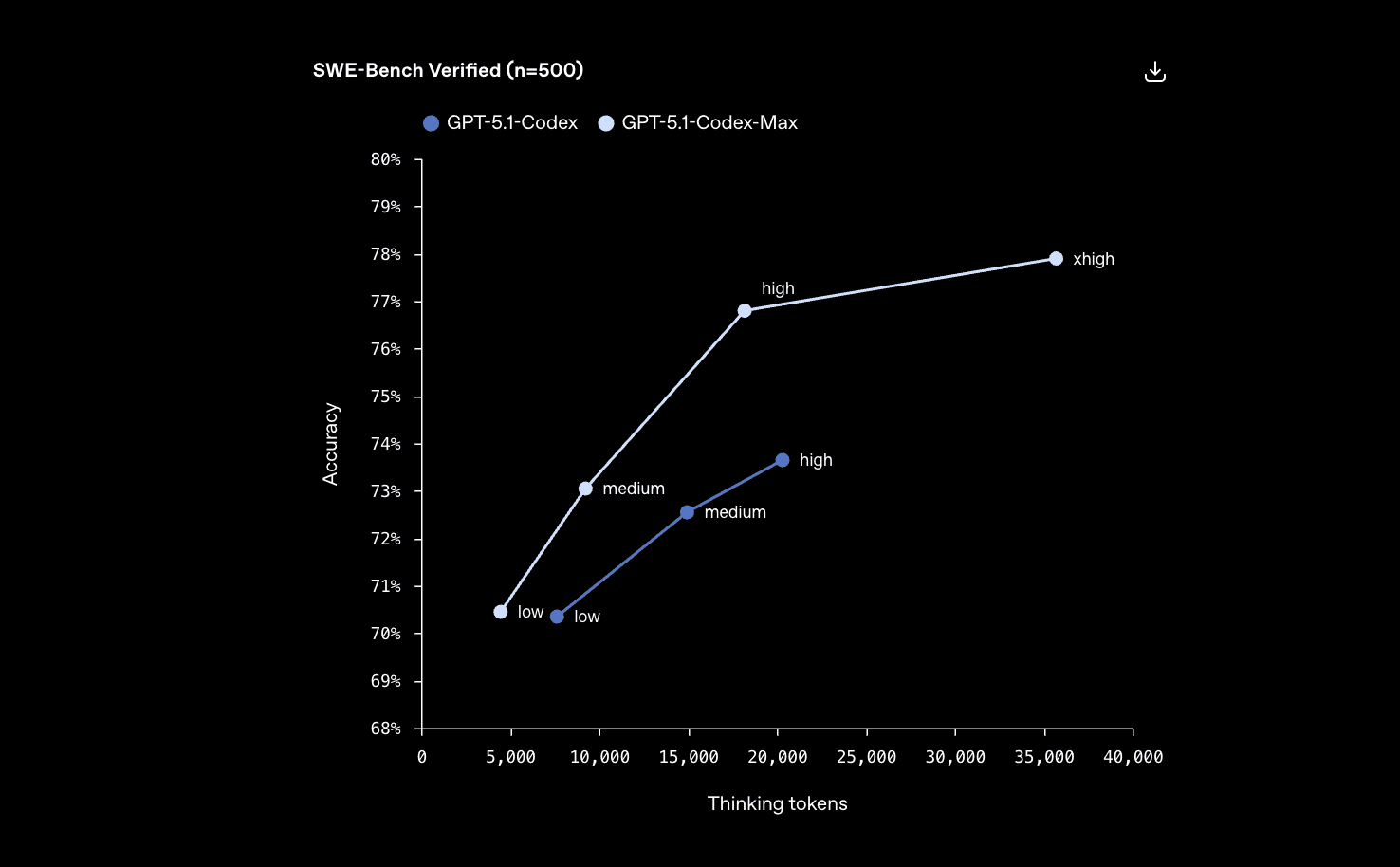
Overview
The name Codex Max has changed meaning. OpenAI launched GPT-5.1-Codex-Max as a standalone coding model for long-running agent tasks, but the current API catalog marks that model deprecated. Its old model ID and pricing should not be treated as OpenAI's present flagship coding offer.
In current Codex documentation, Max is a mode that gives whichever supported model you selected more time to reason about one task. OpenAI recommends it for the hardest problems when depth matters more than speed or usage. It differs from Ultra, which coordinates subagents in parallel rather than increasing one run's reasoning budget.
For API developers, the closest current control is max reasoning effort on GPT-5.6. It is a request setting—not a separate Codex Max model slug—and is billed at the selected model's token rates. The practical migration is to choose a current GPT-5.6 model and then test Max against Extra High on representative hard tasks.
Use cases
The strongest fit depends on the job you need the product to complete, not the size of its feature list.
Use Max for a tightly scoped but unusually hard implementation, debugging, optimization, review, or reasoning task.
Choose it when a marginal reliability gain matters more than latency and additional usage.
Move from the default reasoning level to Max only after a representative task shows that lower efforts miss important requirements.
Capabilities
Max gives the selected model additional room to explore, plan, verify, and revise one difficult task.
The mode applies to a supported model you choose; it is not a separate current model named Codex Max.
Max deepens one run, unlike Ultra mode, which divides independent work among subagents.
GPT-5.6 API requests can set reasoning effort to max while keeping the chosen Sol, Terra, or Luna model.
OpenAI notes that users who do not see Max may need to enable it in application settings.
Process
Step 1
Choose Sol for the most difficult open-ended work, Terra for everyday production work, or Luna for clear high-volume tasks.
Step 2
Run a representative task at the default or Extra High setting and define what success, latency, and usage look like.
Step 3
Use Max only when the task remains difficult enough that additional reasoning could improve a valuable outcome.
Step 4
Review correctness, completeness, tests, evidence, latency, and usage; keep Max only where it produces a measurable gain.
Cost
Current Codex Max has no standalone price because it is a reasoning mode, not a separate product or model. ChatGPT-plan usage counts against the plan allowance and deeper reasoning can consume more of it. API usage is billed at the selected GPT-5.6 model's normal token rates, with Max potentially generating more reasoning tokens.
$20 per month
The standard individual Codex plan with GPT-5.6 access and extensible credits.
From $100 per month
The higher-usage individual option with 5x or 20x the Plus Codex rate limits.
$4 input / $0.40 cached input / $20 output per 1M tokens
The flagship GPT-5.6 API model with max reasoning effort available as a request setting.
$1.25 input / $0.125 cached input / $10 output per 1M tokens
Historical pricing for the deprecated standalone model; not the recommended choice for new integrations.
Pricing checked . Check current pricing at the source ↗
Assessment
Compare
The right alternative depends on the specific output, workflow, controls and budget your project requires.
Coding
Use the main Codex page for the full product, interfaces, agent workflow, and current model choices.
Explore Codex →Coding
Choose Spark for the opposite tradeoff: near-instant, narrow coding iteration rather than maximum reasoning depth.
Explore GPT-5.3-Codex-Spark →Coding
Consider Cursor Composer 2.5 for cost-published long-running agent work inside the Cursor ecosystem.
Explore Composer 2.5 →Consumer
Compare Anthropic's current coding model when provider diversity and a different agent ecosystem matter.
Explore Claude Sonnet 5 →Questions
The current Max reasoning mode is active, but the old standalone gpt-5.1-codex-max API model is deprecated. These are different things.
It gives the selected supported model more time to reason about one hard task. OpenAI recommends it when depth matters more than speed or usage.
Not in the current Codex interface. Max is now a mode. GPT-5.1-Codex-Max was a separate model, but OpenAI's current catalog marks it deprecated.
Max deepens one model run on a single task. Ultra coordinates subagents to work on separate parts of a task in parallel.
There is no separate Max fee. On ChatGPT plans it consumes the included Codex allowance, often faster than lower reasoning settings. In the API, the chosen model's normal token rates apply.
For current Codex use, select a GPT-5.6 model and enable Max only when needed. For API use, benchmark GPT-5.6 with reasoning effort set to max against Extra High and lower settings.
Bottom line
Codex Max is useful, but only after correcting the name: it is now a depth setting, not OpenAI's latest coding model. Use a current GPT-5.6 model, establish a lower-effort baseline, and reserve Max for hard, high-value tasks where better reasoning is worth slower responses and greater usage. Migrate any code that still calls gpt-5.1-codex-max.
Visit Codex Max website ↗
Antigravity - Google's new agentic development platform to build anything, orchestrate agents, and run parallel tasks across workspaces.
Mistral Vibe CLI - Mistral's new open-source CLI coding assistant powered by its Devstral models

Code Arena - LM Arena's evaluation platform for testing models in isolated environments
%20(1).png)
Devstral 2 - Mistral's next-gen family of coding-specific models

Get access to all our AI courses, hundreds of real-world AI use cases, live expert-led workshops, an exclusive network of AI early adopters, and more.
Get unlimited access to all of our current & upcoming industry-specific AI courses for the duration of your subscription.
To keep up with the rapid pace of AI, our team publishes AI implementation guides daily. Our library contains 300+ practical use cases to automate real-world work.
Join weekly, live, interactive sessions with industry leaders who are at the forefront of AI for hands-on implementation guidance and exclusive insights.
Network with an exclusive community of AI-first professionals who are working smarter with AI. Learn how early adopters are using AI in their work and businesses.