Dramatic narration
Storytelling, games, trailers, ads, and character work that benefit from explicit emotion and performance direction.
Independent tool overview
Eleven v3 is ElevenLabs' expressive multilingual text-to-speech model for emotionally directed narration and multi-speaker dialogue. It supports 74 languages, inline audio tags, the web app, mobile tools, and public APIs, but teams should expect variable takes, a 5,000-character request limit, and strict voice-rights review.
Visit the official Eleven v3 site ↗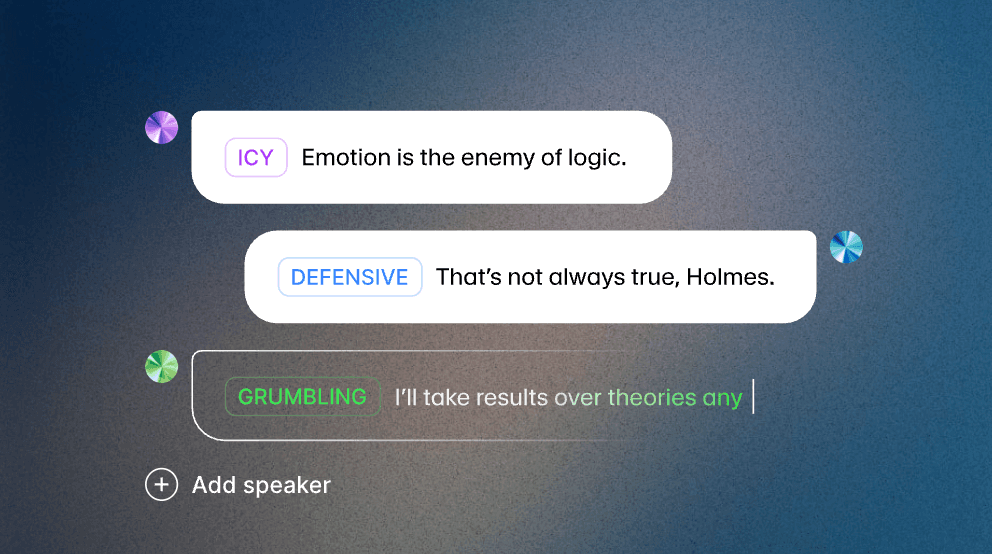
Overview
Eleven v3 is built for performance rather than plain, maximally consistent narration. Script cues in square brackets can direct emotion, delivery, reactions, and some sound events, while Dialogue Mode can render multiple speakers with shared context and timing.
The model is available through ElevenLabs' creative interface and API under the model ID `eleven_v3`. Current official documentation lists 74 supported languages and a 5,000-character limit per text-to-speech request, roughly five minutes of audio. A separate Eleven v3 Conversational model targets lower-latency dialogue; standard v3 remains the dramatic-production choice.
Expressiveness introduces variability. Voice selection, reference-audio quality, stability, punctuation, wording, and tag compatibility all affect the result. Production teams should budget for multiple generations, pronunciation review, editing, and consent/provenance controls rather than assuming one deterministic render.
Use cases
The strongest fit depends on the job you need the product to complete, not the size of its feature list.
Storytelling, games, trailers, ads, and character work that benefit from explicit emotion and performance direction.
Podcasts, scenes, prototypes, and training simulations that need multiple synthetic speakers in one interaction.
Teams creating expressive versions across supported languages with native-speaker review for pronunciation and cultural fit.
Capabilities
Directs delivery with cues such as whispers, laughter, sighs, emotion, accents, or contextual audio events; effectiveness varies by voice.
Generates multiple speakers with contextual prosody and emotional interplay through dedicated text-to-dialogue workflows.
Supports a broad multilingual set spanning major global languages and many lower-resource languages.
Creative, Natural, and Robust behavior trades emotional range against consistency and prompt adherence.
Generates v3 speech in ElevenLabs' creator tools without requiring code.
Supports text-to-speech and text-to-dialogue integration, including streaming flows, with usage charged by character.
Works with designed voices, eligible clones, and a large shared voice library, subject to rights and plan rules.
The web product offers common audio downloads, with higher quality and additional formats depending on plan and interface.
Process
Step 1
Use a licensed library voice, a designed voice, or a properly consented and policy-compliant clone; document the permitted audience, term, and commercial uses.
Step 2
Write numbers, abbreviations, names, and punctuation for how they should sound, then split long scripts at natural boundaries.
Step 3
Use standard v3 for expressive performance, v3 Conversational for supported real-time dialogue, Multilingual v2 for stable long-form work, or Flash when latency and price dominate.
Step 4
Select a voice whose base samples already resemble the intended energy; a whisper tag will not reliably transform a fundamentally shouting voice.
Step 5
Insert emotion, reaction, and direction cues only where they improve the scene, and test their interaction with punctuation and context.
Step 6
Keep the script, voice, model, and settings labeled while producing a small set of takes; remember that each new generation can consume quota.
Step 7
Have a fluent listener check names, numbers, stress, emotion, accent, meaning, and potentially offensive or unnatural delivery.
Step 8
Remove artifacts, normalize levels, keep generation IDs and consent records, disclose synthetic voice where required, and retain a human escalation path for public-facing use.
Cost
ElevenLabs separates creator subscriptions and API economics. In the web product, v3 uses approximately one credit per character. The Free plan is personal and non-commercial; commercial rights begin on Starter. The current API rate card prices standard v3 at $0.10 per 1,000 characters, with subscription or pay-as-you-go options. Taxes and overages can be additional.
$0/month
A personal, non-commercial trial of ElevenLabs tools.
$6/month
The entry creator plan with commercial licensing.
$22/month; first month currently $11
A higher-capacity individual plan with professional voice cloning.
$99/month
For higher-volume and higher-quality individual or production use.
$299 or $990/month
Team plans with seats, collaboration, and more voice-clone capacity.
$0.10 per 1,000 characters
The current standard v3 API unit price before applicable plan discounts, commitments, or taxes.
Pricing checked . Check current pricing at the source ↗
Assessment
Compare
The right alternative depends on the specific output, workflow, controls and budget your project requires.
Miscellaneous
A competing expressive speech model to test when voice style, multilingual quality, or economics differ from Eleven v3.
Explore Fish Audio S1 →Miscellaneous
Hume's open-source speech model emphasizes aligned text and audio and offers a different deployment and control tradeoff.
Explore TADA by Hume AI →Marketing
The broader ElevenLabs platform page is the better comparison point for users choosing among v3, Multilingual, Flash, agents, dubbing, and other audio tools.
Explore ElevenLabs →Questions
Eleven v3 is ElevenLabs' expressive multilingual text-to-speech model. It adds inline audio tags, wide emotional range, and multi-speaker Dialogue Mode for narration and scripted audio.
Current official documentation lists 74 languages. Quality and accent fit can vary by voice and language, so fluent review is still necessary.
Yes. Use model ID `eleven_v3` in the text-to-speech API or the dedicated text-to-dialogue endpoints. Standard requests have a 5,000-character limit.
The website currently charges one credit per character for v3. Creator plans range from Free to enterprise tiers, while the API rate card lists standard v3 at $0.10 per 1,000 characters. Regenerations, other products, taxes, and plan rules affect the total.
Commercial licensing is listed from the $6-per-month Starter plan upward. You must also have the rights to the script, selected voice, likeness, and distribution use; Free is documented as personal and non-commercial.
They are bracketed natural-language directions such as `[whispers]`, `[laughs]`, or emotional cues. They influence the performance but are not deterministic and may work differently with each voice.
It can excel on dramatic sections, but its 5,000-character limit and variable performance make stable long-form production more labor-intensive. ElevenLabs identifies Multilingual v2 as the more stable long-form model.
Standard v3 prioritizes expression over latency. ElevenLabs now offers the separate v3 Conversational model for real-time dialogue, while Flash remains the lower-latency option. Test with the actual workload.
Do not assume you can. ElevenLabs says Professional Voice Clones can only be created for your own verified voice; another person can create and verify their own clone and share it. Instant cloning also requires the necessary rights and consent.
Use a representative multilingual test set with names, numbers, emotion shifts, long sentences, dialogue, and edge cases. Score pronunciation, semantic accuracy, artifacts, latency, retake rate, cost, and listener preference by voice and language.
Bottom line
Eleven v3 is one of the strongest choices when synthetic speech must perform, not merely read. Its tags, dialogue, and language range give directors and developers meaningful creative leverage. That leverage comes with retakes, shorter requests, evolving preview-era behavior, and serious identity-rights obligations. Use it where emotion justifies the extra QA; choose a more stable or lower-latency ElevenLabs model when consistency and throughput matter more.
Visit Eleven v3 website ↗
Wonda - Wondercraft's AI agent for video editing and creative direction

Ace-Step-1.5 - Powerful open-source AI music generation model that creates songs in under two seconds.

Z-Image - Alibaba Tongyi's full base version of its Z-Image Turbo, which ranked as the top open-source image model in December.
Kling 3.0 - Kling's new AI video model with upgraded consistency, realism 15 second clips, native audio, and more

Get access to all our AI courses, hundreds of real-world AI use cases, live expert-led workshops, an exclusive network of AI early adopters, and more.
Get unlimited access to all of our current & upcoming industry-specific AI courses for the duration of your subscription.
To keep up with the rapid pace of AI, our team publishes AI implementation guides daily. Our library contains 300+ practical use cases to automate real-world work.
Join weekly, live, interactive sessions with industry leaders who are at the forefront of AI for hands-on implementation guidance and exclusive insights.
Network with an exclusive community of AI-first professionals who are working smarter with AI. Learn how early adopters are using AI in their work and businesses.