High-stakes support and RAG
Flag answers that may be unsupported, based on the wrong retrieved context, or outside the knowledge base before they reach a customer.
Independent tool overview
Cleanlab TLM Playground has evolved into Cleanlab Detect, a reliability layer that scores LLM and agent outputs in real time so applications can flag uncertain answers and route them to a fallback or human review.
Visit the official TLM Playground site ↗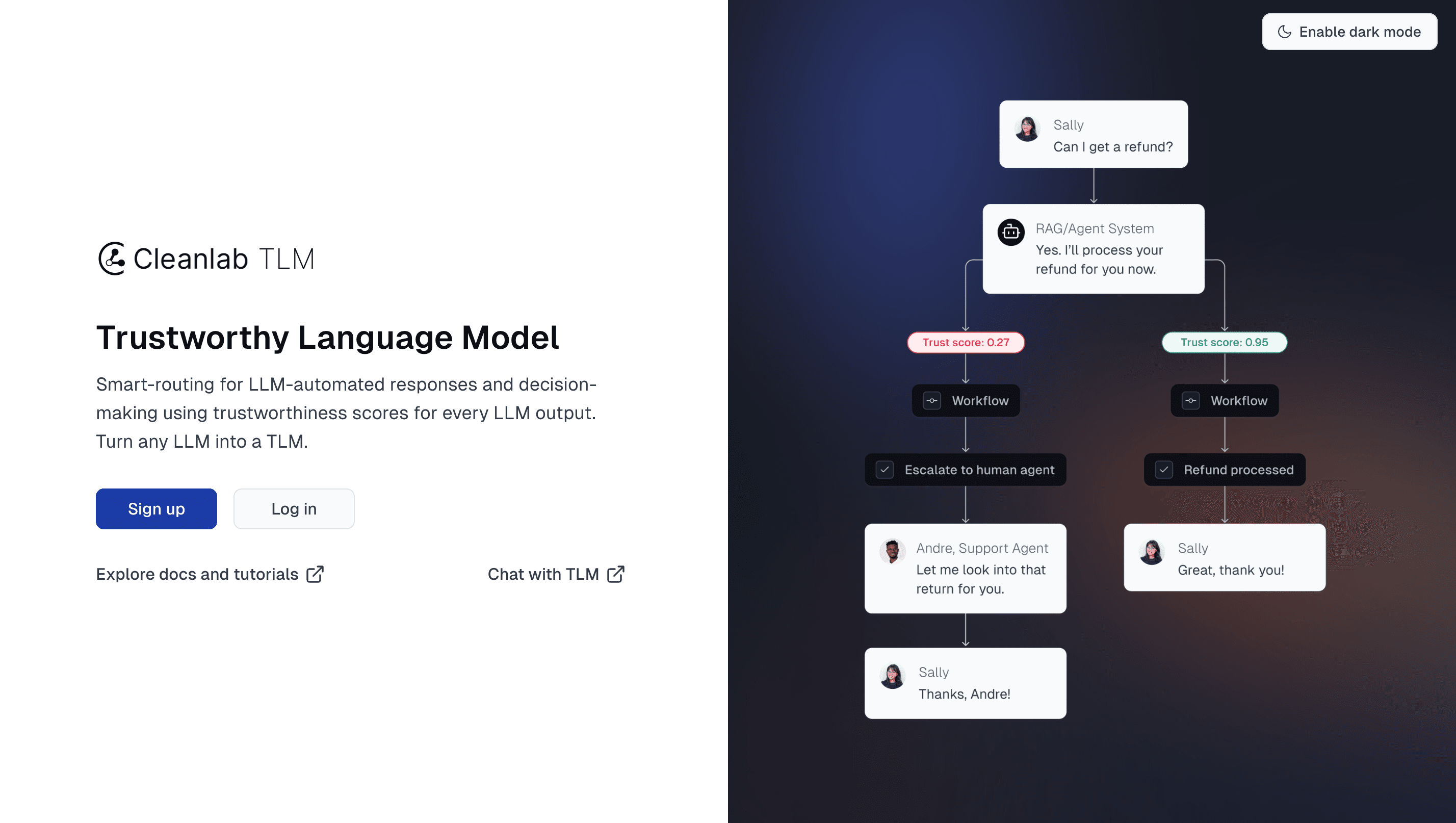
Overview
The original TLM Playground is now part of Cleanlab's broader Detect product. The underlying Trustworthy Language Model API remains documented, while the current product page presents Detect as a production reliability layer for hallucinations, wrong context, and knowledge gaps.
TLM can work in two modes. It can generate an answer and a trustworthiness score in one request, or it can score an existing prompt-and-response pair produced by another model. The second approach lets a team keep its current LLM stack while adding a common evaluation signal.
The score runs from 0 to 1 and represents model uncertainty about whether an output may be incorrect or otherwise flawed. It is an operational signal, not proof that an answer is true. A high score can still accompany a wrong answer, and a low score can accompany a correct one.
Cleanlab documents support for natural-language answers, classifications, structured output, and tool calls. Integrations and examples cover RAG systems, OpenAI APIs and agents, LangChain, LangGraph, streaming, multi-turn conversations, and batch evaluation.
Handshake AI acquired Cleanlab on January 28, 2026. Cleanlab's current site still offers Detect, documentation, API onboarding, and enterprise demos, but prospective enterprise customers should confirm current packaging, support, data handling, and roadmap in their agreement.
Use cases
The strongest fit depends on the job you need the product to complete, not the size of its feature list.
Flag answers that may be unsupported, based on the wrong retrieved context, or outside the knowledge base before they reach a customer.
Add a reliability signal before an agent takes an action, while retaining explicit approval for consequential operations.
Rank large response datasets so evaluators can focus on likely failures, uncertain examples, and threshold edge cases.
Apply one uncertainty layer across responses from different model providers without replacing every generation call.
Capabilities
Assigns a 0–1 score intended to identify outputs that deserve more scrutiny.
The TLM prompt method returns a generated response together with its trustworthiness score.
The API can evaluate a response from another LLM or a human-written prompt-and-response dataset.
Optional logs can explain low scores, while five quality presets trade off evaluation quality, latency, and cost.
Documentation covers classifications, structured responses, and proposed agent actions in addition to ordinary text.
Examples cover retrieval systems, OpenAI Responses and Agents, LangChain, LangGraph, multi-turn chat, streaming, and file search.
TLM supports larger evaluation jobs and asynchronous calls; Cleanlab also advertises private VPC deployment for latency-sensitive enterprise use.
Process
Step 1
Collect normal cases, known failures, ambiguous questions, adversarial inputs, long contexts, and tool-call examples from the actual product.
Step 2
When scoring an existing response, give TLM the same system instructions, retrieved material, conversation history, and user request that the original model received.
Step 3
Store the model, prompt version, retrieved context, response, trust score, explanation, latency, and eventual user or reviewer outcome.
Step 4
Compare scores with human labels and choose different thresholds for harmless copy suggestions, customer answers, and consequential agent actions.
Step 5
Map low scores to abstention, a clarifying question, a safer model, a retrieval retry, or human review instead of merely showing the score.
Step 6
Measure missed errors, false alarms, added latency, and cost before allowing the score to alter production responses.
Step 7
Re-evaluate thresholds when prompts, models, knowledge bases, languages, tool schemas, or user behavior change.
Cost
Cleanlab advertises free TLM API tokens for getting started. After those are used, the API moves to pay-per-token billing shown inside the Cleanlab Account under Usage & Billing. Public pages do not state the current free allowance or token rates. Cleanlab Detect enterprise deployments use request-a-demo pricing.
Free tokens
A Cleanlab account includes an initial allocation for testing the TLM API.
Pay per token
Continued API use is billed by token, with rates varying by base model and quality configuration.
Custom
Production deployment, private infrastructure, support, and commercial terms are handled through Cleanlab sales.
Pricing checked . Check current pricing at the source ↗
Assessment
Compare
The right alternative depends on the specific output, workflow, controls and budget your project requires.
Coding
Consider Helicone when request logging, cost tracking, caching, and LLM observability are the primary need rather than a dedicated trustworthiness score.
Explore Helicone →Coding
Consider AgentOps when the priority is tracing, testing, and debugging multi-step agent behavior.
Explore AgentOps →Coding
Consider LangChain when you want an application framework for building custom retrieval, evaluation, routing, and fallback logic rather than a standalone scoring service.
Explore LangChain →Questions
The original TLM Playground has been folded into Cleanlab's current Detect product. The TLM API, Python client, tutorials, and account-based onboarding remain available.
It is a 0–1 uncertainty signal intended to estimate whether a response may be incorrect or flawed. It should guide review and fallback logic, not be treated as proof that an answer is true.
Yes. Cleanlab documents a method for scoring an existing prompt-and-response pair from another model, as well as a mode where TLM generates and scores the response itself.
Cleanlab's documentation describes scores below 0.7 as typically low and scores above 0.9 as typically high, but production thresholds should be calibrated against labeled examples from the specific domain and risk level.
No. It can prioritize review and trigger a safer path, but consequential decisions still need appropriate validation, policy controls, and human approval.
Cleanlab offers free API tokens, then pay-per-token billing. Current token allowances and rates appear inside the Cleanlab Account rather than on a public pricing table. Enterprise Detect pricing is custom.
Yes. Cleanlab documents scoring proposed tool calls, but a score should not be the only authorization for payments, account changes, data deletion, or other consequential actions.
Handshake AI acquired Cleanlab on January 28, 2026. Cleanlab's current site continues to present Detect, Remediate, documentation, and enterprise contact options.
Cleanlab's public privacy policy says it processes information uploaded or transmitted through its services. Organizations with sensitive data should confirm current retention, subprocessors, regional hosting, training-use restrictions, and private-deployment options in writing.
Bottom line
Cleanlab TLM and Detect are compelling when a production team needs a model-independent uncertainty signal that can drive retries, abstention, or escalation. The value comes from careful calibration and fallback design, not from placing blind trust in a single score. Run it against labeled domain failures, measure added latency and cost, and confirm current commercial and data-handling terms after the Handshake AI acquisition.
Visit TLM Playground website ↗
Get access to all our AI courses, hundreds of real-world AI use cases, live expert-led workshops, an exclusive network of AI early adopters, and more.
Get unlimited access to all of our current & upcoming industry-specific AI courses for the duration of your subscription.
To keep up with the rapid pace of AI, our team publishes AI implementation guides daily. Our library contains 300+ practical use cases to automate real-world work.
Join weekly, live, interactive sessions with industry leaders who are at the forefront of AI for hands-on implementation guidance and exclusive insights.
Network with an exclusive community of AI-first professionals who are working smarter with AI. Learn how early adopters are using AI in their work and businesses.