Private vision-language prototypes
Run image-and-text analysis inside infrastructure you control instead of sending every input to a hosted model.
Independent tool overview
Step3-VL-10B is StepFun's Apache-2.0-licensed, 10-billion-parameter vision-language model for image understanding, OCR, GUI grounding, spatial reasoning, math, and text generation. It targets a single 24GB GPU for BF16 inference, with an official FP8 checkpoint also available.
Visit the official Step3-VL-10B site ↗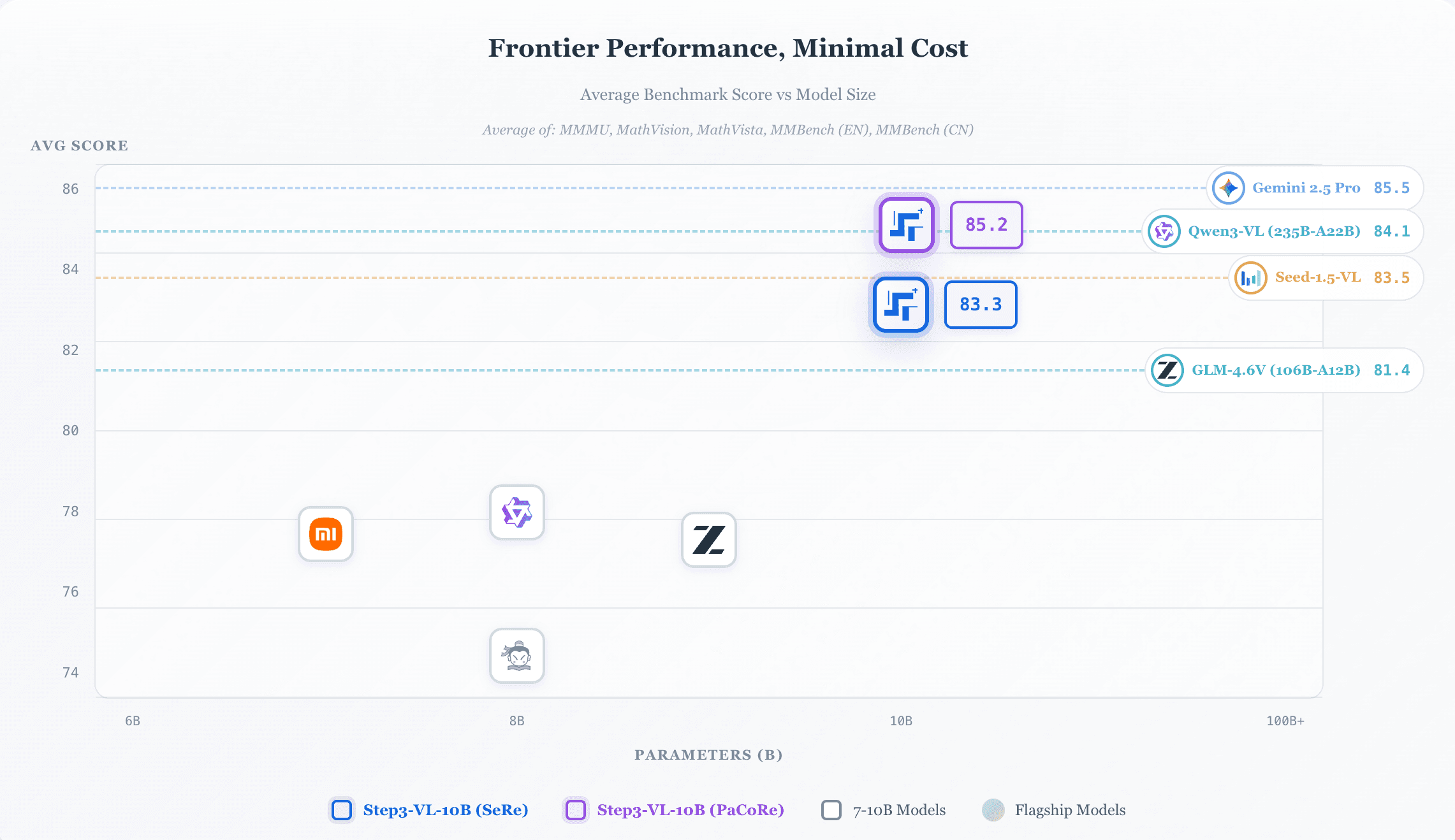
Overview
Step3-VL-10B is an open-weight multimodal foundation model built around a 1.8B-parameter perception encoder, a Qwen3-8B decoder, and a projector that joins visual and language representations. StepFun publishes Base, Chat, and FP8 checkpoints, plus examples for Transformers, vLLM, and SGLang.
The model is most interesting to teams that want capable image-and-text reasoning under their own control. StepFun reports strong results for OCR, documents, GUI grounding, visual STEM problems, and spatial tasks, but its benchmark table is vendor-authored. The model card also discloses an evaluation-setting error affecting some Qwen3-VL comparator results, so teams should reproduce their own task-specific evaluation before treating any ranking as settled.
Use cases
The strongest fit depends on the job you need the product to complete, not the size of its feature list.
Run image-and-text analysis inside infrastructure you control instead of sending every input to a hosted model.
Evaluate extraction, question answering, charts, diagrams, and multilingual document understanding on a compact open-weight model.
Test screenshot perception, interface element grounding, and visual-agent components with a reproducible checkpoint.
Explore math, geometry, physics, graph, and diagram tasks where both perception and multi-step reasoning matter.
Serve the model through vLLM or SGLang behind an OpenAI-compatible endpoint for controlled internal applications.
Capabilities
The Chat checkpoint accepts an image and text prompt, then returns a natural-language response.
A 1.8B-parameter language-optimized perception encoder processes visual input.
The language backbone is a Qwen3-8B decoder joined to the visual encoder through a learned projector.
The documented strategy combines a 728-by-728 global view with multiple 504-by-504 local crops.
The standard SeRe mode uses sequential generation with a documented maximum of 64K tokens in evaluation.
PaCoRe aggregates evidence from 16 parallel rollouts and uses substantially more test-time compute.
The model is trained and benchmarked on text recognition, document, chart, and visual question-answering tasks.
StepFun evaluates screen grounding, visual location, counting, and 2D or 3D spatial understanding.
The model card includes Transformers inference plus vLLM and SGLang server examples.
vLLM and SGLang can expose a familiar chat-completions-style endpoint for applications.
StepFun publishes an official FP8 variant for teams evaluating lower-precision deployment.
The project is published under Apache 2.0, subject to the license's notice, attribution, patent, and warranty terms.
Process
Step 1
Collect representative images, languages, resolutions, prompts, expected outputs, safety cases, and latency requirements.
Step 2
Inspect the repository, custom modeling code, dependencies, checkpoint provenance, Apache notices, and security posture before loading.
Step 3
Use the documented processor and deterministic settings to establish a reproducible local baseline.
Step 4
Measure extraction accuracy, grounding, hallucination, refusal behavior, latency, memory use, and cost on your own data.
Step 5
Use Transformers for direct experiments or vLLM and SGLang when an OpenAI-compatible service and higher throughput are needed.
Step 6
Sandbox inputs, validate outputs, restrict tools, log model and prompt versions, monitor drift, and route uncertain cases to a human.
Cost
StepFun does not charge a license fee for downloading the Apache-2.0 model weights. Real cost comes from GPU hardware or cloud instances, storage, engineering, evaluation, monitoring, and any third-party hosting provider. No official Step3-VL-10B managed-API price was published in the reviewed project materials.
Free download
Base, Chat, and FP8 checkpoints are available under Apache 2.0.
Free, best effort
An official Hugging Face Space provides a convenient evaluation surface when available.
Infrastructure cost
The documented target is at least 24GB of VRAM, such as an RTX 4090 or A100.
Provider-specific
Teams can deploy with their own cloud stack or a compatible model-hosting provider.
Pricing checked . Check current pricing at the source ↗
Assessment
Compare
The right alternative depends on the specific output, workflow, controls and budget your project requires.
Miscellaneous
Compare Tencent's vision-reasoning model when visual thinking quality matters more than this exact 10B deployment target.
Explore Hunyuan Vision 1.5 Thinking →Consumer
Consider Qwen's broader omnimodal family when audio and video understanding are also required.
Explore Qwen3.5-Omni →Coding
Consider Meta's model family when ecosystem breadth and established self-hosting tooling are priorities.
Explore Meta Llama Models →Consumer
Consider a managed Gemini API when infrastructure operations matter less than hosted multimodal capability.
Explore Gemini 3 →Questions
It is StepFun's 10-billion-parameter open-weight vision-language model for image-and-text reasoning, OCR, documents, GUI grounding, spatial tasks, math, and general conversation.
StepFun publishes the repository and model checkpoints under Apache License 2.0. The more precise description is open-weight, because the released artifact is a trained model rather than a fully reproducible disclosure of every training datum and process.
The official model card lists about 20GB for the weights, about 4GB of runtime overhead, and a 24GB minimum for the documented BF16 setup. Production workloads may need more headroom.
SeRe is the standard sequential reasoning mode. PaCoRe aggregates 16 parallel reasoning rollouts, which can improve reported scores but materially increases compute, latency, and implementation complexity.
Yes. The official model card provides vLLM and SGLang examples that expose OpenAI-compatible endpoints.
Apache 2.0 generally permits commercial use, modification, and distribution when its conditions are followed. Organizations should have counsel review license compliance and their specific data, output, patent, and regulatory risks.
The published tables are primarily vendor-reported. The model card also notes an evaluation-setting error for some comparator results, so reproduce the tests that matter to your application.
Not by itself. Visual grounding can be wrong. Any agent needs narrow permissions, sandboxing, action validation, user confirmation for consequential steps, and detailed monitoring.
Bottom line
Step3-VL-10B is a compelling compact vision-language checkpoint for teams that value self-hosting, permissive licensing, and a credible path to 24GB-GPU deployment. Its official serving recipes and broad multimodal evaluation make it practical to test. Treat the headline benchmark story as a starting hypothesis, especially given the disclosed comparator-setting correction, and approve it only after task-specific accuracy, safety, latency, and cost testing.
Visit Step3-VL-10B website ↗
Translate with ChatGPT - Translate text, voice, or images instantly across 50+ languages

ERNIE 5.0 - Baidu's omni-modal, top-ranked Chinese model
TranslateGemma
.png)
Qwen3-Max-Thinking - Alibaba's new flagship reasoning model competitive with models like Claude 4.5 Opus, GPT 5.2-Thinking, and Gemini 3 Pro across benchmarks

Get access to all our AI courses, hundreds of real-world AI use cases, live expert-led workshops, an exclusive network of AI early adopters, and more.
Get unlimited access to all of our current & upcoming industry-specific AI courses for the duration of your subscription.
To keep up with the rapid pace of AI, our team publishes AI implementation guides daily. Our library contains 300+ practical use cases to automate real-world work.
Join weekly, live, interactive sessions with industry leaders who are at the forefront of AI for hands-on implementation guidance and exclusive insights.
Network with an exclusive community of AI-first professionals who are working smarter with AI. Learn how early adopters are using AI in their work and businesses.