Controlled model hosting
Deploy model weights in infrastructure selected and governed by your team rather than depending only on a closed consumer app.
Independent tool overview
Meta Llama is a family of downloadable, open-weight AI models for developers and researchers. The current Llama 4 releases—Scout and Maverick—use a mixture-of-experts architecture for text, code, and image understanding, but they remain large infrastructure projects governed by Meta's custom Llama 4 Community License rather than a standard open-source license.
Visit the official Meta Llama Models site ↗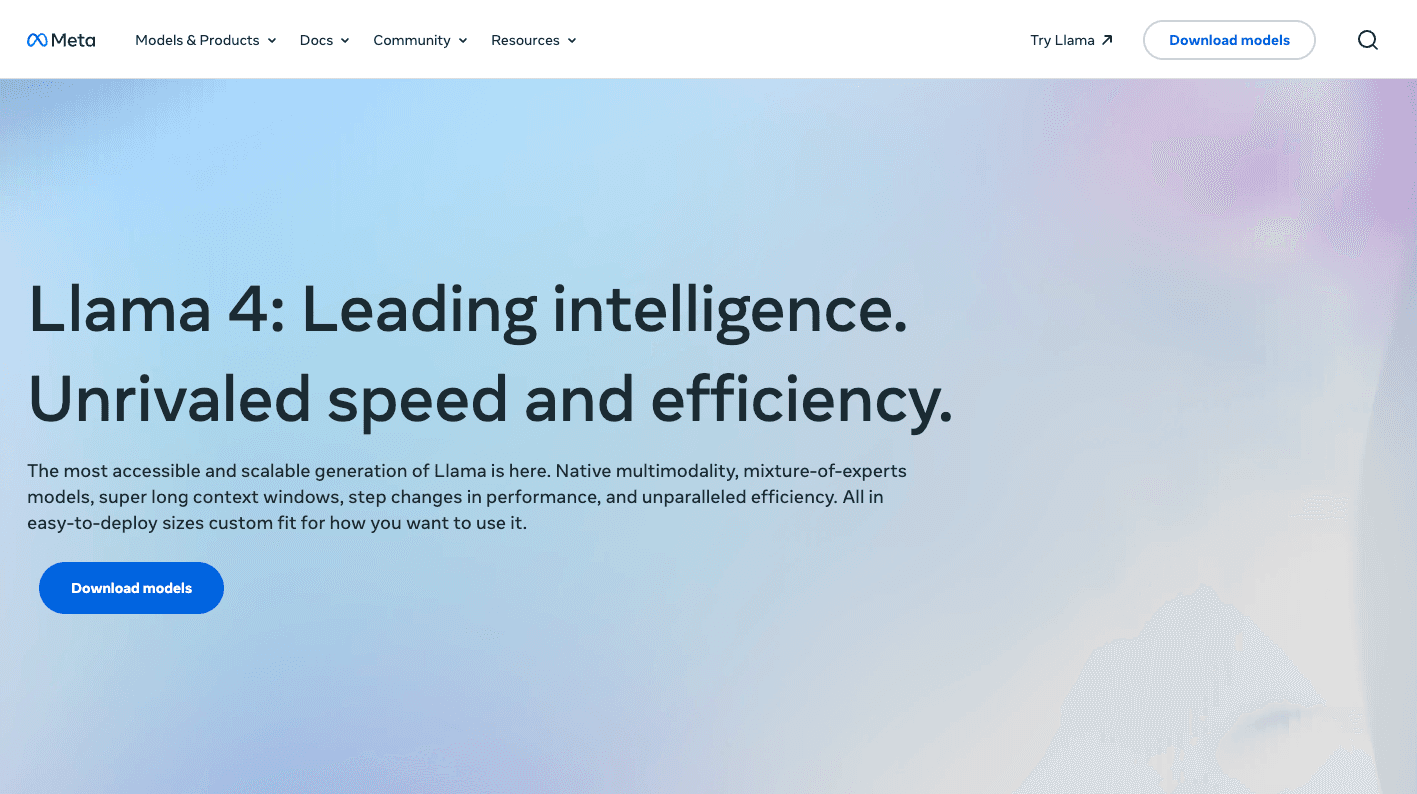
Overview
Meta Llama is a model family rather than a single end-user app. Developers can obtain weights from Meta or distribution partners, run them in their own infrastructure, fine-tune supported releases, or use a cloud provider that serves compatible Llama endpoints.
The newest model family currently highlighted in Meta's official developer materials is Llama 4. Scout activates 17 billion parameters across 16 experts, with 109 billion total parameters and a published maximum context length of 10 million tokens. Maverick also activates 17 billion parameters but uses 128 experts, 400 billion total parameters, and a 1 million-token context length.
Both Llama 4 releases are natively multimodal for text and image input and produce text or code. Meta's model card lists 12 officially supported languages and an August 2024 knowledge cutoff. These are static models, so applications that need current facts must add retrieval, tools, or fresh domain data.
Llama weights are often described as open, but the licensing distinction matters. Llama 4 uses a custom community license with attribution, naming, acceptable-use, redistribution, scale, and regional conditions. Teams should review the exact license for the specific Llama generation they deploy instead of assuming every Llama model has the same terms.
Use cases
The strongest fit depends on the job you need the product to complete, not the size of its feature list.
Deploy model weights in infrastructure selected and governed by your team rather than depending only on a closed consumer app.
Build assistants that combine text prompts with image understanding, captioning, or visual question answering.
Evaluate large document collections or codebases with Scout's published long-context capability, while testing quality at the lengths you actually need.
Adapt an eligible Llama release to a domain or workflow after reviewing its license, data, and safety requirements.
Use a provider that serves Llama models when self-hosting the full checkpoint is not operationally practical.
Inspect model weights, published model cards, benchmarks, data disclosures, and safety guidance.
Capabilities
The smaller Llama 4 mixture-of-experts release has 17B active and 109B total parameters, native text-and-image input, and a published 10M-token maximum context.
The larger released Llama 4 model has 17B active and 400B total parameters, multimodal input, a 1M-token context, and stronger capacity than Scout.
Early-fusion training lets the released Llama 4 models reason over text and images within the same model.
Only a subset of total parameters is activated for a token, balancing model capacity with inference efficiency.
Meta lists direct access plus distribution through Hugging Face, Kaggle, cloud platforms, and edge partners.
Llama 3.1, 3.2, 3.2-Vision, and 3.3 remain relevant when a smaller footprint, text-only model, or existing ecosystem support is more important than Llama 4 capabilities.
Meta publishes model cards, an acceptable-use policy, and supporting repositories for safety evaluation and deployment guidance.
Process
Step 1
Define whether the application needs image understanding, long context, multiple languages, code generation, local deployment, or a smaller older checkpoint.
Step 2
Review the version-specific license, acceptable-use policy, supported languages, knowledge cutoff, intended uses, and geographic conditions.
Step 3
Test memory, quantization, throughput, latency, storage, networking, and concurrency instead of selecting a model from active-parameter count alone.
Step 4
Request weights for self-hosting or compare cloud and inference partners based on price, region, privacy, controls, and model version.
Step 5
Add retrieval, tool use, system prompts, access controls, logging, and fallbacks around the static foundation model.
Step 6
Measure accuracy, hallucination, visual reasoning, long-context retrieval, safety, latency, and cost with your own tasks.
Step 7
Implement required attribution, naming and notices, confirm data rights, review high-risk use cases, and monitor production outputs.
Cost
Meta makes Llama model weights available without an upfront download fee under version-specific community licenses. That is not the same as free deployment: self-hosting requires substantial compute and engineering, while cloud and inference providers set their own token, endpoint, fine-tuning, or capacity prices.
No download fee
Access is governed by the license and approval or distribution process for the selected model.
Infrastructure costs vary
The operator pays for GPUs, storage, networking, observability, security, and engineering.
Provider pricing
Managed Llama endpoints are billed under each partner's current terms.
Pricing checked . Check current pricing at the source ↗
Assessment
Compare
The right alternative depends on the specific output, workflow, controls and budget your project requires.
Consumer
A newer open-weight multimodal mixture-of-experts alternative for teams comparing licenses, efficiency, and deployment footprints.
Explore Mistral 4 Small →Consumer
Google's current open-weight family offers additional model sizes and an alternative ecosystem and license.
Explore Gemma 4 →Consumer
A compact open-weight model family worth testing when local resource limits matter more than maximum model capacity.
Explore Qwen3.5 Small →Coding
A local model runner that can simplify experiments with compatible Llama and other community model packages.
Explore Ollama →Questions
Meta Llama is a family of downloadable foundation models that developers can run, customize, or access through hosting partners for text, code, and—in Llama 4—image-understanding applications.
Meta currently publishes Llama 4 Scout and Llama 4 Maverick. Both activate 17B parameters, while Scout has 109B total parameters and Maverick has 400B total parameters.
Scout is the smaller release and has a published 10M-token context limit. Maverick has many more total experts and parameters, a 1M-token context limit, and a larger deployment footprint.
Llama 4 weights are openly available, but they use Meta's custom Llama 4 Community License rather than a standard OSI-approved open-source license. The exact conditions should be reviewed before use or redistribution.
Llama 4 Scout and Maverick accept multilingual text and images and produce text or code. Older Llama releases vary, including text-only and dedicated vision versions.
Meta's model card lists up to 10 million tokens for Scout and 1 million tokens for Maverick. Teams should benchmark usable accuracy and cost at their actual input lengths.
Meta says Scout can fit on a single H100 GPU with on-the-fly int4 quantization. Maverick's FP8 weights fit on a single H100 DGX host, which contains multiple GPUs rather than one ordinary graphics card.
There is no upfront fee to download the weights under the applicable license, but compute, cloud inference, storage, engineering, safety testing, and operations can be expensive.
The license includes redistribution notices and a prominent Built with Llama requirement for covered products or services. It also contains naming rules for distributed AI models improved with Llama materials or outputs.
It grants commercial and research rights subject to its conditions. Among other terms, organizations above the specified 700 million monthly-active-user threshold must request a separate license from Meta.
Not inherently. The published Llama 4 releases have an August 2024 knowledge cutoff, so current applications need retrieval, external tools, or updated domain sources.
Choose Llama 4 for current native multimodal and long-context capabilities. An older or smaller Llama model may be easier and cheaper to deploy when text-only performance or existing integrations are sufficient.
Bottom line
Meta Llama remains a strong option for teams that value downloadable weights, deployment choice, and a large supporting ecosystem. Llama 4 adds meaningful multimodal and long-context capabilities, but Scout and Maverick are not lightweight models, and their custom license deserves the same attention as performance and GPU cost. The right choice should follow a task-specific evaluation that includes accuracy, usable context, infrastructure, safety, regional availability, and legal terms.
Visit Meta Llama Models website ↗
Observability platform for managing LLM performance.

Replit Agent: Is your ai coding companion for building, debugging, and deploying code directly in replit.

Generate apps using screenshots for inspiration.

Google Firebase: Firebase helps developers build and scale apps with backend infrastructure, analytics, and real-time databases.

Get access to all our AI courses, hundreds of real-world AI use cases, live expert-led workshops, an exclusive network of AI early adopters, and more.
Get unlimited access to all of our current & upcoming industry-specific AI courses for the duration of your subscription.
To keep up with the rapid pace of AI, our team publishes AI implementation guides daily. Our library contains 300+ practical use cases to automate real-world work.
Join weekly, live, interactive sessions with industry leaders who are at the forefront of AI for hands-on implementation guidance and exclusive insights.
Network with an exclusive community of AI-first professionals who are working smarter with AI. Learn how early adopters are using AI in their work and businesses.