Full-stack prototypes
Turn a clear product brief into a hosted application with interface, server logic, storage, authentication, and deployment in one environment.
Independent tool overview
Replit Agent is an AI software builder inside Replit that can plan, design, code, debug, and publish applications from natural-language requests. Its all-in-one workspace is convenient for prototypes and production-oriented builds, but Agent, hosting, databases, and integrations draw from shared credits, so teams need active cost controls and hands-on testing.
Visit the official Replit Agent site ↗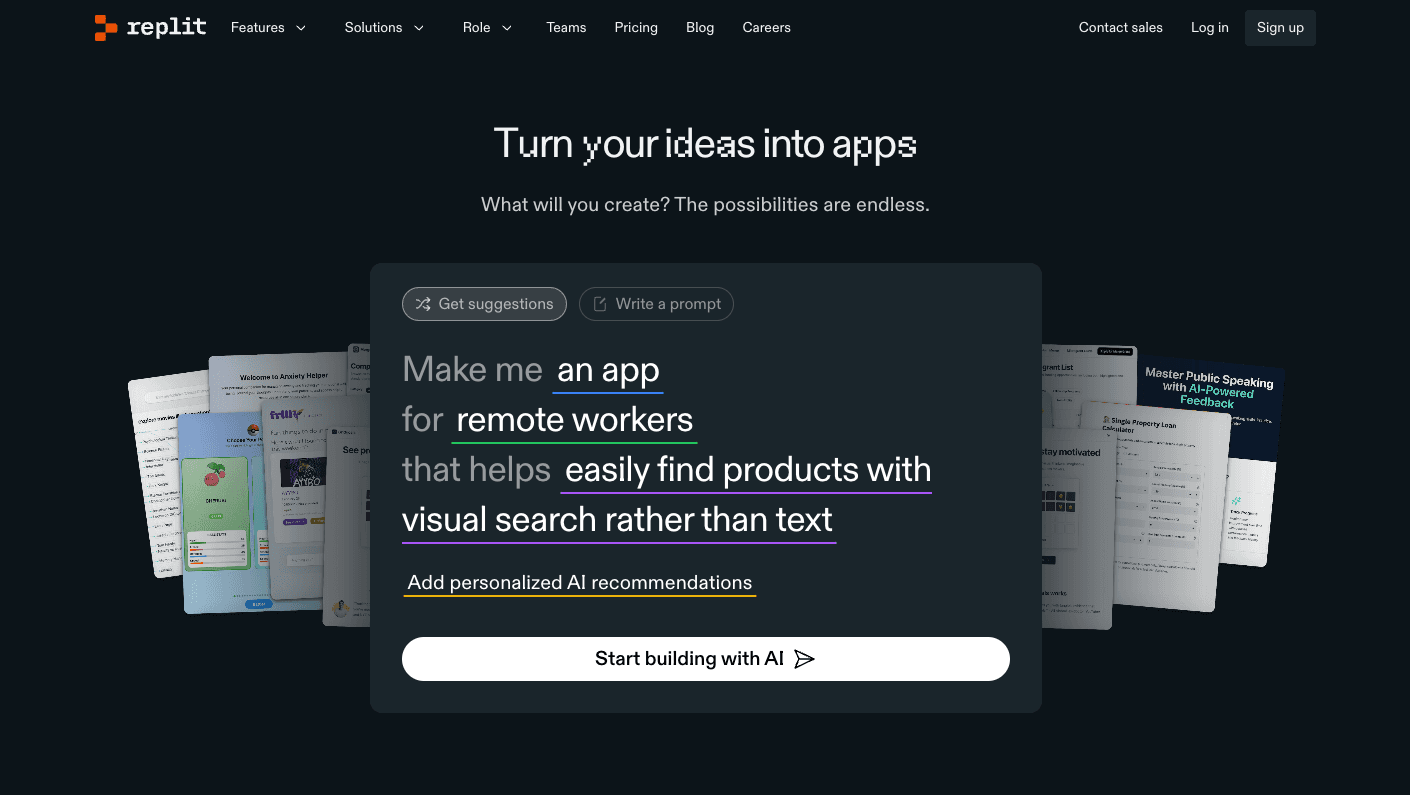
Overview
Replit Agent combines an AI coding agent with a hosted development environment, visual design tools, databases, integrations, collaboration, and publishing. Users can begin with an idea, an existing project, a screenshot, or a design, then ask Agent to create and modify working software.
Plan Mode lets users review scope, success criteria, and implementation steps before files change. Build Mode can write and edit code, run commands, debug errors, and create checkpoints, while the Visual Editor and Design Canvas provide more direct control over layout and content.
Replit’s billing model is broader than a flat AI subscription. Paid Agent work uses effort-based pricing, and subscription credits also cover cloud services such as published apps, storage, databases, and some third-party AI integrations. A project can therefore cost more than its base plan if Agent or infrastructure usage exceeds the included credits.
Use cases
The strongest fit depends on the job you need the product to complete, not the size of its feature list.
Turn a clear product brief into a hosted application with interface, server logic, storage, authentication, and deployment in one environment.
Product managers, founders, designers, and operators can collaborate with Agent while still inspecting the plan, preview, code, and checkpoints.
Core and Pro include multiple collaborators, shared workspaces, task planning, and background Agent work without separate per-seat pricing within plan limits.
Build landing pages, dashboards, internal tools, chatbots, mobile apps, slides, data visualizations, and other artifacts without assembling a separate toolchain first.
Capabilities
Plan Mode prepares a reviewable approach before code changes, while Build Mode executes tasks and records completed work in checkpoints.
Agent can plan changes, write code, run commands, explain behavior, debug failures, and iterate on an application.
Users can explore visual directions, annotate designs, convert designs into artifacts on paid plans, and directly edit page content and layout.
Replit provides hosted workspaces, databases, storage, authentication options, secrets, logs, and multiple publishing approaches inside the same platform.
Agent checkpoints capture changes and can restore files, Agent memory, tasks, and optionally databases when a build goes in the wrong direction.
Paid plans can connect third-party services, while some generated apps can use provider APIs such as Claude, ChatGPT, or Gemini through Replit-managed billing.
Current plans support two parallel agents on Core and ten on Pro, with additional collaboration and task-planning features.
Starter includes one published project for 30 days, while Core and Pro support unlimited published projects with infrastructure usage billed through credits.
Process
Step 1
Define the target user, primary workflow, required data, constraints, and what the first usable version must accomplish.
Step 2
Ask Agent to identify scope, risks, success criteria, and out-of-scope work, then reduce the build before approving changes.
Step 3
Attach screenshots, sketches, files, example data, errors, and explicit instructions about what must not change.
Step 4
Implement one working slice at a time so cost, regressions, and rollback decisions stay manageable.
Step 5
Exercise authentication, permissions, forms, database writes, payments, failure states, mobile layouts, and deployment behavior yourself.
Step 6
Configure usage alerts and hard limits, then monitor Agent, integration, database, storage, network, and deployment charges together.
Step 7
Inspect generated code, secrets handling, dependencies, access rules, backups, export needs, and incident procedures before production use.
Cost
Replit combines plan fees with shared credits and usage-based charges. Agent’s paid modes use effort-based pricing, while publishing, databases, storage, network use, and third-party AI services can consume the same credit pool.
Free
Entry plan for exploring Replit with daily Agent credits and limited publishing.
$20/month or $17/month annually
Paid plan for personal projects and small collaborative builds.
$100/month or $95/month annually
Professional plan for commercial builds and larger collaborative workloads.
Custom
Enterprise plan with custom scale, security, privacy, and deployment controls.
Pricing checked . Check current pricing at the source ↗
Assessment
Compare
The right alternative depends on the specific output, workflow, controls and budget your project requires.
Coding
Lovable is a strong alternative for prompt-driven web applications with a more design-forward product experience.
Explore Lovable →Coding
Bolt is useful for rapidly generating and running web applications in a browser-based development environment.
Explore Bolt.new →Business Operations
ChatGPT is more flexible for code discussion and multi-tool work when you do not need Replit’s integrated hosting and database stack.
Explore ChatGPT →Questions
Replit Agent is an AI software builder inside Replit that can plan, design, code, debug, and help publish applications from natural-language requests and supplied context.
Replit’s Starter plan is free and includes daily Agent credits, limited Agent intelligence, Design Canvas, the Visual Editor, and one 30-day published project. Full builds and Plan Mode require a paid plan.
Core is $20 monthly or $17 per month billed annually, while Pro is $100 monthly or $95 per month billed annually. Agent and cloud usage can create additional charges after included credits are consumed.
Paid Agent work is priced according to the complexity and work performed rather than a flat per-message fee. Replit shows task costs and asks for confirmation before a paid action begins.
Credits can apply to Agent work and cloud services including published apps, storage, databases, and certain third-party AI integrations.
It can build and publish full-stack applications, but production readiness depends on independent testing, security review, observability, data protection, capacity planning, and ongoing maintenance.
Yes. Checkpoints record completed work and can restore files, Agent context, tasks, and optionally database state.
Plan Mode can perform billable reasoning in the paid path even when it does not change files, so users should monitor usage and confirm the active billing mode.
Bottom line
Replit Agent is one of the most complete idea-to-deployment AI building environments, especially for founders and small teams that value speed and an integrated stack. Its main tradeoff is financial and operational: Agent work and infrastructure share a variable credit system, while generated applications still require serious human testing, security review, and cost monitoring.
Visit Replit Agent website ↗
Meta Llama Models: Llama models from meta offer open-source, state-of-the-art foundational models for research and deployment.

Ollama: Lets you run open-source llms locally for privacy-friendly and high-performance ai experiences.

Observability platform for managing LLM performance.

Google Firebase: Firebase helps developers build and scale apps with backend infrastructure, analytics, and real-time databases.

Get access to all our AI courses, hundreds of real-world AI use cases, live expert-led workshops, an exclusive network of AI early adopters, and more.
Get unlimited access to all of our current & upcoming industry-specific AI courses for the duration of your subscription.
To keep up with the rapid pace of AI, our team publishes AI implementation guides daily. Our library contains 300+ practical use cases to automate real-world work.
Join weekly, live, interactive sessions with industry leaders who are at the forefront of AI for hands-on implementation guidance and exclusive insights.
Network with an exclusive community of AI-first professionals who are working smarter with AI. Learn how early adopters are using AI in their work and businesses.