Existing workflow owners
Teams with live Agent Builder canvases need the remaining window to inventory behavior, preserve test cases, and complete a migration.
Independent tool overview
OpenAI Agent Builder is a visual multi-agent workflow canvas that remains available temporarily but is being retired; OpenAI says it will no longer be available after November 30, 2026.
Visit the official Agent Builder site ↗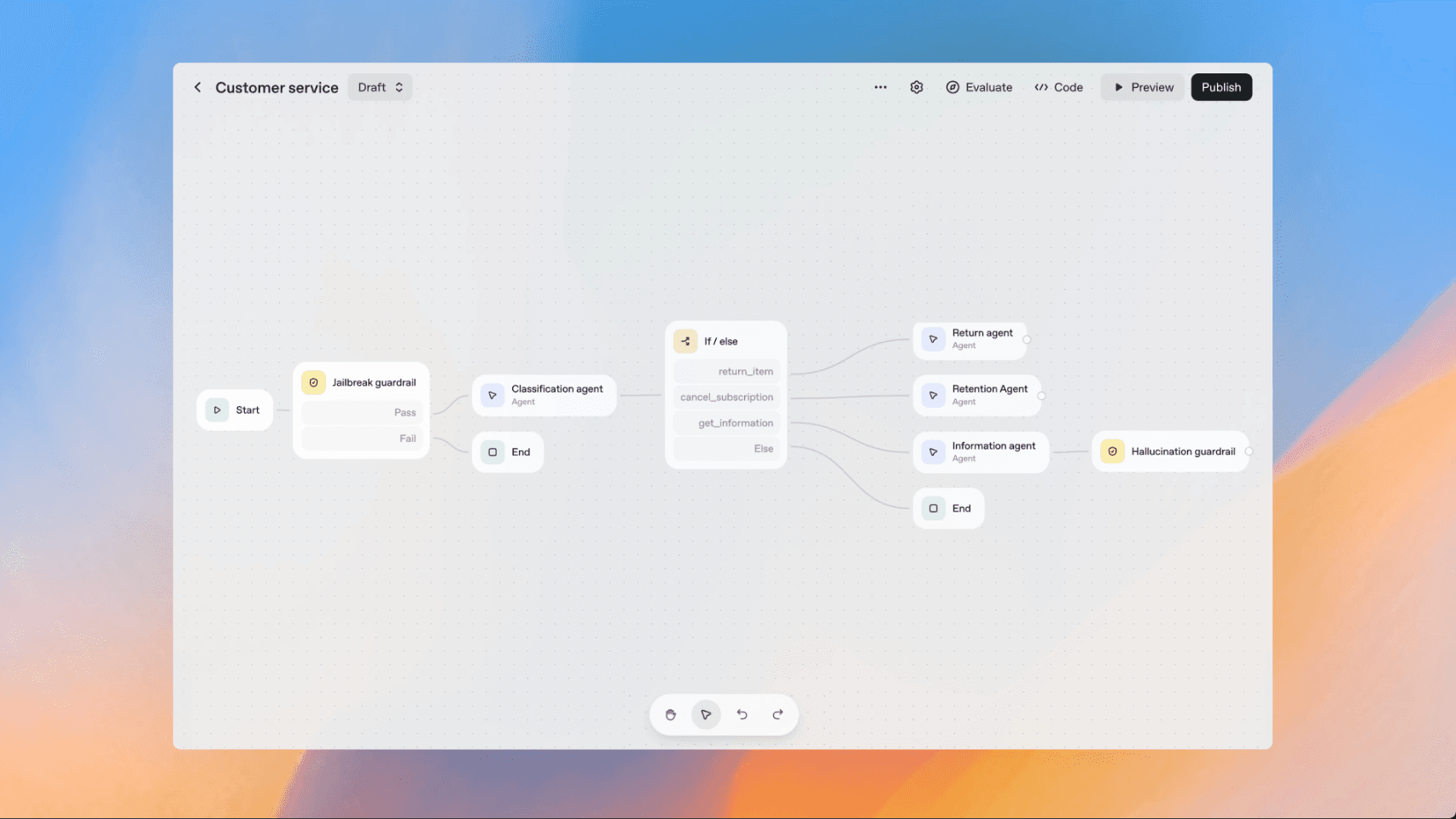
Overview
OpenAI launched Agent Builder in beta as a drag-and-drop canvas for composing agent logic, connecting tools, adding guardrails, previewing runs, configuring evaluations, and versioning multi-agent workflows. It was part of AgentKit alongside ChatKit and Connector Registry and used standard OpenAI API models and tools rather than a separate proprietary runtime charge.
The product is now in wind-down. OpenAI added a June 3, 2026 notice stating that Agent Builder and its Evals product will be unavailable on the platform from November 30, 2026 onward. Do not begin a new production dependency on it. Existing users should document their workflow behavior, test cases, tools, prompts, permissions, and failure paths, then rebuild workflows that must continue in the OpenAI Agents SDK or, for natural-language team workflows, evaluate Workspace Agents in ChatGPT.
Use cases
The strongest fit depends on the job you need the product to complete, not the size of its feature list.
Teams with live Agent Builder canvases need the remaining window to inventory behavior, preserve test cases, and complete a migration.
The visual graph can help engineers and domain experts identify agents, tools, handoffs, guardrails, and decision branches that code must reproduce.
A disposable internal demo may still illustrate an old workflow, provided no one mistakes it for a durable production platform.
Teams evaluating AgentKit-era projects can use the remaining interface and launch materials to understand how the original visual workflow model worked.
Capabilities
Agent logic was composed with connected nodes instead of being written entirely as orchestration code.
The canvas supported flows involving more than one configured agent and explicit transitions between workflow steps.
Builders could connect agent nodes to tools needed for retrieval, business logic, or other actions.
The original product supported guardrail configuration for checks such as identifying sensitive data or unwanted behavior.
Teams could exercise a workflow in the builder before using it in an application.
The launch materials described evaluation configuration alongside the workflow, although that platform product is also being retired.
Agent Builder tracked workflow versions to support iteration and deployment control.
Users could begin from a blank canvas or prebuilt workflow templates.
Process
Step 1
Avoid adding new production workflows or major features to a product with a confirmed shutdown date.
Step 2
Record owners, users, models, prompts, nodes, tools, credentials, guardrails, versions, inputs, outputs, and downstream consumers.
Step 3
Save representative inputs, expected results, tool-call rules, approval points, failures, and traces without copying secrets into documentation.
Step 4
Use the Agents SDK for workflows that must continue as code; assess Workspace Agents for team workflows better expressed through natural-language instructions.
Step 5
Keep the application's external contract stable while recreating orchestration, tools, handoffs, guardrails, state, and tracing in the replacement.
Step 6
Compare old and new behavior on the captured test set, move traffic gradually, verify observability and rollback, then decommission Agent Builder dependencies before November 30.
Cost
Agent Builder has no separate license price. During its remaining availability, model tokens and API tools are billed at OpenAI's standard API rates. Migration to the open-source Agents SDK also has no SDK license fee, but API, tool, storage, and infrastructure charges remain.
No separate platform fee
The visual builder is included with standard OpenAI API usage pricing during the wind-down period.
Usage based
Actual cost depends on the selected models, token volume, built-in tools, storage, and external systems used by the workflow.
No SDK license fee
The recommended code-based migration path is available for Python and TypeScript.
Pricing checked . Check current pricing at the source ↗
Assessment
Compare
The right alternative depends on the specific output, workflow, controls and budget your project requires.
Agents
OpenAI explicitly recommends Workspace Agents for team workflows that are better expressed through natural-language prompting than orchestration code.
Explore Workspace Agents →Business Operations
n8n provides a general visual automation canvas with self-hosting options and a broader ecosystem of deterministic workflow integrations.
Explore n8n →Agents
ElevenLabs Agent Workflows is a visual builder focused on conversational and voice-agent flows.
Explore Agent Workflows →Coding
AgentOps focuses on tracing, testing, and debugging agent systems when observability is the most urgent migration need.
Explore AgentOps →Questions
Yes. OpenAI says Agent Builder is being wound down and will no longer be available on the OpenAI platform from November 30, 2026 onward.
As of August 30, 2026, OpenAI describes it as being in wind-down rather than already unavailable. Existing users should use the remaining time for migration, not expansion.
OpenAI recommends the Agents SDK for workflows that need to continue as code and Workspace Agents in ChatGPT for use cases better suited to natural-language prompting.
It provided a visual canvas for composing multi-agent logic with tools and guardrails, previewing runs, configuring evaluations, starting from templates, and versioning workflows.
It has no separate platform charge in the launch pricing. Model tokens and tools are billed at standard OpenAI API rates, and that usage continues to matter during migration testing.
Do not plan on it. OpenAI says the product will no longer be available from that date. A workflow that must continue needs a verified replacement before the shutdown.
No. The SDK itself has no license fee, but OpenAI model and tool usage remains billable, and your own hosting, storage, monitoring, and engineering have costs.
Inventory prompts, models, nodes, tools, schemas, permissions, guardrails, versions, state, approval gates, error paths, representative inputs, expected outcomes, traces, owners, and downstream dependencies.
Bottom line
Agent Builder was a useful visual prototyping and collaboration layer, but its confirmed shutdown dominates any present-day evaluation. Existing users should treat it as a migration source, not a platform to grow. Start rebuilding critical workflows in the Agents SDK now, verify them in parallel, and leave time for a controlled cutover before November 30, 2026.
Visit Agent Builder website ↗
Anything - AI agent that ships mobile and web apps without coding

Petri - Anthropic's open-source agentic system for evaluating LLM safety
Action Agent - Writer's enterprise-ready autonomous AI that works on your behalf
Gemini 2.5 Computer Use - A specialized model to power agents that can interact with user interfaces

Get access to all our AI courses, hundreds of real-world AI use cases, live expert-led workshops, an exclusive network of AI early adopters, and more.
Get unlimited access to all of our current & upcoming industry-specific AI courses for the duration of your subscription.
To keep up with the rapid pace of AI, our team publishes AI implementation guides daily. Our library contains 300+ practical use cases to automate real-world work.
Join weekly, live, interactive sessions with industry leaders who are at the forefront of AI for hands-on implementation guidance and exclusive insights.
Network with an exclusive community of AI-first professionals who are working smarter with AI. Learn how early adopters are using AI in their work and businesses.