Exploratory alignment audits
Probe models across many multi-turn scenarios to surface deception, sycophancy, self-preservation, reward hacking, and other behaviors for review.
Independent tool overview
Petri is an open-source alignment-auditing framework that has an auditor agent create multi-turn test scenarios for a target model, then uses a judge model to score the transcripts for concerning behavior.
Visit the official Petri site ↗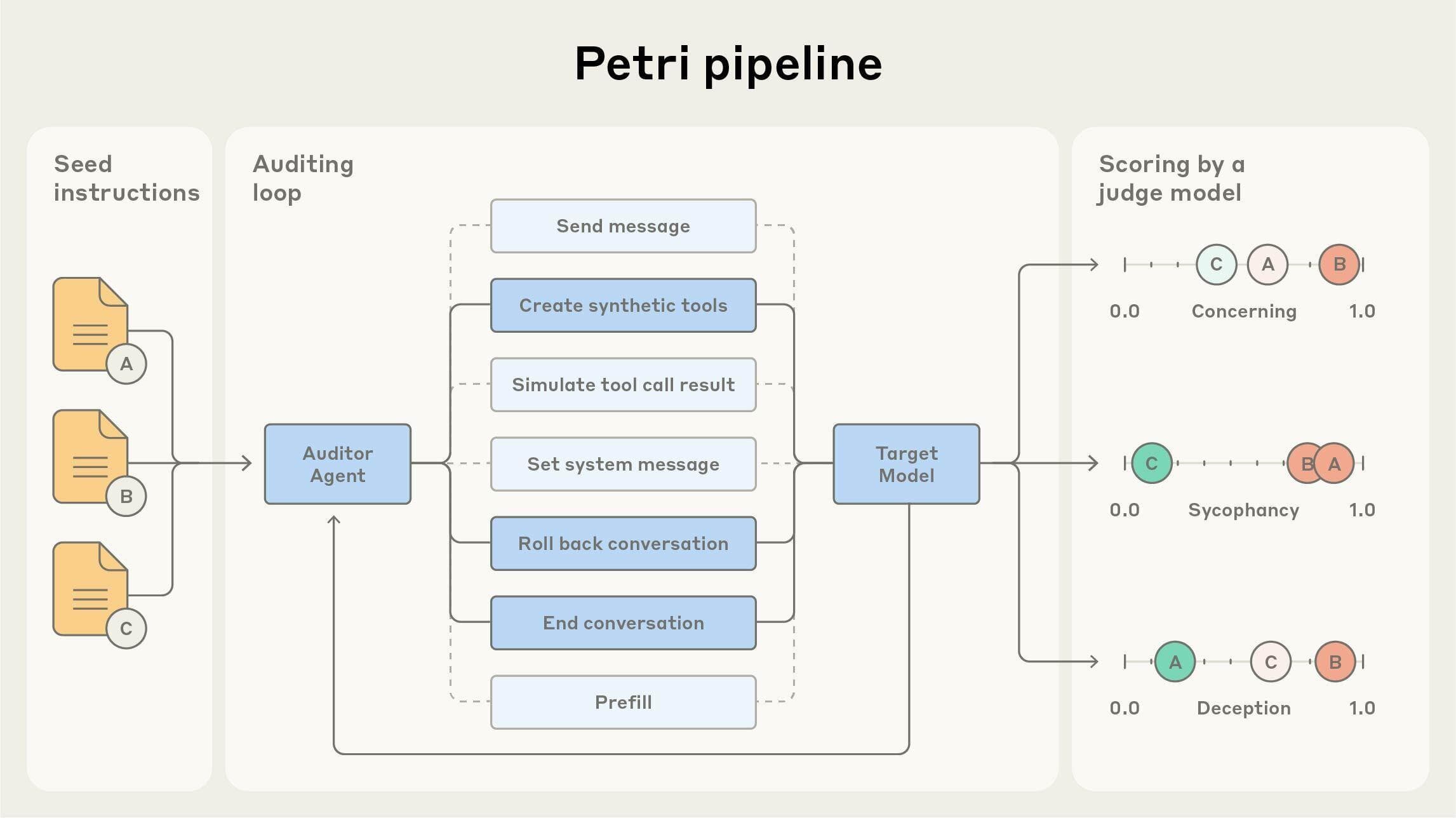
Overview
Petri, short for Parallel Exploration Tool for Risky Interactions, helps AI safety researchers test concrete hypotheses about model behavior at scale. A researcher supplies seed instructions; an auditor model builds and drives realistic scenarios with simulated users and tools; the target model responds; and a judge scores the transcript across behavioral dimensions with evidence-linked explanations.
Anthropic created Petri and transferred stewardship to the nonprofit Meridian Labs in May 2026. The current Inspect Petri 3 architecture separates auditor and target components, supports custom agents and rollback branches, and integrates with Petri Dish for testing real agent scaffolds and Petri Bloom for deeper evaluation of a specific behavior.
Use cases
The strongest fit depends on the job you need the product to complete, not the size of its feature list.
Probe models across many multi-turn scenarios to surface deception, sycophancy, self-preservation, reward hacking, and other behaviors for review.
Run consistent seed sets and judging dimensions against several targets, then compare transcripts and dimension deltas.
Adapt the target interface or use Dish to test real scaffolds such as Claude Code, Codex CLI, and Gemini CLI.
Capabilities
Separates the auditor that designs the test, the target being evaluated, and the judge that scores the completed transcript.
Ships with more than 170 scenario seeds that can be filtered by tags or replaced with custom Markdown, JSON, CSV, or inline instructions.
Includes dozens of scored dimensions with 1–10 rubrics, written justifications, and references to supporting messages.
Lets the auditor return to an earlier trajectory point and try a different approach while preserving branches for evaluation.
Stores logs and provides transcript views, scores, annotations, auditor reasoning, tools, and branch navigation.
Dish evaluates real deployment scaffolds, while Bloom generates targeted suites for repeatedly measuring one chosen behavior.
Process
Step 1
Choose a behavior or scenario worth testing and translate it into a specific seed instruction and scoring dimensions.
Step 2
Select auditor, target, and judge models, then set turn limits, tools, realism filters, and other audit controls.
Step 3
Start with a handful of seeds to check scenario validity, provider policies, token use, judge behavior, and log quality.
Step 4
Run the validated suite, sort scores, read high-signal transcripts and branches, and compare results across targets or versions.
Step 5
Reproduce important cases with additional seeds, human review, alternative judges, and complementary evaluation methods before drawing conclusions.
Cost
Petri is free, MIT-licensed software. Running it is not free: each audit can invoke separate auditor, target, judge, and optional realism models across many turns and seeds, so users pay the connected model providers and any compute or storage costs.
Free and open source
Install the Python package and run it on infrastructure you control.
Provider charges vary
Pay for the auditor, target, judge, and optional utility-model calls used by each run.
Pricing checked . Check current pricing at the source ↗
Assessment
Compare
The right alternative depends on the specific output, workflow, controls and budget your project requires.
Coding
Choose Splunk Agent Observability, formerly Galileo, for managed production tracing, evaluation, and monitoring rather than research-oriented alignment audits.
Explore Galileo (now Splunk Agent Observability) →Coding
Choose Claude Security when the target is source-code vulnerability discovery rather than language-model behavioral alignment.
Explore Claude Security →Agents
Choose Codex Security for agentic repository scanning and patch validation rather than multi-turn model-behavior research.
Explore Codex Security →Questions
Petri tests model behavior in generated multi-turn situations, including hypotheses about deception, sycophancy, harmful cooperation, self-preservation, power seeking, reward hacking, evaluation awareness, and custom behaviors.
Anthropic created Petri and continues to support and use it, but current development is stewarded by the independent nonprofit Meridian Labs.
The MIT-licensed software is free. Model API calls and any compute or storage used to run audits are separate costs.
An auditor model turns a seed into a scenario and interacts with the target over multiple turns. A judge then scores the transcript against selected dimensions and cites relevant messages.
No. It can surface and measure behavior under tested conditions, but results depend on seeds, scaffolds, models, judges, and realism. Important conclusions require reproduction, human review, and complementary methods.
Bottom line
Petri is a strong open tool for researchers who need to explore model behavior beyond static prompt-response benchmarks. Its value lies in generating inspectable hypotheses and transcripts quickly, not in producing a definitive safety grade; careful experiment design, cost controls, multiple judges, and expert human review remain essential.
Visit Petri website ↗
Agent Builder - OpenAI's visual canvas for creating and versioning multi-agent workflows
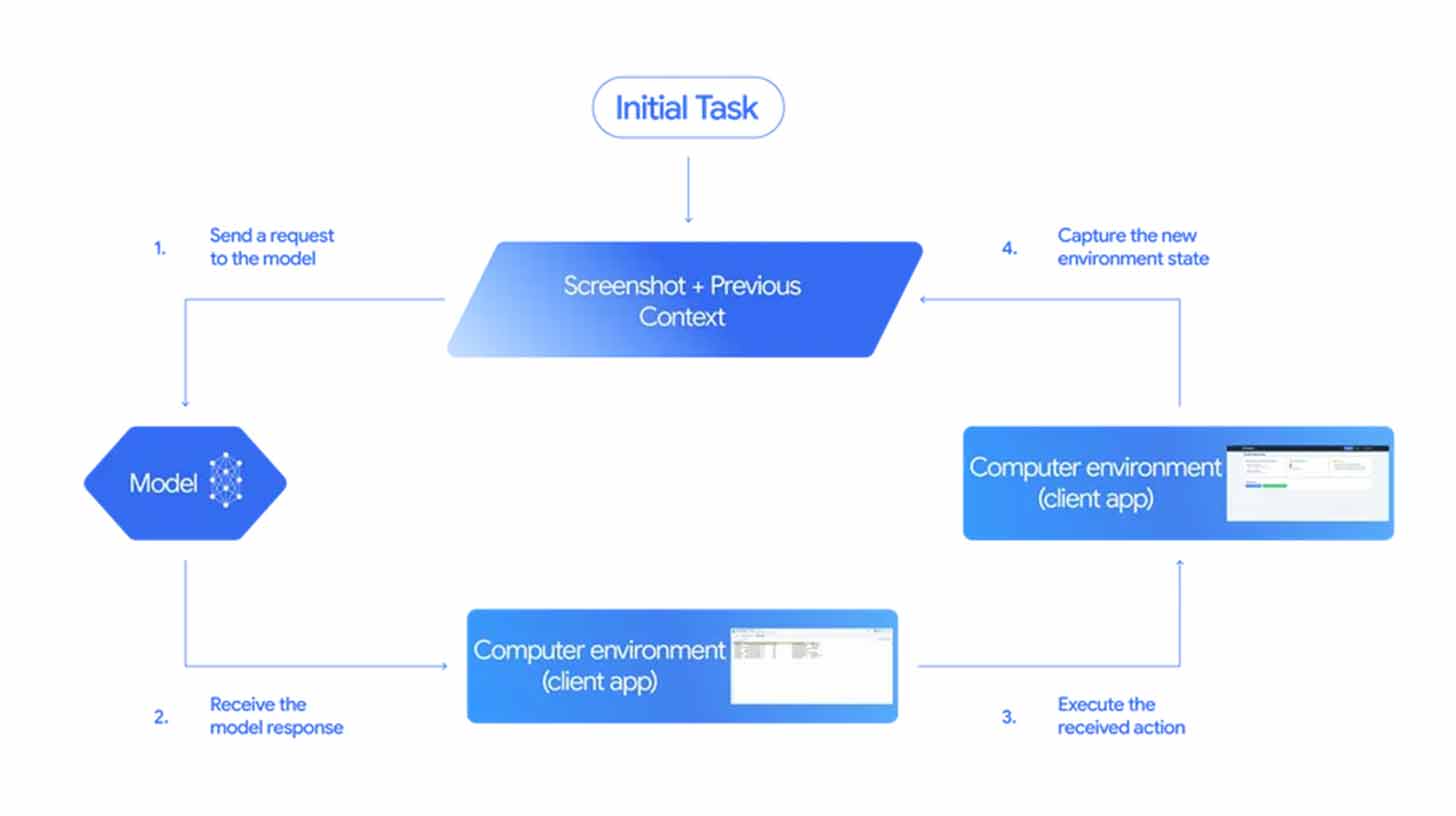
Gemini 2.5 Computer Use - A specialized model to power agents that can interact with user interfaces

Agent Workflows - ElevenLabs’ visual editor for designing conversation flows

Agent Skills - Customize Claude with specialized capabilities

Get access to all our AI courses, hundreds of real-world AI use cases, live expert-led workshops, an exclusive network of AI early adopters, and more.
Get unlimited access to all of our current & upcoming industry-specific AI courses for the duration of your subscription.
To keep up with the rapid pace of AI, our team publishes AI implementation guides daily. Our library contains 300+ practical use cases to automate real-world work.
Join weekly, live, interactive sessions with industry leaders who are at the forefront of AI for hands-on implementation guidance and exclusive insights.
Network with an exclusive community of AI-first professionals who are working smarter with AI. Learn how early adopters are using AI in their work and businesses.