Multi-client accounting firms
Run and monitor recurring work across an entire client book instead of automating one company or one spreadsheet at a time.
Independent tool overview
Ramp Stack is an AI accounting operating system built for firms that manage books for multiple clients. Its agents can perform reconciliations, prepare schedules and journal entries, run variance analysis, and move work between source systems and the ledger while preserving a reviewable audit trail.
Visit the official Ramp Stack site ↗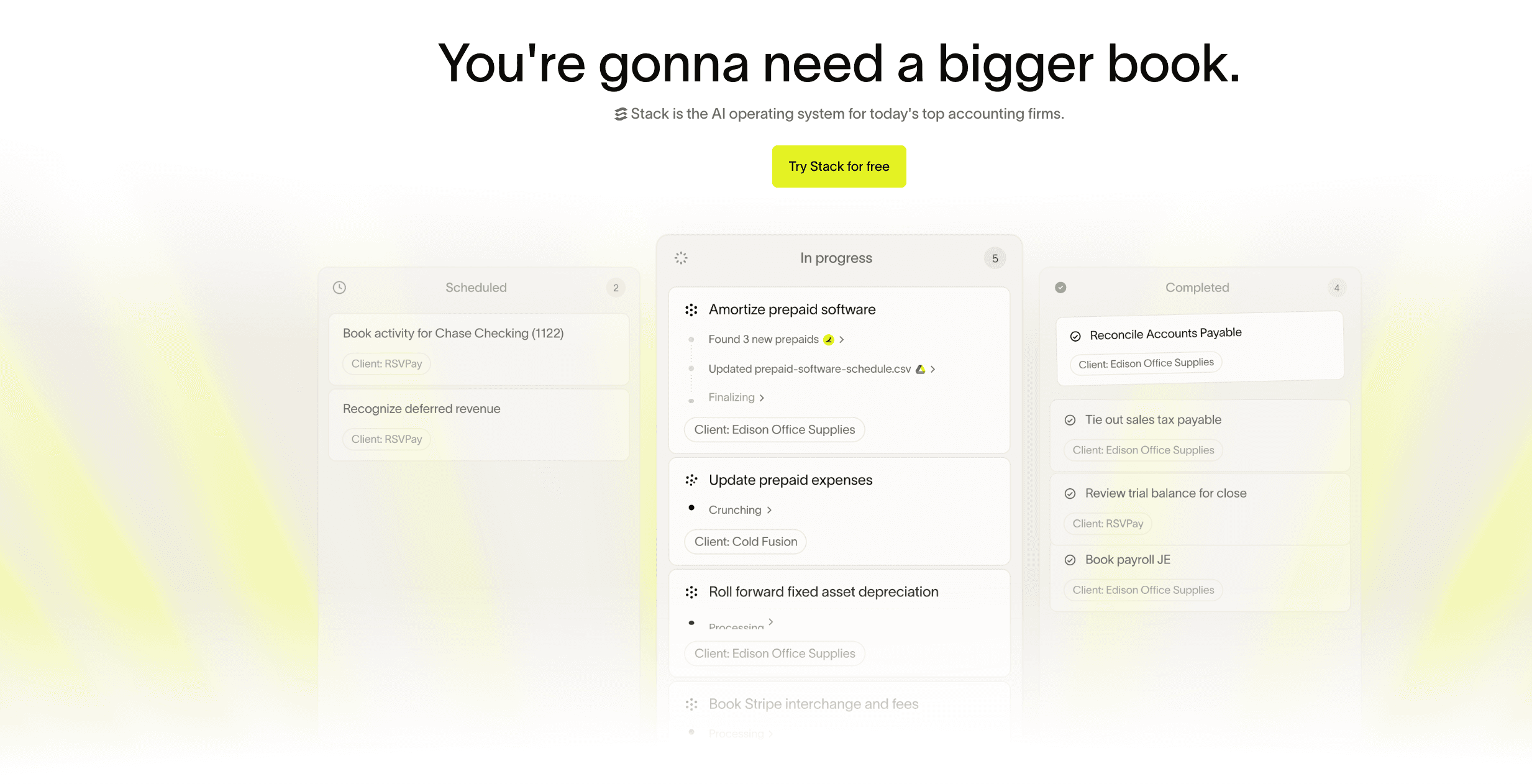
Overview
Ramp Stack is not a general bookkeeping chatbot. It is a workflow platform for accounting firms, including outsourced bookkeeping, client accounting services, fractional-controller, and CPA practices. Firms connect client systems, turn their procedures into reusable skills, and assign agents to recurring close work.
The core product combines three layers: integrations that read and write across accounting and file systems, agents that execute defined work, and a cross-client console for monitoring what is complete, running, blocked, or waiting for approval. Accountants decide which actions can run automatically and which require sign-off before posting.
Ramp launched Stack in June 2026 and currently advertises introductory free access through August 2026. It has not published the ongoing Stack price that follows that promotion, so firms should obtain written pricing, scope, and implementation terms before moving production work onto the platform.
Use cases
The strongest fit depends on the job you need the product to complete, not the size of its feature list.
Run and monitor recurring work across an entire client book instead of automating one company or one spreadsheet at a time.
Standardize reconciliations, schedule roll-forwards, accruals, journal entries, and variance reporting while retaining review checkpoints.
Convert established checklists and client-specific accounting rules into reusable skills that agents can execute consistently.
Benefit from direct context where client spend, accounts payable, banking, cards, and accounting data already flow through Ramp.
Capabilities
Executes real close work such as account reconciliation, transaction coding, schedules, journal entries, accruals, and flux or variance analysis.
Turns a firm's standard operating procedures into editable instructions that can be applied across clients and adapted for exceptions.
Shows which tasks are complete, in progress, blocked, or awaiting a reviewer across the firm's client portfolio.
Connects accounting software, file repositories, spreadsheets, bank accounts, cards, and other source systems so agents can act on live data.
Structures outputs like accounting workpapers and links decisions and numbers back to source data for review.
Lets firms decide which routine actions can run autonomously and which discrepancies or entries must pause for human judgment.
Stores differences such as capitalization policies, revenue timing, allocation dimensions, and vendor treatment at the client level.
Runs recurring accounting processes on a schedule so close work can happen continuously instead of accumulating at month end.
Process
Step 1
Start with one cooperative client and a repetitive, well-understood workflow that has a clear expected result and reviewer.
Step 2
Link the ledger, bank and card feeds, file repositories, spreadsheets, and other systems needed to complete the task.
Step 3
Upload an existing close checklist and turn the firm's accounting treatment, materiality thresholds, exceptions, and client rules into a reusable skill.
Step 4
Require sign-off for journal entries, unusual discrepancies, policy exceptions, and any action with material financial-statement impact.
Step 5
Review the agent's source links, formulas, reasoning trail, and proposed postings against the same evidence an accountant would use manually.
Step 6
Measure rework, exception frequency, close time, and reviewer effort before applying the skill to more clients or granting greater autonomy.
Cost
Ramp's public Stack page says the product is free through August 2026. As of August 29, 2026, no public post-promotion subscription or usage price is listed. Firms should treat the free period as an introductory offer and request the ongoing commercial terms before committing data, workflows, or client delivery.
Free through August 2026
Ramp's current public offer for accounting firms trying Stack.
Not publicly listed
Commercial terms after the introductory period require confirmation from Ramp.
Pricing checked . Check current pricing at the source ↗
Assessment
Compare
The right alternative depends on the specific output, workflow, controls and budget your project requires.
Finance
A useful comparison for firms and small businesses already centered on QuickBooks and Intuit's accounting ecosystem.
Explore Intuit Assist →Data Analysis
A lighter-weight route for formula help, summaries, and spreadsheet analysis when full agent execution and ledger write-back are unnecessary.
Explore Google Sheets AI →Business Operations
Better suited to drafting, research, and one-off analysis when the team does not need a connected, auditable accounting execution layer.
Explore ChatGPT →Finance
A research-focused finance alternative for analyzing companies and financial documents rather than running a firm's bookkeeping workflows.
Explore Fintool →Questions
Ramp Stack is an AI workflow platform for accounting firms. Agents perform reconciliations, journal entries, schedules, accruals, reporting, and other close work using connected client systems and firm-defined procedures.
It is designed for boutique bookkeeping and client-accounting practices through large multi-client CPA firms. It is not positioned primarily as a self-service bookkeeping app for one small business.
Ramp says Stack is free through August 2026. As of August 29, 2026, the company has not published the ongoing price after that introductory period, so firms should request written commercial terms.
It can prepare and sync journal entries, but the firm controls autonomy and approval boundaries. Material or unusual entries should remain subject to qualified human review.
Ramp says firms can add clients whether or not they are Ramp customers and connect external accounting systems, file repositories, bank accounts, and cards.
Ramp says Stack uses encryption in transit and at rest, is built on infrastructure with SOC 2 controls, keeps firm skills private, does not use client data or firm processes to train its models, and has zero-data-retention contracts with model providers. Firms should verify those controls against their own regulatory and client obligations.
It is designed to execute and document repetitive accounting work, not replace professional responsibility. Accountants remain responsible for controls, judgments, exceptions, approvals, and the accuracy of client deliverables.
Bottom line
Ramp Stack is one of the more ambitious accounting-agent products because it connects execution, reusable firm procedures, and cross-client oversight instead of stopping at chat. It is most compelling for process-mature firms willing to run a measured pilot. The biggest immediate unknown is commercial: Ramp's public free period ends with August 2026, while ongoing pricing is not yet posted.
Visit Ramp Stack website ↗
ChatGPT for Personal Finance - OpenAI's new personal finance advisor with live bank account access via Plaid

Agentic Trading - Robinhood's new MCP connection allowing AI agents to trade for users via their own agentic account

Meow - Financial infrastructure that lets AI agents open bank accounts, issue cards, send money, and audit spend via MCP

Mercury Command - natural-language agent for banking tasks, with built-in approvals

Get access to all our AI courses, hundreds of real-world AI use cases, live expert-led workshops, an exclusive network of AI early adopters, and more.
Get unlimited access to all of our current & upcoming industry-specific AI courses for the duration of your subscription.
To keep up with the rapid pace of AI, our team publishes AI implementation guides daily. Our library contains 300+ practical use cases to automate real-world work.
Join weekly, live, interactive sessions with industry leaders who are at the forefront of AI for hands-on implementation guidance and exclusive insights.
Network with an exclusive community of AI-first professionals who are working smarter with AI. Learn how early adopters are using AI in their work and businesses.