Apple ecosystem users
Siri AI is built into Apple's platforms, so it can work with device context, system apps, and supported third-party app actions.
Independent tool overview
Apple's next-generation Siri adds conversational answers, personal context, onscreen awareness, cross-app actions, and web knowledge across supported Apple devices.
Visit the official Siri AI site ↗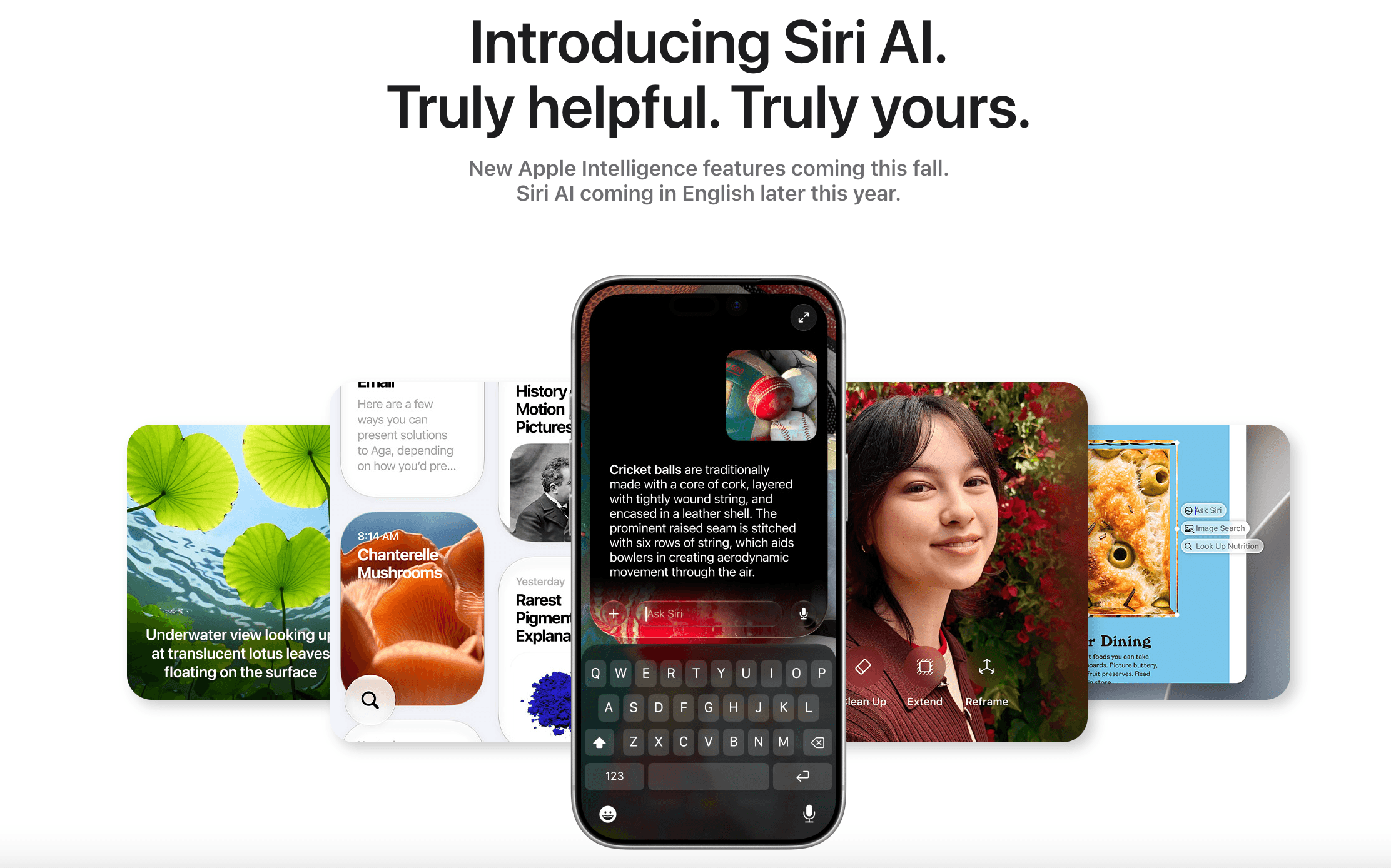
Overview
Siri AI is Apple's rebuilt personal assistant powered by the next generation of Apple Intelligence. It is designed to answer broad questions, understand what is on screen, search personal context across apps, and carry out multi-step actions throughout Apple's operating systems.
The important caveat is availability: Apple opened Siri AI to developer testing in June 2026 and says the public beta will arrive later in 2026. The full Siri AI experience is therefore not yet a generally available replacement for the current Siri as of this review.
Use cases
The strongest fit depends on the job you need the product to complete, not the size of its feature list.
Siri AI is built into Apple's platforms, so it can work with device context, system apps, and supported third-party app actions.
Use natural conversation to find information, draft messages, locate personal details, or act on content without moving through multiple apps manually.
Apple combines on-device models with Private Cloud Compute for requests that need larger server-based models.
Capabilities
Searches relevant information across messages, email, photos, and other indexed app content to answer personal questions.
Understands supported content currently visible on screen so users can ask follow-up questions or take related actions.
Uses Apple's App Intents and App Toolbox architecture to complete actions within and across compatible apps.
Can retrieve current information from the web and continue the answer through a natural back-and-forth conversation.
Provides a place to start or revisit conversations, with history privately synchronized through iCloud across supported products.
Adds visual question answering on supported devices and systemwide drafting, rewriting, and proofreading tools.
Process
Step 1
Check Apple's current availability notes and verify that your device, region, language, and software version support Siri AI.
Step 2
Update the device and turn on Apple Intelligence under Apple Intelligence & Siri in Settings.
Step 3
Invoke Siri by voice or the device control, then ask a question or refer to personal or onscreen context.
Step 4
Check generated answers and confirm consequential actions before Siri sends, edits, purchases, or shares anything.
Cost
Apple does not list a separate fee for Siri AI. It is included as a software capability on compatible Apple hardware, but availability depends on the device, operating system, region, and language.
Included
No separate subscription is announced; supported Apple hardware and software are required.
Pricing checked . Check current pricing at the source ↗
Assessment
Compare
The right alternative depends on the specific output, workflow, controls and budget your project requires.
Business Operations
A broadly available conversational assistant with strong general-purpose research, writing, and multimodal capabilities.
Explore ChatGPT →Content Creator
A strong alternative for users centered on Google services and Android devices.
Explore Gemini →Business Operations
A better fit for people whose work and personal workflows are already built around Microsoft products.
Explore Microsoft Copilot →Questions
Siri AI is Apple's next-generation version of Siri, powered by Apple Intelligence and designed around conversational answers, personal context, onscreen awareness, web knowledge, and actions across apps.
Apple made Siri AI available for developer testing in June 2026. As of August 29, 2026, Apple still described the consumer release as a public beta arriving later in 2026.
Apple has not announced a separate Siri AI subscription. The feature is included on compatible Apple devices, so the practical cost is the supported hardware required to run it.
Apple lists iPhone 15 Pro models and iPhone 16 or later, iPad mini with A17 Pro, iPads with M1 or later, Apple-silicon Macs, Apple Vision Pro, and eligible Apple Watch models paired with an Apple Intelligence-enabled iPhone. The newest Siri AI features also require the 2026 operating-system releases.
No. Apple says its architecture uses models that run on device and larger models on Apple servers through Private Cloud Compute. Some supporting capabilities, including the Spotlight index and App Toolbox, operate on device.
It can when developers expose supported content and actions through Apple's App Intents and Spotlight frameworks. The depth of integration therefore varies by app.
Bottom line
Siri AI could become the most useful assistant for people committed to Apple's ecosystem because it connects conversation with personal context and system-level actions. For now, treat it as a promising beta-stage product rather than a fully available everyday assistant, and verify device and regional eligibility before relying on the headline features.
Visit Siri AI website ↗
Kimi Work - Moonshot's local desktop agent running up to 300 parallel agents

Poetic - AI that learns your procedures, then self-heals when apps change

Hermes Desktop - Nous Research's persistent-memory agent as a native desktop app
Exa Agent- Exa's cost-effective, frontier-level web research API

Get access to all our AI courses, hundreds of real-world AI use cases, live expert-led workshops, an exclusive network of AI early adopters, and more.
Get unlimited access to all of our current & upcoming industry-specific AI courses for the duration of your subscription.
To keep up with the rapid pace of AI, our team publishes AI implementation guides daily. Our library contains 300+ practical use cases to automate real-world work.
Join weekly, live, interactive sessions with industry leaders who are at the forefront of AI for hands-on implementation guidance and exclusive insights.
Network with an exclusive community of AI-first professionals who are working smarter with AI. Learn how early adopters are using AI in their work and businesses.