Entity and account enrichment
Research a supplied company or prospect list and return consistent fields with supporting sources.
Independent tool overview
Exa Agent is a developer API for asynchronous, multi-step web research that can return cited prose or structured data for list-building, enrichment and open-ended investigations.
Visit the official Exa Agent site ↗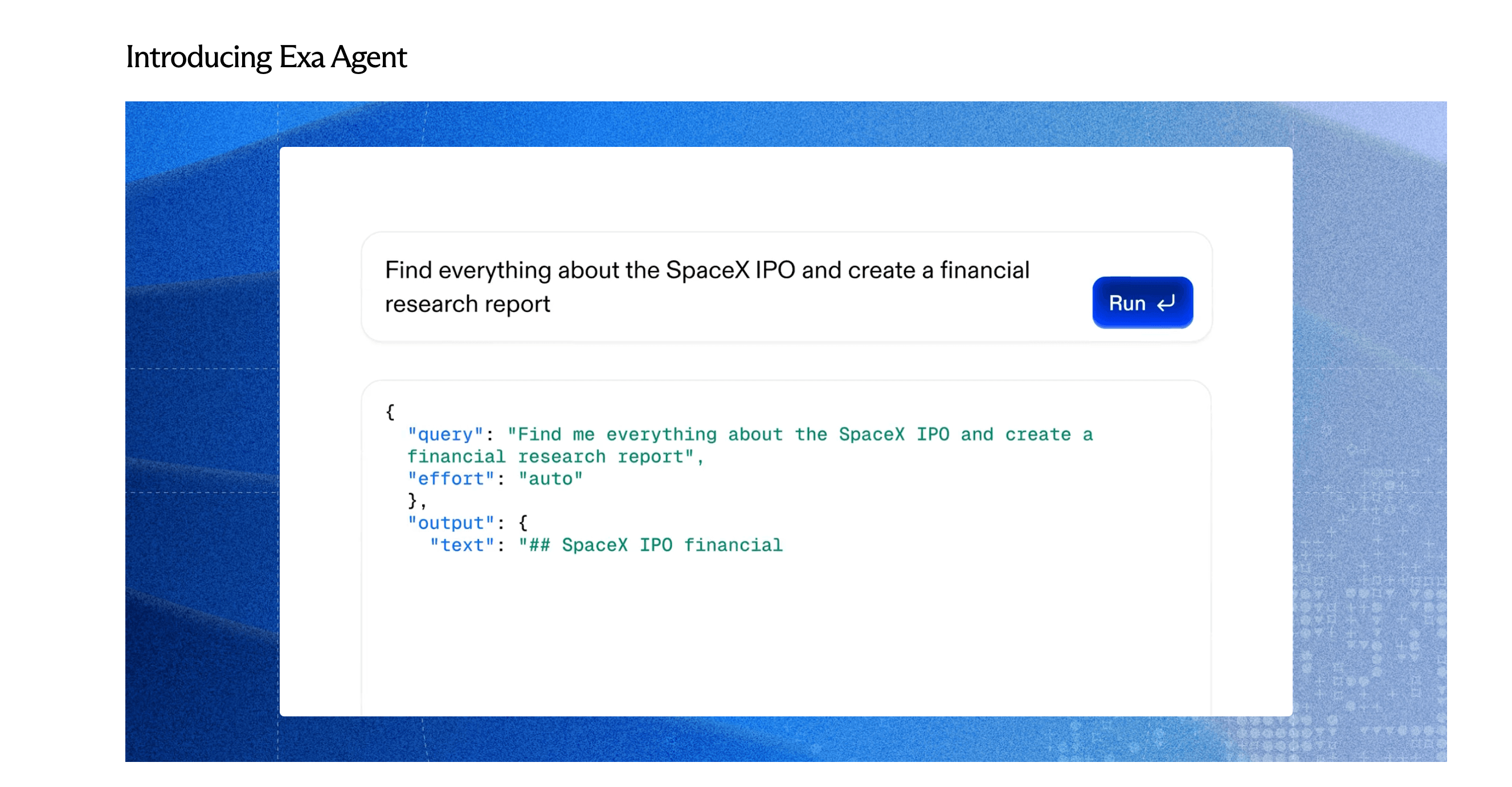
Overview
Exa Agent combines language models with Exa's search and page-retrieval infrastructure. A developer submits a natural-language research task, optionally supplies input data and an output schema, then receives a long-running agent job that searches, reads and synthesizes sources.
The product is aimed at applications rather than individual researchers. Its strongest fit is a workflow that needs repeatable, machine-readable research—such as enriching companies, assembling a market map or producing a cited brief—not a one-off browser answer.
Exa documents the Agent API as beta, so request headers, behavior and pricing may change. Production teams should also validate source quality, handle partial or failed runs and avoid treating a citation as proof that the model interpreted a source correctly.
Use cases
The strongest fit depends on the job you need the product to complete, not the size of its feature list.
Research a supplied company or prospect list and return consistent fields with supporting sources.
Build lists of products, companies, people or events across many web sources.
Add long-running web investigation to an agent, dashboard or internal workflow through one API.
Capabilities
Searches, reads and reasons across multiple sources instead of returning a single search-results page.
The outputSchema parameter can request JSON that matches fields defined by the application.
The input.data parameter can attach records that the agent should research or enrich.
Research results include source grounding so downstream users can inspect the supporting pages.
Minimal, low, medium, high, x-high and auto modes trade cost, latency and completeness.
Supports server-sent events plus endpoints for creating, reading, listing, cancelling and replaying run events.
Process
Step 1
Specify the question, inclusion rules, freshness requirements and exact fields the application needs.
Step 2
Send the prompt, effort preference, optional input data and optional output schema to the Agent API.
Step 3
Stream lifecycle events or poll the run, with retry and cancellation handling for slow or failed jobs.
Step 4
Check required fields, inspect citations, deduplicate entities and route uncertain or high-impact results for review.
Cost
Fixed effort modes cost from $0.012 to $1.00 per run. Auto effort instead scales compute and search usage to the task. Contact enrichment and specialized Exa Connect providers are charged separately.
$0.012 per run
Lowest-cost mode for lightweight tasks.
$0.025 per run
Narrow factual tasks and short answers.
$0.10 per run
Exa's recommended starting point for standard research.
$0.50 per run
Harder tasks requiring more research and citations.
$1.00 per run
Highest fixed effort for valuable completeness-sensitive work.
Usage based
Dynamically scales research effort and cost.
Pricing checked . Check current pricing at the source ↗
Assessment
Compare
The right alternative depends on the specific output, workflow, controls and budget your project requires.
Agents
Choose Parallel Search for another agent-oriented web search and research API.
Explore Parallel Search →Consumer
Choose Gemini Deep Research Agent for Google's long-running research API and ecosystem.
Explore Gemini Deep Research Agent →Data Analysis
Choose Perplexity when researchers need an end-user answer engine rather than an embedded API workflow.
Explore Perplexity →Questions
Exa Agent is an API that performs asynchronous, multi-step web research and returns cited prose or structured output for applications.
Fixed modes range from $0.012 for Minimal to $1.00 for X-high per run. Auto effort is billed from Agent Compute Units and search tool calls, with contact enrichment charged separately.
Search returns web results and content for an application to process. Agent performs a longer workflow that searches multiple times, reads sources, reasons over them and produces a synthesized result.
Yes. Developers can supply an outputSchema so the final result follows defined fields, which is useful for enrichment and database pipelines.
It can be integrated today, but Exa's documentation labels the API beta. Production use should isolate the integration, monitor changes and validate results before automated decisions.
Bottom line
Exa Agent is compelling for developers who need cited, structured web research inside a product without building their own search-and-synthesis loop. The biggest tradeoffs are beta stability, asynchronous integration work and the need to validate research before it drives a database or decision.
Visit Exa Agent website ↗
Poetic - AI that learns your procedures, then self-heals when apps change

Voice Agent Builder- xAI's no-code platform for voice agents running on Grok Voice

Siri AI - Apple's newly overhauled on-device AI assistant
Gemini Managed Agents - Google's sandboxed agent API with background tasks and remote tools

Get access to all our AI courses, hundreds of real-world AI use cases, live expert-led workshops, an exclusive network of AI early adopters, and more.
Get unlimited access to all of our current & upcoming industry-specific AI courses for the duration of your subscription.
To keep up with the rapid pace of AI, our team publishes AI implementation guides daily. Our library contains 300+ practical use cases to automate real-world work.
Join weekly, live, interactive sessions with industry leaders who are at the forefront of AI for hands-on implementation guidance and exclusive insights.
Network with an exclusive community of AI-first professionals who are working smarter with AI. Learn how early adopters are using AI in their work and businesses.