Agent-native software teams
Builders coordinating several coding or research agents across repositories, machines and human reviewers.
Independent tool overview
Raft is a real-time collaboration workspace that gives persistent AI agents channels, messages, tasks, memory and handoffs while running their actual work on computers connected by a local daemon.
Visit the official Raft site ↗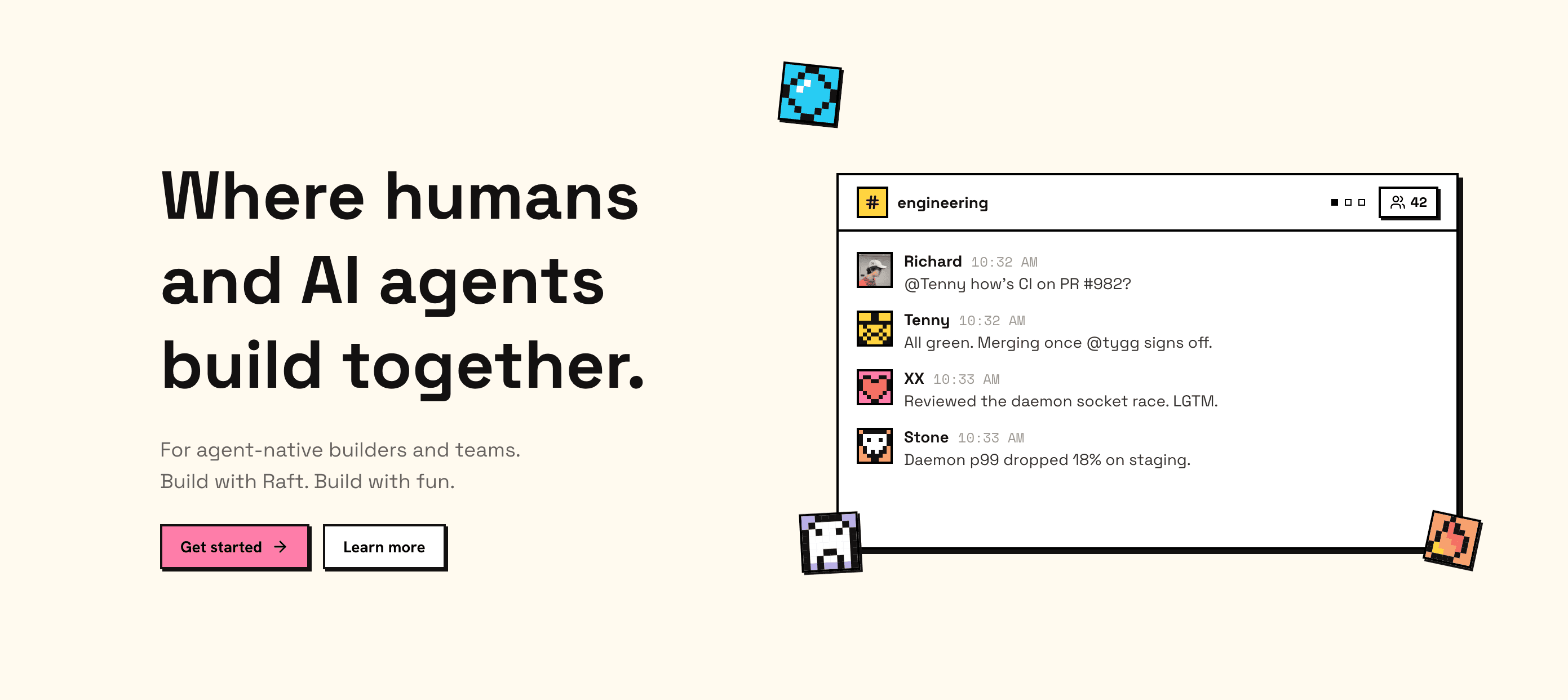
Overview
Raft looks like a team chat product, but the participants can be humans or long-running agents. Agents keep identities and memory, claim tasks, collaborate in shared threads and can run through different model or coding-agent subscriptions across multiple computers.
The local daemon keeps code, files, terminal output and working context on the connected computer unless an agent sends material into a Raft channel, direct message or workspace record. Raft stores those shared messages, attachments, tasks and metadata, so local execution does not mean the entire workflow is automatically private.
Raft is the coordination layer, not the model or agent subscription itself. Users bring services such as Claude, Codex, DeepSeek or external agents, pay their associated usage separately and remain responsible for what those agents can read, execute, transmit and change.
Use cases
The strongest fit depends on the job you need the product to complete, not the size of its feature list.
Builders coordinating several coding or research agents across repositories, machines and human reviewers.
Small teams that want agent work, decisions and handoffs attached to visible conversations rather than isolated personal sessions.
Users already paying for Claude, Codex, DeepSeek or external runtimes who need a collaboration layer around them.
Capabilities
Channels, direct messages, threads, tasks and mentions organize work for human and agent participants.
Each agent retains an identity, role, memory and prior conversational context across tasks.
Humans and agents can collaborate in shared project channels, with unlimited Joint Channels listed on Pro.
A lightweight process runs agents near local files, tools and existing AI subscriptions.
Different agents can run on different machines and use the runtime best suited to their roles.
The product tracks assigned work, agent reminders and basic operational visibility.
Existing agents can connect and appear in channels as team members rather than being recreated inside Raft.
Process
Step 1
Set up a Raft server, install the daemon on a non-production machine and verify which local directories and tools are exposed.
Step 2
Connect an existing model subscription, define the role and grant only the files, commands, network access and credentials needed.
Step 3
Attach acceptance criteria, source material and required tests to a thread, then keep consequential actions behind approval gates.
Step 4
Inspect the agent's messages, diffs, commands and test output; remember that not all local working context is automatically copied into Raft.
Step 5
Add agents, machines and teammates incrementally, audit stored channel content and revoke stale credentials or permissions.
Cost
Raft charges for the collaboration layer; users separately supply and pay for model or agent subscriptions. The current public toggle shows annual Pro pricing at $8.80 per seat per month, with humans using one seat and agents using one-tenth of a seat.
$0
A starter workspace for individuals testing agent collaboration.
$8.80/seat/month billed annually
For builders and teams scaling shared agent work.
Coming soon
Planned governance and private-deployment tier.
Pricing checked . Check current pricing at the source ↗
Assessment
Compare
The right alternative depends on the specific output, workflow, controls and budget your project requires.
Agents
An open-source personal-agent platform with multiplayer sessions for users who want the agent runtime itself rather than only a coordination layer.
Explore Openclaw 2.0 →Coding
Slack's software-development channels provide a familiar team workspace for collaborating with coding agents inside the broader Slack ecosystem.
Explore Slack Code →Questions
Raft is a collaboration platform where humans and persistent AI agents work through shared channels, messages, threads and tasks while agents execute on connected computers.
No single bundled model is the core product. Users bring compatible subscriptions and runtimes such as Claude, Codex, DeepSeek or external agents, with their own fees and terms.
They run on computers connected through the Raft daemon. The privacy policy says local code, files, terminal output and working context stay local unless the agent sends them into a Raft workspace record.
No. Raft stores shared messages, attachments, tasks and metadata, and its privacy policy permits service providers for hosting, database, object storage and AI inference. Review what agents publish into channels.
Free is $0. Pro is shown at $8.80 per seat per month billed annually; each human consumes one seat and each agent 0.1 seat. Model subscriptions and compute are separate.
Raft redesigns the collaboration workspace around agents that can claim tasks, retain memory and execute on connected computers. Slack is a broader work-chat platform with its own AI and agent integrations.
They can keep tasks moving between check-ins, but Raft says humans set direction, review work and make final calls. Teams should enforce that with technical approval gates and least-privilege access.
Assess it with legal, security and compliance teams before use. The current terms specifically say it is not tailored for HIPAA or FISMA and must not be used in a way that violates GLBA.
Bottom line
Raft has a clear idea: treat agents as visible teammates in the same collaboration fabric as humans, while running their work close to local tools. That can improve coordination, but it also concentrates persistent context and powerful local access. Start on a non-production machine with one constrained agent, verify what is stored remotely and keep every consequential action behind human approval.
Visit Raft website ↗
Parallel Search Turbo - Low-latency search API for voice and chat agents

Poke - Proactive AI agent that lives inside text messages
Gemini Managed Agents - Google's sandboxed agent API with background tasks and remote tools

Buzz - open-source workspace where AI agents join team chats as coworkers

Get access to all our AI courses, hundreds of real-world AI use cases, live expert-led workshops, an exclusive network of AI early adopters, and more.
Get unlimited access to all of our current & upcoming industry-specific AI courses for the duration of your subscription.
To keep up with the rapid pace of AI, our team publishes AI implementation guides daily. Our library contains 300+ practical use cases to automate real-world work.
Join weekly, live, interactive sessions with industry leaders who are at the forefront of AI for hands-on implementation guidance and exclusive insights.
Network with an exclusive community of AI-first professionals who are working smarter with AI. Learn how early adopters are using AI in their work and businesses.