Realtime voice and chat
Ground factual replies in current web sources without adding a long research pause to every turn.
Independent tool overview
Parallel Search Turbo is the lowest-latency mode in Parallel's Search API, designed to return ranked web sources and compressed, LLM-ready excerpts for voice, chat and high-volume agent workflows. Parallel advertises 200 ms median search latency and $1 per 1,000 requests, but Turbo is a retrieval layer—not a finished answer engine or a substitute for deeper research and authoritative live-data feeds.
Visit the official Parallel Search Turbo site ↗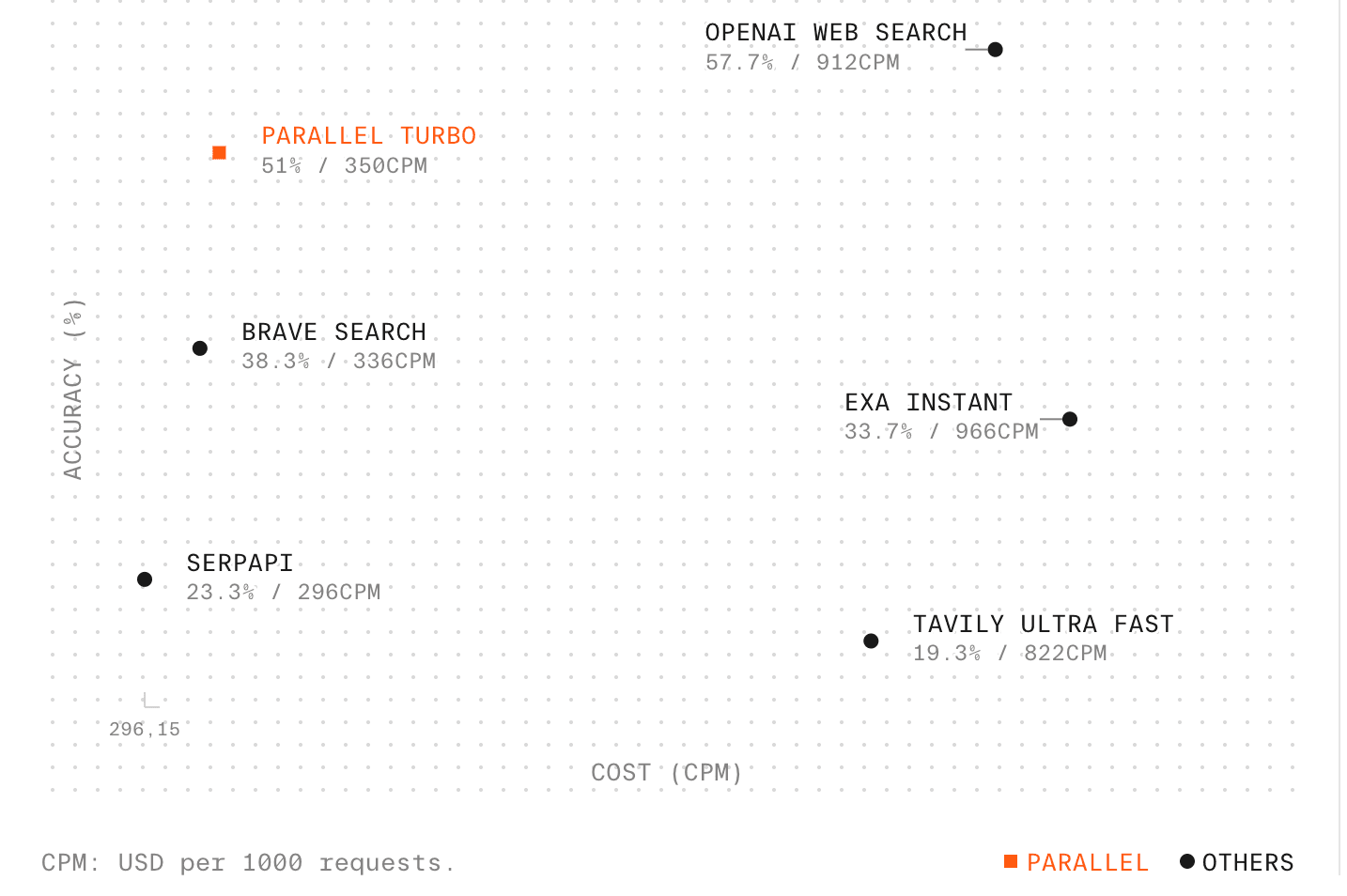
Overview
Parallel Search Turbo lets an application send a search objective and optional keyword queries to one synchronous API and receive ranked URLs with dense excerpts for an AI model's context window.
The mode is aimed at interactions where users are waiting, such as voice assistants, chat, support and agent loops. Parallel reports 200 ms p50 search latency, while its broader published Search API range is 200 ms to 3 seconds.
Its strongest use is a bounded grounding step: the application decides when search is necessary, retrieves a small evidence packet and asks its model to answer from that evidence. Complex multi-source synthesis belongs in a deeper research workflow.
Use cases
The strongest fit depends on the job you need the product to complete, not the size of its feature list.
Ground factual replies in current web sources without adding a long research pause to every turn.
Run many inexpensive retrieval calls where basic web context matters more than deep synthesis.
Return current source material to an existing model and interface while retaining control of the final answer.
Capabilities
Parallel reports 200 ms p50 search latency for Turbo, optimized for interactive agent experiences.
Returns ranked pages with compressed, query-relevant passages instead of only titles and short search-engine snippets.
Accepts a natural-language objective, targeted search queries or both so an agent can express intent and coverage.
Developers can cap results and excerpt sizes to manage latency and the amount of web text passed into a model.
Turbo is selected through the Search API's mode setting, making it possible to trade speed against depth within one integration.
Process
Step 1
Let the application decide whether a request needs current web context; greetings and clarifications usually do not.
Step 2
Turn follow-ups and relative dates into a self-contained objective plus a small set of targeted queries.
Step 3
Keep the API key off the client, choose turbo mode and set explicit result and excerpt limits.
Step 4
Pass the returned evidence to the model, require claims to stay within it and expose usable source links in the interface.
Step 5
Track search latency separately from full-answer latency, evaluate final-answer quality and route complex questions to deeper research.
Cost
Parallel lists Turbo at $1 per 1,000 Search API requests, with 10 results and excerpts included. Its pricing page also advertises up to 5,000 requests per month free; additional results and other modes or products can add cost.
$0
Published monthly allowance for testing and light use.
$1 per 1,000 requests
Pay-as-you-go low-latency search with 10 ranked results and excerpts per request.
Custom quote
Organization-level controls and support for larger deployments.
Pricing checked . Check current pricing at the source ↗
Assessment
Compare
The right alternative depends on the specific output, workflow, controls and budget your project requires.
Data Analysis
Consider Exa for another developer-focused search and content-retrieval API with semantic web discovery.
Explore Exa →Data Analysis
Consider Perplexity when the goal is an answer-first research experience for people rather than a low-level search component.
Explore Perplexity →Questions
It is a low-latency mode in Parallel's Search API that returns ranked URLs and compressed excerpts for AI agents, voice assistants, chat and other interactive applications.
Parallel listed Turbo at $1 per 1,000 requests on August 31, 2026, with 10 results and excerpts included. Check the live pricing page for free-credit and additional-result terms.
No. Parallel reports 200 ms as median p50 latency from its launch evaluation. Real latency depends on the request, network, region and application, and the full answer also includes routing and model-generation time.
No. It supplies web sources and excerpts. Your application must pass that evidence to a model, constrain the response, display sources and handle failures.
Use a deeper research or Task workflow when a question requires broad discovery, multiple hops, structured synthesis or stronger verification than a fast grounding call provides.
Not by itself. Web results must be treated as untrusted evidence, checked against authoritative sources and reviewed by qualified humans when decisions affect health, law, money, employment or safety.
Bottom line
Parallel Search Turbo is compelling when search latency and cost directly affect an AI product's user experience. The value is strongest as a fast, controlled evidence layer inside a well-evaluated application. It should not be marketed internally as an accuracy guarantee or used as the only verification step for complex or consequential answers.
Visit Parallel Search Turbo website ↗
Gemini Managed Agents - Google's sandboxed agent API with background tasks and remote tools
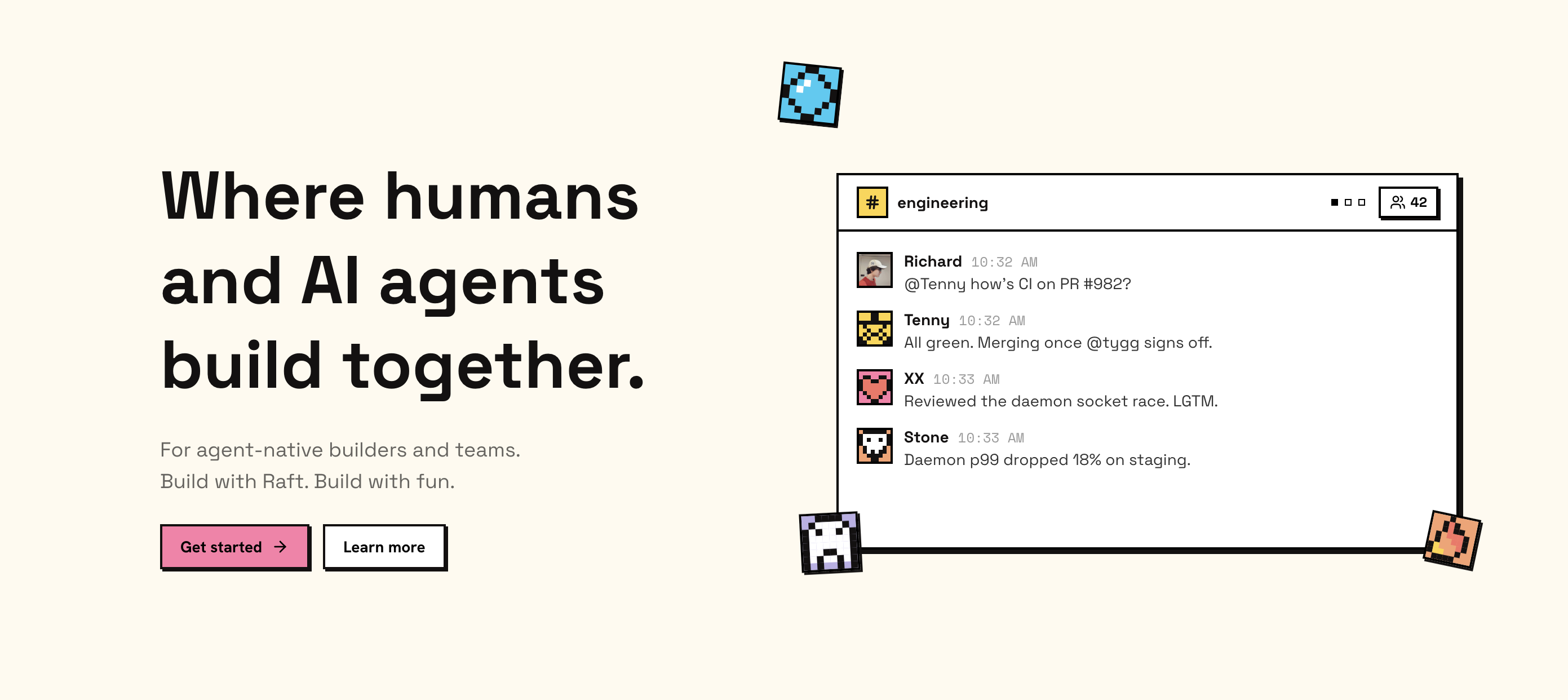
Raft - Slack-style workspace pairing teams with persistent, local AI agents
Voice Agent Builder- xAI's no-code platform for voice agents running on Grok Voice

Poke - Proactive AI agent that lives inside text messages

Get access to all our AI courses, hundreds of real-world AI use cases, live expert-led workshops, an exclusive network of AI early adopters, and more.
Get unlimited access to all of our current & upcoming industry-specific AI courses for the duration of your subscription.
To keep up with the rapid pace of AI, our team publishes AI implementation guides daily. Our library contains 300+ practical use cases to automate real-world work.
Join weekly, live, interactive sessions with industry leaders who are at the forefront of AI for hands-on implementation guidance and exclusive insights.
Network with an exclusive community of AI-first professionals who are working smarter with AI. Learn how early adopters are using AI in their work and businesses.