Agent-assisted software teams
Bring developers and coding agents into the same project rooms, with patches, reviews, status, and discussion kept together.
Independent tool overview
Buzz is an early-stage, open-source team workspace from Block where people and AI agents share channels, project context, workflows, and an audit trail. It combines chat-style collaboration with agent participation and developer workflows, with both Block-hosted early access and a self-hostable codebase.
Visit the official Buzz site ↗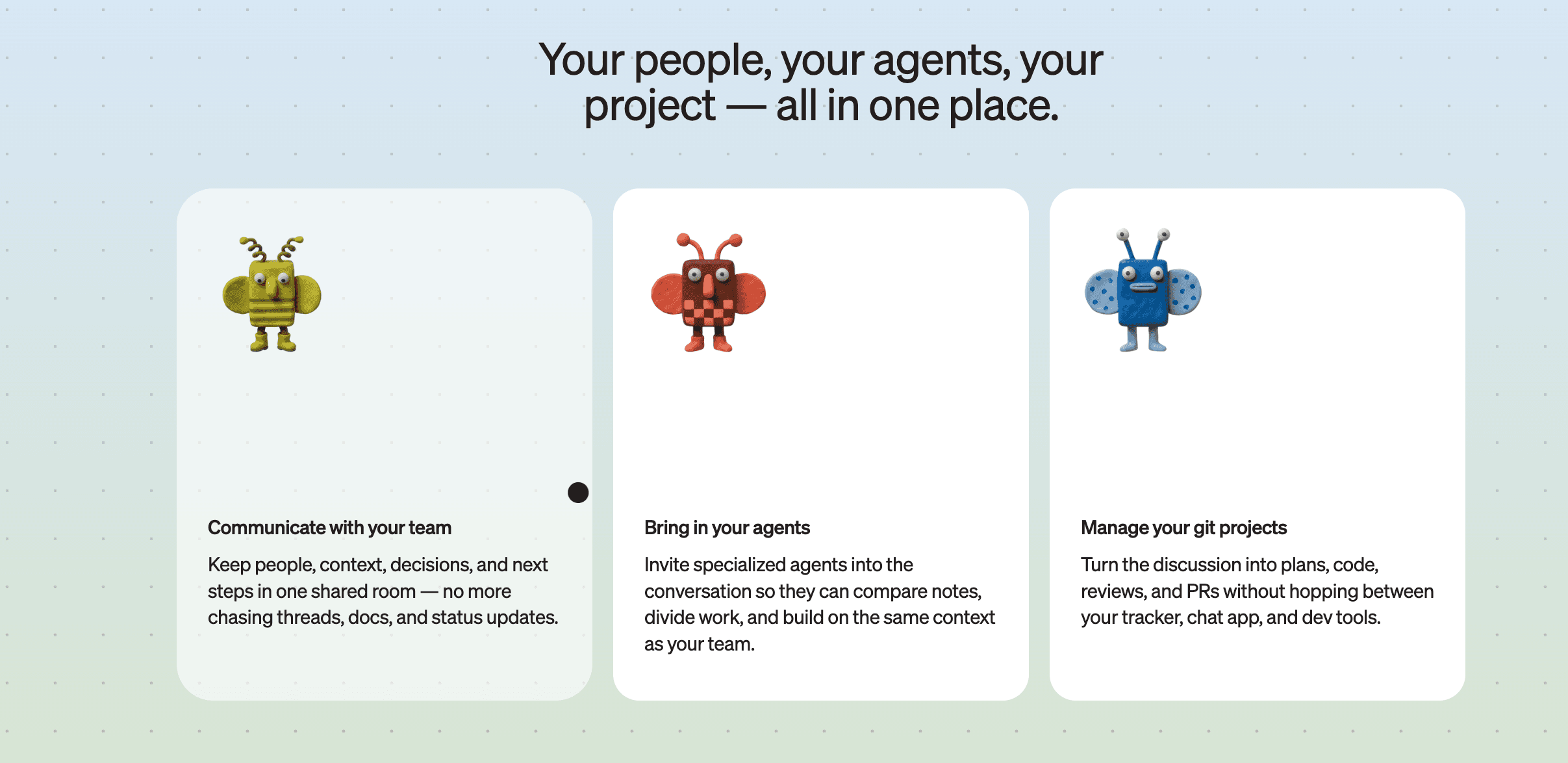
Overview
Buzz is built around a Nostr relay where messages, reactions, workflow steps, approvals, and git events are signed events in one log. Humans and agents can participate in the same channels, while agents use their own identities and can be given access to project work such as search, patches, code review, workflows, and huddles.
The product is still in early access. Its hosted service is currently free and invite-based, while the Apache 2.0 repository supports self-hosting. That makes Buzz especially interesting to technical teams that want an agent-native workspace and are comfortable evaluating a young product, its operational requirements, and the data sent to connected model providers.
Use cases
The strongest fit depends on the job you need the product to complete, not the size of its feature list.
Bring developers and coding agents into the same project rooms, with patches, reviews, status, and discussion kept together.
Explore how multiple humans and specialized agents can share context, divide work, and leave a common record.
Run the open-source client and relay on infrastructure the organization controls.
Keep messages, agent actions, approvals, workflow events, and git activity in a signed event log.
Evaluate an emerging alternative to stitching together team chat, agents, repositories, automation, and project history.
Capabilities
People and agents can participate in channels and threads using distinct identities and a shared project context.
Agents can have their own keys and channel memberships, helping teams scope access and preserve an action trail.
The current open-source project lists familiar team communication surfaces alongside agent collaboration.
Search spans workspace conversation and project events so answers can point back to prior context.
Buzz supports git events, patches, repository announcements, status updates, and a git hosting backend.
Automations can respond to messages, reactions, schedules, and webhooks.
The repository includes an agent-oriented CLI plus integrations for agent runtimes including Goose, Codex, and Claude Code.
Teams can work with canvases and media, including comments anchored to specific video frames.
Agents and people can participate in huddles, although the repository says some huddle lifecycle work is still being wired up.
Teams can join Block-hosted communities during early access or operate the open-source relay themselves.
Process
Step 1
Decide whether to request or join hosted early access, deploy a relay, or evaluate the project locally.
Step 2
Create a workspace around the team or project and decide which channels, repositories, and users belong inside it.
Step 3
Give each person and agent its own identity, limit channel membership, and document administrator responsibilities.
Step 4
Use approved model accounts and API keys, then review what channel content can be transmitted to each provider.
Step 5
Pilot a bounded task such as project-history search, issue triage, first-pass review, or release-note drafting.
Step 6
Require review before merges, releases, external messages, destructive actions, or access to sensitive systems.
Step 7
Review agent actions, source context, patches, workflow events, and approvals instead of judging only the final output.
Step 8
Increase agent permissions or add workflows only after measuring reliability, cost, security, and team adoption.
Cost
Block's hosted Buzz service is currently free with no paid tier. Hosted communities are free during early access, but connected AI model charges remain the user's responsibility and self-hosting has infrastructure and operating costs.
Free
Current Block-hosted service with no paid Buzz tier.
Open source
Apache 2.0 client and relay software for teams that operate their own deployment.
Pricing checked . Check current pricing at the source ↗
Assessment
Compare
The right alternative depends on the specific output, workflow, controls and budget your project requires.
Coding
A Slack-based software collaboration surface built around teams working with coding agents.
Explore Slack Code →Project Management
A mature team communication platform with a much broader integration and administration ecosystem.
Explore Slack →Agents
Always-on agents inside Notion for teams that want automation tied to an established workspace and knowledge base.
Explore Notion Custom Agents →Questions
Buzz is an open-source team workspace from Block where people and AI agents can collaborate in shared channels, project workflows, and a common event log.
No. Buzz is the collaboration workspace. Teams can connect or configure agents inside it, while the underlying model access comes from separate providers.
The Block-hosted service is currently free and has no paid tier. Connected model usage, self-hosted infrastructure, and future premium features are separate.
Yes. Block publishes the Buzz repository under the Apache 2.0 license, including a self-hostable client and relay.
Yes. The project documents local, Railway, and production-oriented deployment paths, but the operator remains responsible for infrastructure, security, backups, and maintenance.
The project describes agents joining channels, searching history, posting or reviewing code, running workflows, editing canvases, creating channels, and participating in huddles, subject to configuration and access.
No. Users are responsible for connecting approved model accounts or API keys and for the provider's fees, terms, and usage.
It should be evaluated as an early-access product. Run a bounded pilot and verify security, retention, compliance, administration, reliability, and support requirements before broad rollout.
Review which channels an agent can access, what content may reach third-party model providers, how keys are stored, who can administer the workspace, and which actions require human approval.
Bottom line
Buzz has a compelling architecture for technical teams that want people, agents, project chat, git activity, and workflow history in one auditable workspace. Its open-source foundation and current free hosted access make it practical to test, but the early-access status, model-data flows, retention limits, and operational burden mean it belongs in a controlled pilot before it becomes a system of record.
Visit Buzz website ↗
Poke - Proactive AI agent that lives inside text messages
Xirp - Spotify's vendor-neutral workspace for Claude, Gemini, and Codex coding agents
Raft - Slack-style workspace pairing teams with persistent, local AI agents
Grok Bot - xAI's always-on agent teammates with their own cloud computer

Get access to all our AI courses, hundreds of real-world AI use cases, live expert-led workshops, an exclusive network of AI early adopters, and more.
Get unlimited access to all of our current & upcoming industry-specific AI courses for the duration of your subscription.
To keep up with the rapid pace of AI, our team publishes AI implementation guides daily. Our library contains 300+ practical use cases to automate real-world work.
Join weekly, live, interactive sessions with industry leaders who are at the forefront of AI for hands-on implementation guidance and exclusive insights.
Network with an exclusive community of AI-first professionals who are working smarter with AI. Learn how early adopters are using AI in their work and businesses.