Medical imaging prototypes
Adapt a multimodal model for radiology, dermatology, pathology, ophthalmology, CT, MRI, or longitudinal imaging workflows.
Independent tool overview
MedGemma is Google's collection of free open-weight Gemma 3 models for developers building and validating medical text, imaging, and clinical-reasoning applications.
Visit the official MedGemma site ↗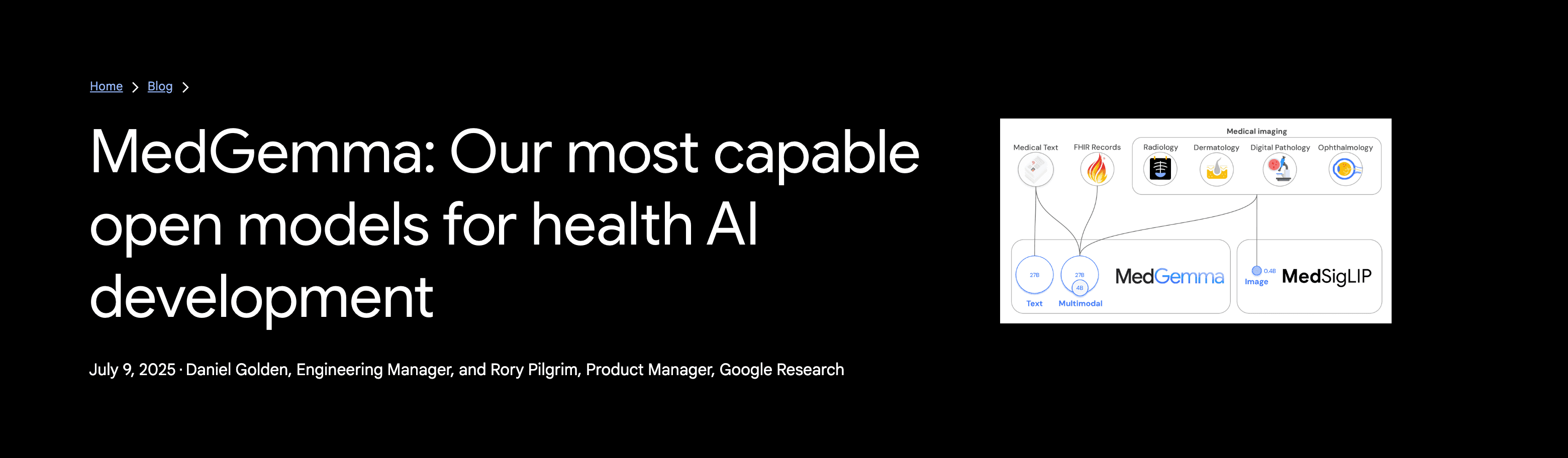
Overview
MedGemma is a collection of Google Health AI Developer Foundations models adapted from Gemma 3 for medical text and image comprehension. It is a developer building block, not a patient-facing chatbot or a ready-to-deploy clinical product. Teams download the weights, deploy them in their own environment or cloud account, and adapt the models to a narrowly defined healthcare use case.
The current collection includes MedGemma 1.5 as a 4B multimodal instruction-tuned model, plus MedGemma 1 variants at 4B and 27B. MedGemma 1.5 improves medical reasoning, medical-record interpretation, lab-report extraction, CT and MRI volume interpretation, whole-slide pathology, longitudinal chest X-rays, and anatomical localization. Google continues to recommend the larger 27B model for more complex text-heavy applications.
The weights are free for research and commercial use under Google's Health AI Developer Foundations terms, but they are open-weight rather than open-source. MedGemma is not clinical-grade out of the box. Developers are responsible for evaluation, adaptation, patient-data protection, regulatory compliance, and independent verification before any real-world medical use.
Use cases
The strongest fit depends on the job you need the product to complete, not the size of its feature list.
Adapt a multimodal model for radiology, dermatology, pathology, ophthalmology, CT, MRI, or longitudinal imaging workflows.
Build and evaluate systems for summarization, structured extraction, patient intake, triage support, or clinical reasoning.
Run open weights on local, edge, air-gapped, or controlled cloud infrastructure when data sovereignty matters.
Fine-tune, prompt, or orchestrate a healthcare-specific base model against an organization's own data and validated task.
Capabilities
A compute-efficient text-and-image model with improvements across medical reasoning, records, documents, and multiple medical imaging modalities.
Larger text-only and multimodal options for workloads where stronger baseline medical text performance justifies higher compute requirements.
MedGemma 1.5 expands adaptation targets to CT and MRI volumes, whole-slide histopathology, longitudinal chest X-rays, and anatomical localization.
Extract structured information from lab reports and interpret text-based EHR data as part of a validated application workflow.
Download the weights from Hugging Face and run them locally, on private infrastructure, or through a cloud deployment selected by the developer.
Adapt the models with prompt engineering, in-context examples, supervised fine-tuning, retrieval, or a larger agentic system.
Use Model Garden presets, managed batch jobs, endpoints, GKE, DICOM and FHIR integrations, and Google Cloud governance controls.
The model cards document support for at least 128K tokens, enabling long medical records and document collections subject to deployment memory.
Process
Step 1
Specify the exact input, output, users, clinical setting, risks, and success criteria before choosing a model.
Step 2
Use MedGemma 1.5 4B for efficient multimodal work or evaluate a 27B MedGemma 1 model for more demanding text and reasoning tasks.
Step 3
Apply prompt engineering, retrieval, fine-tuning, or orchestration using representative, appropriately governed medical data.
Step 4
Measure performance, safety, subgroup behavior, workflow fit, privacy, and regulatory requirements with qualified clinical and technical reviewers.
Cost
Google provides MedGemma weights at no charge for research and commercial use under the HAI-DEF terms. There is no free hosted MedGemma application: users pay for their own local hardware or usage-based cloud compute, storage, networking, and operations.
Free
The current compute-efficient multimodal model, distributed under the HAI-DEF terms.
Free
Larger model options for stronger baseline text performance and selected multimodal workloads.
Infrastructure cost
Run MedGemma on local, private-cloud, edge, or air-gapped infrastructure.
Usage-based
Deploy through Google Cloud or another hosting provider and pay for the underlying infrastructure.
Pricing checked . Check current pricing at the source ↗
Assessment
Compare
The right alternative depends on the specific output, workflow, controls and budget your project requires.
Content Creator
A managed general-purpose Gemini experience when self-hosting and deep healthcare-specific model customization are unnecessary.
Explore Gemini →Healthcare
A clinician-facing product for verified U.S. doctors who need a managed workflow rather than downloadable developer weights.
Explore ChatGPT for Clinicians →Healthcare
A managed healthcare-oriented assistant option for organizations prioritizing an application experience over model infrastructure.
Explore CompliantChatGPT →Questions
MedGemma is Google's collection of open-weight Gemma 3 variants trained for medical text and image comprehension. It is designed as a developer foundation for healthcare AI applications.
The model weights are free for research and commercial use under the Health AI Developer Foundations terms. You still pay for hardware, hosting, adaptation, security, and operations.
No. Google describes HAI-DEF models as open-weight, not open-source. The model weights use the HAI-DEF terms, while accompanying repository code is licensed under Apache 2.0.
MedGemma is not clinical-grade out of the box and should not be used as an unvalidated diagnostic system. Any clinical application requires meaningful adaptation, independent verification, qualified oversight, and applicable regulatory authorization.
MedGemma 1.5 4B is the current compute-efficient multimodal release with expanded medical imaging, records, and document capabilities. MedGemma 1 27B requires much more memory but is generally the stronger baseline for complex text-heavy tasks.
Yes. The weights can run on local or private infrastructure. Google's approximate static weight footprints range from 3.4 to 6.4 GB for 4B and 21 to 46.4 GB for 27B depending on precision, before runtime and context-cache overhead.
Google's HAI-DEF FAQ says MedGemma deployed on Google Cloud processes data within the customer's project and that Google does not access or log patient information or use it to train foundation models. Organizations still remain responsible for configuration, privacy, BAAs, and compliance.
Bottom line
MedGemma is a compelling foundation for teams that have the medical expertise, data governance, infrastructure, and evaluation program required to build a healthcare AI system responsibly. MedGemma 1.5 makes advanced imaging and record tasks more accessible in a 4B model, while the 27B options remain useful for harder text workloads. It is not a shortcut to a deployable clinical product; the real work is adaptation, validation, oversight, and compliance.
Visit MedGemma website ↗
Chai-2 - an AI model capable of creating functional antibodies for drug development
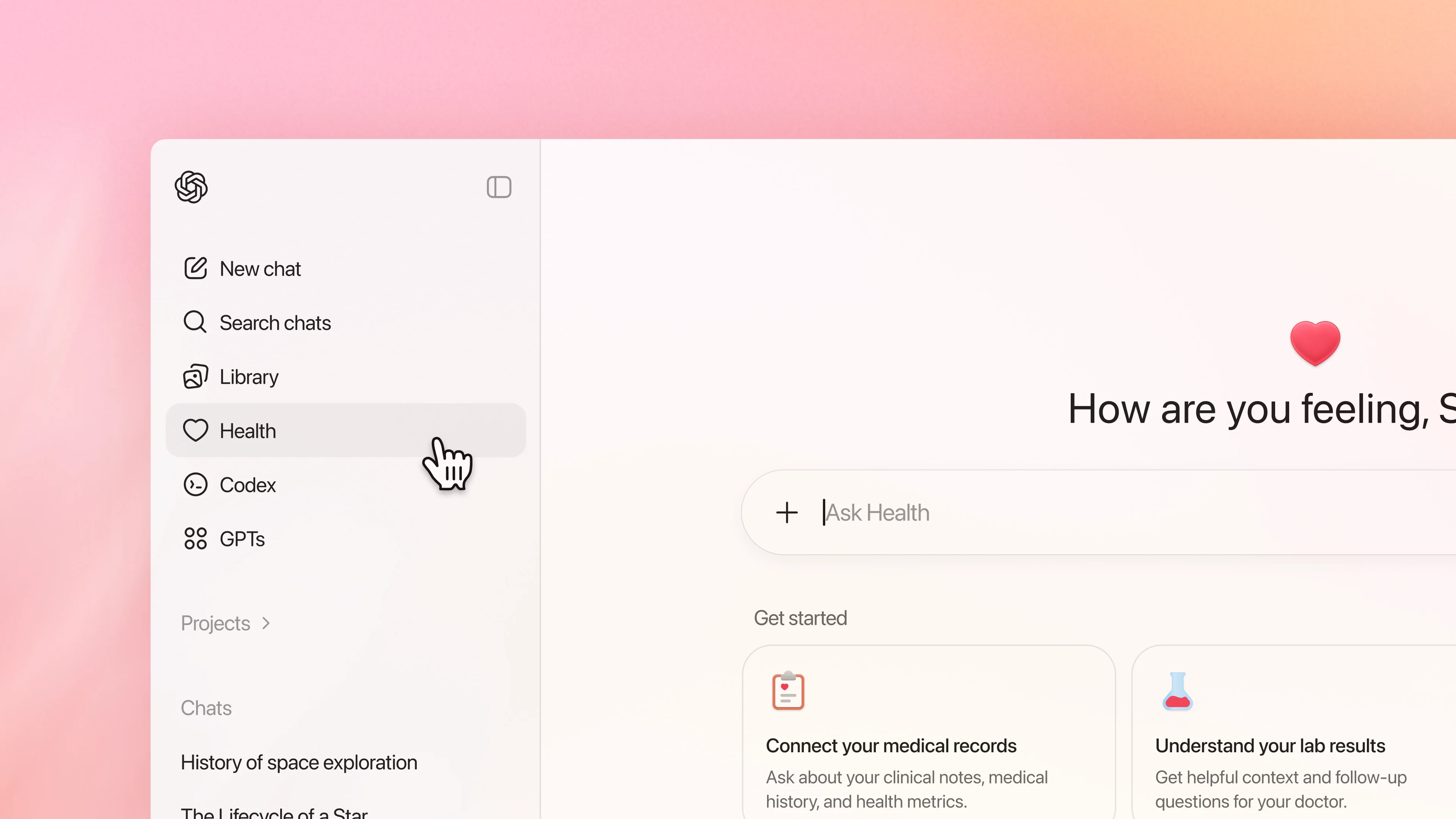
ChatGPT Health - Dedicated, private experience for health conversations within ChatGPT, enabling connecting medical data and wellness apps

Personal AI for mental health tracking and support.

Unleash your culinary creativity with our recipe generator.

Get access to all our AI courses, hundreds of real-world AI use cases, live expert-led workshops, an exclusive network of AI early adopters, and more.
Get unlimited access to all of our current & upcoming industry-specific AI courses for the duration of your subscription.
To keep up with the rapid pace of AI, our team publishes AI implementation guides daily. Our library contains 300+ practical use cases to automate real-world work.
Join weekly, live, interactive sessions with industry leaders who are at the forefront of AI for hands-on implementation guidance and exclusive insights.
Network with an exclusive community of AI-first professionals who are working smarter with AI. Learn how early adopters are using AI in their work and businesses.