Preparing for appointments
Summarize concerns and produce a question list for discussion with a licensed clinician.
Independent tool overview
Health in ChatGPT is a dedicated consumer space for health and wellness conversations, with optional medical-record and app connections, separate memory, and added privacy controls.
Visit the official Health in ChatGPT site ↗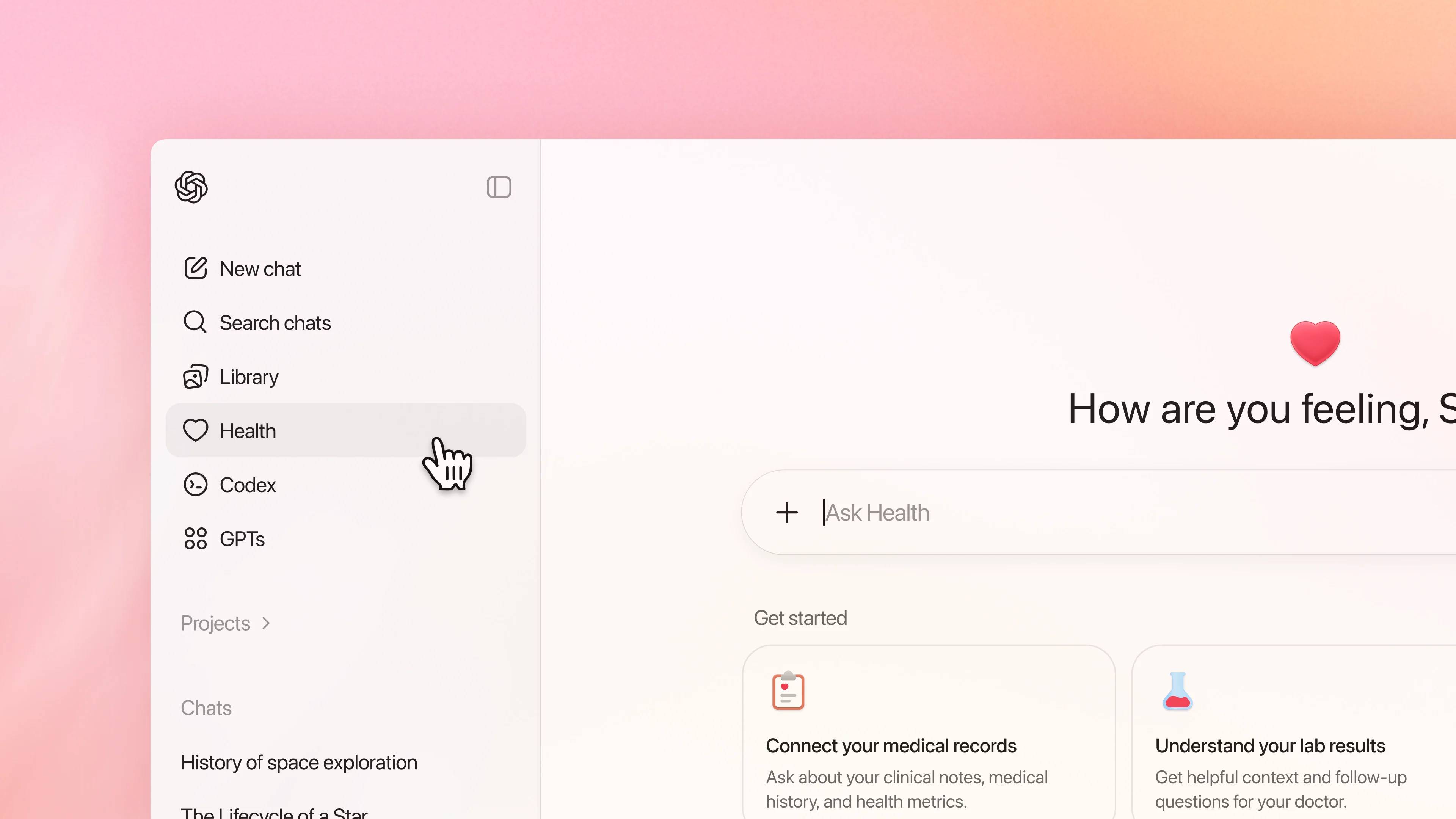
Overview
Health in ChatGPT—launched as ChatGPT Health—is a dedicated space where eligible adults can ask health questions and optionally connect supported medical records, Apple Health, and wellness services. Its chats, files, connected sources, instructions, and health-specific memories are kept inside the Health space rather than flowing back into ordinary ChatGPT conversations.
The product is designed to help people understand information, notice patterns, prepare questions, and navigate care. It is not intended to diagnose or treat disease, and it is not a HIPAA-covered clinical workspace. Urgent symptoms require immediate professional help, while diagnosis, medication, testing, and treatment decisions belong with qualified clinicians who have the full history and can examine the patient.
Use cases
The strongest fit depends on the job you need the product to complete, not the size of its feature list.
Summarize concerns and produce a question list for discussion with a licensed clinician.
Explain unfamiliar terms in lab results, visit summaries, prescriptions, and uploaded documents.
Compare supported records, activity, sleep, workouts, or other connected data over time.
Organize next steps, insurance questions, and information to bring to an appointment.
Discuss realistic diet, exercise, sleep, and habit ideas within clearly stated medical constraints.
Turn dense health information into an easier starting point for a conversation with a professional.
Capabilities
Health conversations, files, apps, and memories are contained in a separate ChatGPT experience.
Eligible U.S. adults can sign in to supported provider portals and sync available records.
iPhone users can authorize selected Apple Health information for contextual conversations.
Supported services can contribute relevant nutrition, activity, lab, or wellness context after separate authorization.
Saved context and prior Health chat history can personalize future answers without making Health memories available to ordinary chats.
Health may use helpful context from main chats, but Health information does not flow back into non-Health conversations.
Users can add supported images and documents for explanation, subject to medical and privacy limitations.
Health supports conversational input through voice mode and dictation.
Current online information can supplement a conversation, but source quality and applicability still require review.
Health-only preferences can specify what to focus on, avoid, or change in response style.
Users can inspect or delete saved Health memories and control memory behavior from Health or Personalization settings.
OpenAI describes layered encryption and isolation for Health data in addition to ChatGPT's baseline protections.
Process
Step 1
Use an eligible U.S. account, open Health from the sidebar, and remember that rollout remains gradual.
Step 2
Enable multi-factor authentication, protect recovery methods, and review active ChatGPT sessions.
Step 3
Ask a de-identified question first and connect records or apps only when the extra context is necessary.
Step 4
Choose the accounts and data sources deliberately, and re-authorize apps specifically for the Health space.
Step 5
Ask for an explanation, trend summary, or appointment questions while giving relevant dates and constraints.
Step 6
Compare names, units, reference ranges, timestamps, medications, and provider notes with the original portal or document.
Step 7
Contact a clinician for diagnosis or treatment and use emergency services for urgent or severe symptoms.
Step 8
Delete chats and memories separately, disconnect records and apps, and verify which imported or referenced data remains.
Cost
Health does not have a separate add-on price. OpenAI currently includes it during a gradual U.S. rollout for eligible Free, Go, Plus, and Pro users. Free is $0, Plus is $20 per month, and Pro is offered at $100 and $200 per month; Go pricing can vary by checkout market.
$0
Eligible U.S. adults can receive Health access as the gradual rollout reaches their account.
Varies by market
Lower-cost paid ChatGPT plan with higher limits than Free for eligible features.
$20/month
Paid individual plan with broader ChatGPT model and tool access.
$100 or $200/month
Higher-usage individual plans that also qualify for Health access.
Pricing checked . Check current pricing at the source ↗
Assessment
Compare
The right alternative depends on the specific output, workflow, controls and budget your project requires.
Healthcare
Choose ChatGPT for Clinicians if you are an eligible verified U.S. clinician who needs cited clinical search and an individual BAA option.
Explore ChatGPT for Clinicians →Healthcare
Choose Docus for a consumer-oriented AI health assistant with a separate medical second-opinion workflow.
Explore Docus →Business Operations
Choose standard ChatGPT for general non-sensitive questions when a dedicated Health memory or connected health data is unnecessary.
Explore ChatGPT →Questions
OpenAI's current help documentation calls the dedicated product Health in ChatGPT. ChatGPT Health remains the familiar launch name.
It is gradually rolling out to logged-in ChatGPT Free, Go, Plus, and Pro users in the United States who are at least 18.
There is no separate Health fee. It is included for eligible U.S. users on Free and supported paid ChatGPT plans as rollout reaches their accounts.
No. OpenAI says Health is designed to support—not replace—medical care and is not intended for diagnosis or treatment.
Eligible U.S. adults can connect records from supported provider systems inside Health. Coverage varies, and the original medical record remains the authoritative source.
Yes, with an iPhone. Users choose the connection and should review which health categories they authorize.
OpenAI says Health chats, files, and memories are not used to train its foundation models.
ChatGPT Health is a consumer product, so OpenAI says HIPAA and BAAs do not apply to it. Covered healthcare organizations should evaluate ChatGPT for Healthcare or another appropriately contracted product.
No. Chats, memories, and connected sources must be managed separately. Disconnect apps or records in Settings, and delete any conversations or memories that already contain referenced information.
OpenAI says Health information and memories do not flow back into ordinary chats. Health may use helpful context from main chats, creating a one-way boundary.
Bottom line
Health in ChatGPT is most useful as an organizer and explainer: it can bring scattered records and wellness context together, surface questions, and help users prepare for care. Its separate data space and no-training policy are meaningful, but it is still a consumer AI product—not a diagnostic service or HIPAA clinical environment. Connect the minimum necessary data, verify every medical detail, and involve a qualified professional in care decisions.
Visit Health in ChatGPT website ↗
Get access to all our AI courses, hundreds of real-world AI use cases, live expert-led workshops, an exclusive network of AI early adopters, and more.
Get unlimited access to all of our current & upcoming industry-specific AI courses for the duration of your subscription.
To keep up with the rapid pace of AI, our team publishes AI implementation guides daily. Our library contains 300+ practical use cases to automate real-world work.
Join weekly, live, interactive sessions with industry leaders who are at the forefront of AI for hands-on implementation guidance and exclusive insights.
Network with an exclusive community of AI-first professionals who are working smarter with AI. Learn how early adopters are using AI in their work and businesses.


