Evidence review at the point of care
Find cited studies, public-health guidance, and clinical guidelines for a clinician to inspect.
Independent tool overview
ChatGPT for Clinicians is OpenAI's free, clinician-focused ChatGPT workspace for verified U.S. physicians, nurse practitioners, physician assistants, and pharmacists.
Visit the official ChatGPT for Clinicians site ↗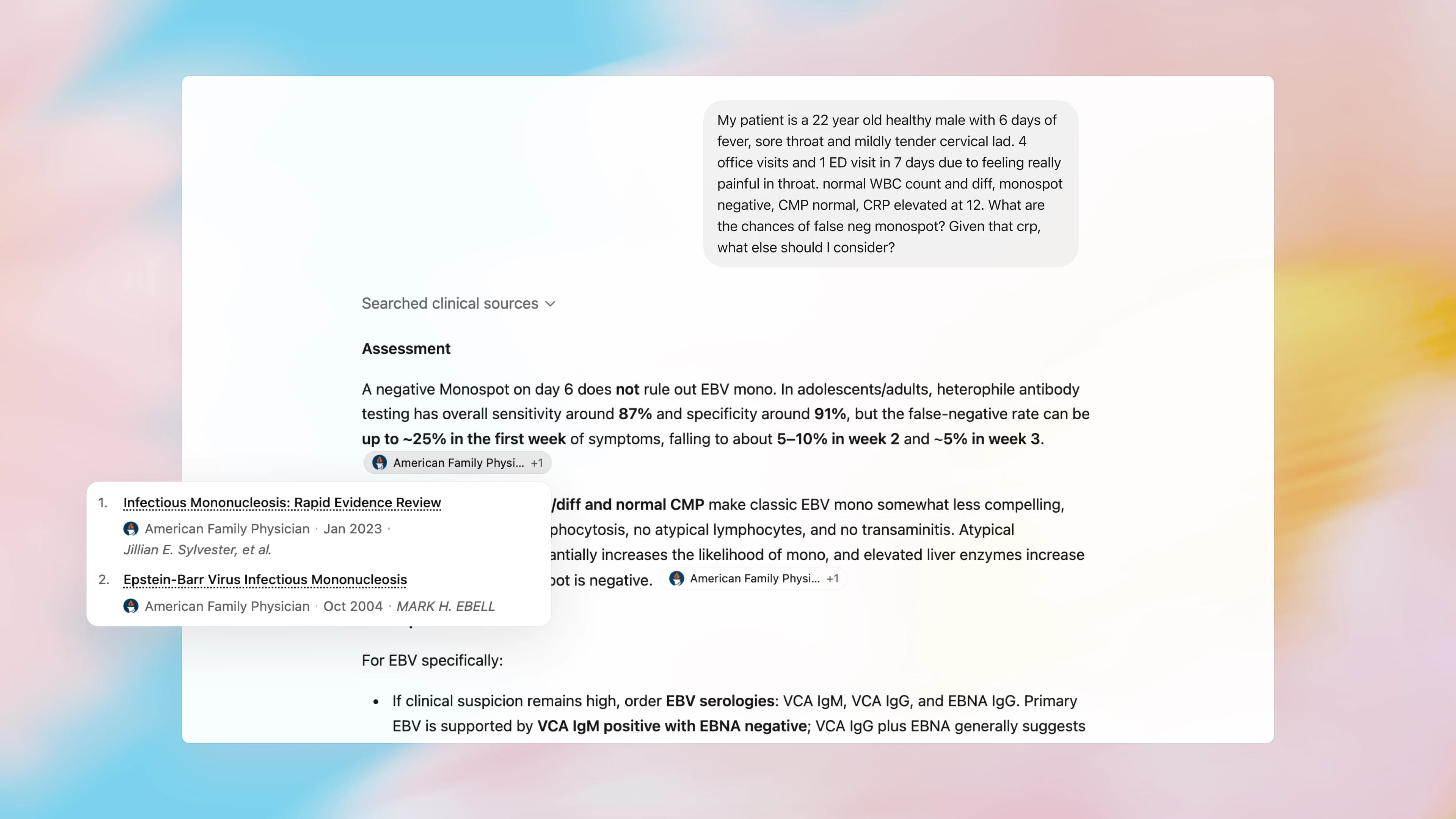
Overview
ChatGPT for Clinicians is a self-serve workspace designed for individual U.S. clinicians. It combines ChatGPT's advanced models with trusted clinical search, cited medical evidence, deep research, reusable clinical skills, documentation support, and CME credit for eligible questions. Enrollment requires a ChatGPT account, a valid NPI, and license verification through a third-party provider.
The product is an evidence and workflow assistant, not an independent decision-maker. Clinicians remain responsible for diagnosis, treatment, documentation, source review, and patient safety. Protected health information should only be entered after an eligible user has signed the in-product Business Associate Agreement and confirmed that the intended workflow, feature, and any third-party connection are covered.
Use cases
The strongest fit depends on the job you need the product to complete, not the size of its feature list.
Find cited studies, public-health guidance, and clinical guidelines for a clinician to inspect.
Build deeper, cited reviews across journals while letting the clinician steer sources and scope.
Prepare first drafts of notes, referrals, prior-authorization letters, and patient instructions for review.
Structure possibilities, missing information, and evidence without delegating the final clinical judgment.
Translate approved medical information into plain-language explanations that a clinician can correct and personalize.
Give an eligible practitioner a dedicated workspace without waiting for an organization-wide deployment.
Capabilities
Free access to OpenAI's current frontier models for clinical questions, research, and documentation workflows.
Retrieves current evidence from peer-reviewed research, public-health sources, and clinical guidelines.
Responses can include titles, journals, authors, and publication dates so the clinician can open and verify the evidence.
Produces longer cited literature reviews for questions that require synthesis across multiple sources.
Pre-built skills help repeat common workflows such as referral letters, prior authorizations, and patient instructions.
Guided prompts provide a structured starting point for common clinical and administrative tasks.
Drafts notes and communications that remain subject to clinician correction, approval, and the medical record's requirements.
Eligible evidence-review questions can count toward continuing medical education credit under the current program rules.
The clinician workspace appears alongside the user's existing ChatGPT workspace and can be selected from the account switcher.
Supports custom GPTs, projects, memory, and canvas within the clinician-focused environment.
Apps can bring outside information into workflows, subject to their permissions, agreements, and privacy practices.
Eligible clinicians can review and sign a Business Associate Agreement from the workspace's Agreements settings.
Process
Step 1
Sign in with a ChatGPT account and complete NPI and professional-license verification.
Step 2
Use de-identified information by default; before any PHI, confirm authorization and sign the applicable BAA.
Step 3
State the setting, population, question, dates, exclusions, and desired evidence type without adding unnecessary identifiers.
Step 4
Request guideline dates, study design, population, outcomes, limitations, and direct source links.
Step 5
Open citations and verify that they exist, support the claim, apply to the patient, and have not been superseded.
Step 6
Check medications, allergies, comorbidities, contraindications, local protocols, and information the model did not receive.
Step 7
Correct facts, clinical reasoning, coding, tone, and patient-specific instructions before signing or sharing.
Step 8
Record the clinician's decision and validated evidence according to organizational and professional requirements.
Cost
OpenAI says ChatGPT for Clinicians is free at launch for verified individual clinicians in the United States. A ChatGPT account, valid NPI, and verifiable license are required. Organization-wide ChatGPT for Healthcare is a separate enterprise product with custom pricing.
Free
Self-serve clinician workspace for eligible verified U.S. individuals.
Pricing checked . Check current pricing at the source ↗
Assessment
Compare
The right alternative depends on the specific output, workflow, controls and budget your project requires.
Healthcare
Choose ChatGPT Health for a dedicated consumer health experience rather than a verified-clinician workspace.
Explore Health in ChatGPT →Business Operations
Choose standard ChatGPT for general, non-PHI work when clinician-specific search, CME, and an individual BAA are unnecessary.
Explore ChatGPT →Healthcare
Choose Docus for a consumer-oriented AI health assistant and access to medical second-opinion workflows.
Explore Docus →Questions
It is a dedicated version of ChatGPT for verified individual U.S. clinicians, with clinical search, citations, deep research, documentation tools, reusable skills, and CME support.
At launch, eligible users are verified U.S. physicians (MD or DO), nurse practitioners, physician assistants, and pharmacists with a valid NPI and verifiable license.
OpenAI currently offers it free to eligible verified U.S. clinicians.
OpenAI lists it as a HIPAA-eligible product when used under an applicable BAA and configured according to that agreement. A product alone does not make every workflow compliant; the clinician and organization must meet their own privacy, security, authorization, and minimum-necessary obligations.
Do not enter PHI unless an applicable BAA is in place and you are authorized to do so. OpenAI says eligible individual clinicians can sign a BAA in Settings under Agreements.
OpenAI says content shared in ChatGPT for Clinicians is not used to train its models.
It can answer clinical questions using peer-reviewed studies, public-health guidance, and clinical guidelines, with citations that clinicians can open and independently verify.
No. It is intended to support evidence review, reasoning, research, and documentation. The licensed clinician remains responsible for all care decisions and should verify the output against the patient record and authoritative sources.
ChatGPT for Clinicians is a self-serve workspace for eligible individuals. ChatGPT for Healthcare is the enterprise option for organizations needing centralized controls, company data connections, governance, and multi-user BAA coverage.
Not through the general launch program. OpenAI says it plans to expand access and begin pilots outside the United States as local regulations permit.
Bottom line
ChatGPT for Clinicians is a compelling free evidence and documentation assistant for eligible U.S. practitioners, particularly because it combines cited clinical search, deeper literature review, reusable workflows, and an individual BAA path. The safeguards are operational, not magical: clinicians must minimize PHI, verify every consequential claim at the source, correct all documentation, and retain full responsibility for patient care.
Visit ChatGPT for Clinicians website ↗
Get access to all our AI courses, hundreds of real-world AI use cases, live expert-led workshops, an exclusive network of AI early adopters, and more.
Get unlimited access to all of our current & upcoming industry-specific AI courses for the duration of your subscription.
To keep up with the rapid pace of AI, our team publishes AI implementation guides daily. Our library contains 300+ practical use cases to automate real-world work.
Join weekly, live, interactive sessions with industry leaders who are at the forefront of AI for hands-on implementation guidance and exclusive insights.
Network with an exclusive community of AI-first professionals who are working smarter with AI. Learn how early adopters are using AI in their work and businesses.


