Coding-agent experiments
Teams can pair M2.5 with a sandbox and tool harness to test repository analysis, code changes, and multi-step debugging workflows.
Independent tool overview
MiniMax M2.5 is a prior-generation but still available open-weight language model built for coding, tool use, search, and document-heavy agent workflows.
Visit the official M2.5 site ↗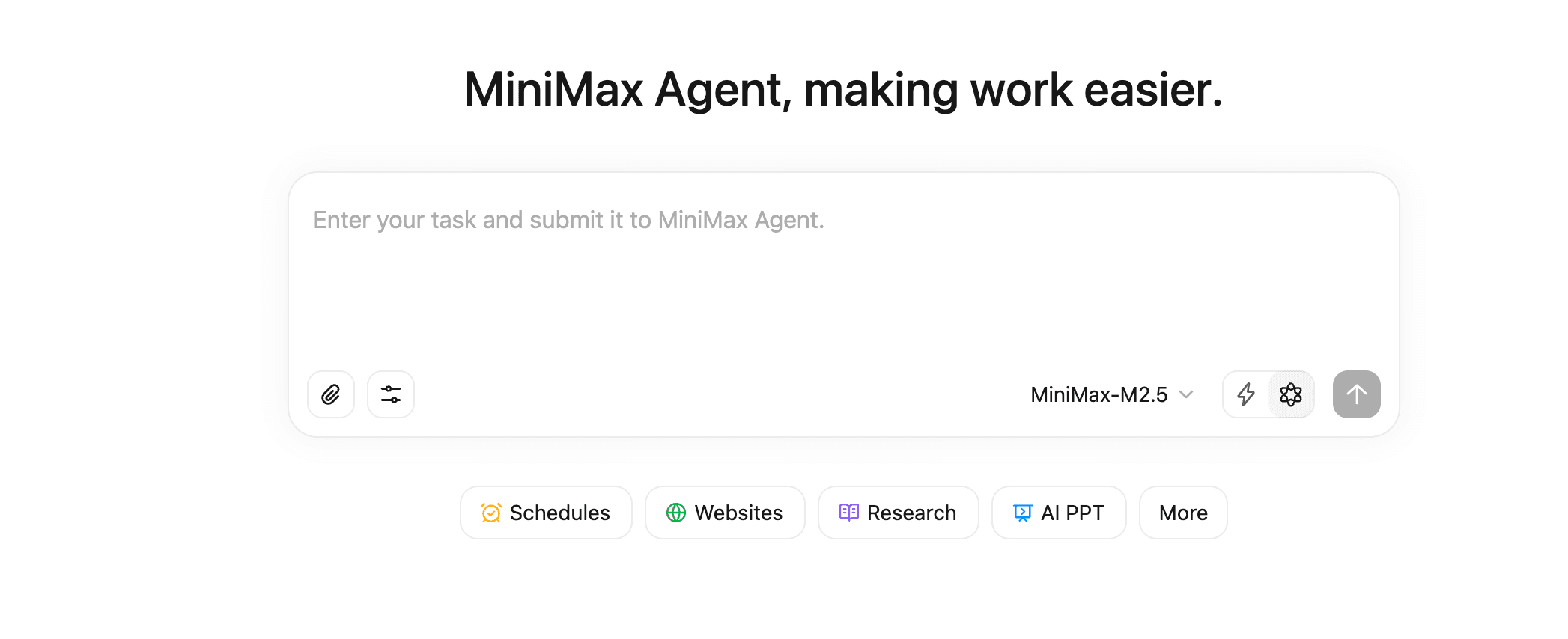
Overview
MiniMax M2.5 is a reasoning-focused text model designed for coding and multi-step agent work. It can generate and refactor code, call tools, search through an agent harness, and help create or manipulate office documents when the surrounding application gives it the required tools. MiniMax distributes the model weights and also serves M2.5 through its API in standard and high-speed variants.
M2.5 is no longer MiniMax's newest model: the API now places it in the legacy-model section behind M2.7 and M3. It remains useful for teams that already depend on it, want reproducible open-weight deployment, or need a relatively inexpensive model for agent experiments. New projects should benchmark it against MiniMax's current models and other open-weight coding models before standardizing on it.
Use cases
The strongest fit depends on the job you need the product to complete, not the size of its feature list.
Teams can pair M2.5 with a sandbox and tool harness to test repository analysis, code changes, and multi-step debugging workflows.
The standard API has low token prices for an agent-oriented reasoning model, especially when prompts can reuse cached context.
Organizations that need control over hosting can download the weights and serve them with supported inference frameworks.
The hosted model supports a large shared input-and-output context for workflows that need substantial code, logs, or documents.
Teams already using its API behavior can keep a stable model target while evaluating migration to newer MiniMax releases.
Capabilities
M2.5 is trained for planning, code generation, refactoring, testing, and multi-step software tasks across several programming languages.
The MiniMax text API accepts tool definitions and supports model-selected function calls for agent workflows.
The model can reason between tool calls, letting an agent inspect results and adjust its next action.
MiniMax documents a 204,800-token combined context window for the hosted M2.5 and M2.5-highspeed endpoints.
The two hosted variants use the same model capability, with the high-speed endpoint trading higher token prices for faster generation.
The API offers separate cache-read and cache-write pricing, which can reduce repeated-context costs when implemented carefully.
MiniMax publishes M2.5 weights on Hugging Face under a modified MIT model license for local or private deployment.
Official deployment guidance covers SGLang, vLLM, Transformers, KTransformers, and ModelScope.
MiniMax positions the model for software work, search, and agent-assisted Word, spreadsheet, and presentation tasks when connected to suitable tools.
Process
Step 1
Use the MiniMax API for fast adoption or download the weights when infrastructure control matters more than setup simplicity.
Step 2
Give the model a clear objective, acceptance criteria, relevant context, and explicit limits on files, systems, or actions.
Step 3
Expose narrowly scoped functions for code, search, files, or business systems instead of unrestricted credentials and shell access.
Step 4
Execute generated code and agent actions in a sandbox with network, secret, and write controls appropriate to the risk.
Step 5
Review diffs, run tests, validate cited sources, and compare the final artifact with the original requirements before accepting it.
Step 6
Measure quality, latency, token use, and failure rate against M2.7, M3, or another candidate before committing to M2.5 for new production work.
Cost
M2.5 remains available through MiniMax's pay-as-you-go API and as downloadable weights. The hosted model is now priced and labeled as a legacy option; infrastructure and engineering costs apply to self-hosting.
$0.30 input / $1.20 output per 1M tokens
The standard hosted endpoint, documented at approximately 60 output tokens per second.
$0.60 input / $2.40 output per 1M tokens
A faster hosted variant with the same stated model performance and roughly 100 output tokens per second.
No per-token model fee
Downloadable model weights for teams prepared to operate large-model inference infrastructure.
Pricing checked . Check current pricing at the source ↗
Assessment
Compare
The right alternative depends on the specific output, workflow, controls and budget your project requires.
Consumer
MiniMax's newer M2-series model is the most direct migration path for teams that want updated agent and coding performance.
Explore Minimax M2.7 →Coding
A much smaller open-weight coding model to evaluate when deployment footprint and local serving practicality matter.
Explore Qwen3.6-27B →Agents
Another open agent-focused model family for teams comparing tool use, coding quality, and hosting options.
Explore Kimi K2.5 →Business Operations
A broad open-model ecosystem with chat and API access for developers comparing cost and reasoning capability.
Explore DeepSeek →Questions
MiniMax M2.5 is an open-weight text model released in February 2026 for coding, tool use, search, reasoning, and agent-assisted office work. It is available through MiniMax's API and as downloadable weights.
Yes. MiniMax still lists M2.5 and M2.5-highspeed as supported text API models and publishes the weights. However, its pricing page now classifies M2.5 as a legacy model behind newer releases.
The model weights and deployment materials are publicly downloadable. MiniMax labels the model license Modified MIT, so it is better described as open-weight and users should read the exact license terms before deployment.
As of August 30, 2026, the standard endpoint costs $0.30 per million input tokens and $1.20 per million output tokens. The high-speed endpoint costs $0.60 input and $2.40 output per million tokens, with separate cache pricing.
MiniMax's current API overview lists a 204,800-token combined input-and-output context window for both M2.5 endpoints. Self-hosted limits can depend on the serving configuration and available memory.
Yes, but it is not a typical laptop-scale model. The roughly 230B-parameter checkpoint requires substantial storage and accelerator resources; official guidance focuses on frameworks such as SGLang and vLLM.
It is designed for coding agents, but no language model should receive unrestricted production access. Use a sandbox, narrow permissions, automated tests, human review, and a rollback path.
Treat M2.5 as a strong legacy candidate, not the automatic default. Run representative evaluations against M2.7, M3, and other current models using the same harness, tools, prompts, and cost accounting.
Bottom line
MiniMax M2.5 remains a credible low-cost, open-weight model for coding and agent research, especially for existing integrations or teams that need deployment control. Because MiniMax now treats it as a legacy API model, new production projects should use it as a benchmark candidate and choose only after testing newer alternatives on real tasks.
Visit M2.5 website ↗
Orchids 1.0 - AI app builder for any stack with BYO model subscriptions

GPT 5.3 Codex Spark - OpenAI’s ultra-fast model for real-time coding
Oz - Warp's cloud platform for orchestrating hundreds of coding agents in parallel
Rork Max - Rork's AI-powered native iOS app builder for every Apple platform

Get access to all our AI courses, hundreds of real-world AI use cases, live expert-led workshops, an exclusive network of AI early adopters, and more.
Get unlimited access to all of our current & upcoming industry-specific AI courses for the duration of your subscription.
To keep up with the rapid pace of AI, our team publishes AI implementation guides daily. Our library contains 300+ practical use cases to automate real-world work.
Join weekly, live, interactive sessions with industry leaders who are at the forefront of AI for hands-on implementation guidance and exclusive insights.
Network with an exclusive community of AI-first professionals who are working smarter with AI. Learn how early adopters are using AI in their work and businesses.