Self-hosted coding agents
Teams can connect the model to repository, terminal, and test tools while retaining control over the weights and inference environment.
Independent tool overview
Qwen3.6-27B is a 27-billion-parameter open-weight vision-language model built for agentic coding, repository work, reasoning, and long-context multimodal tasks.
Visit the official Qwen3.6-27B site ↗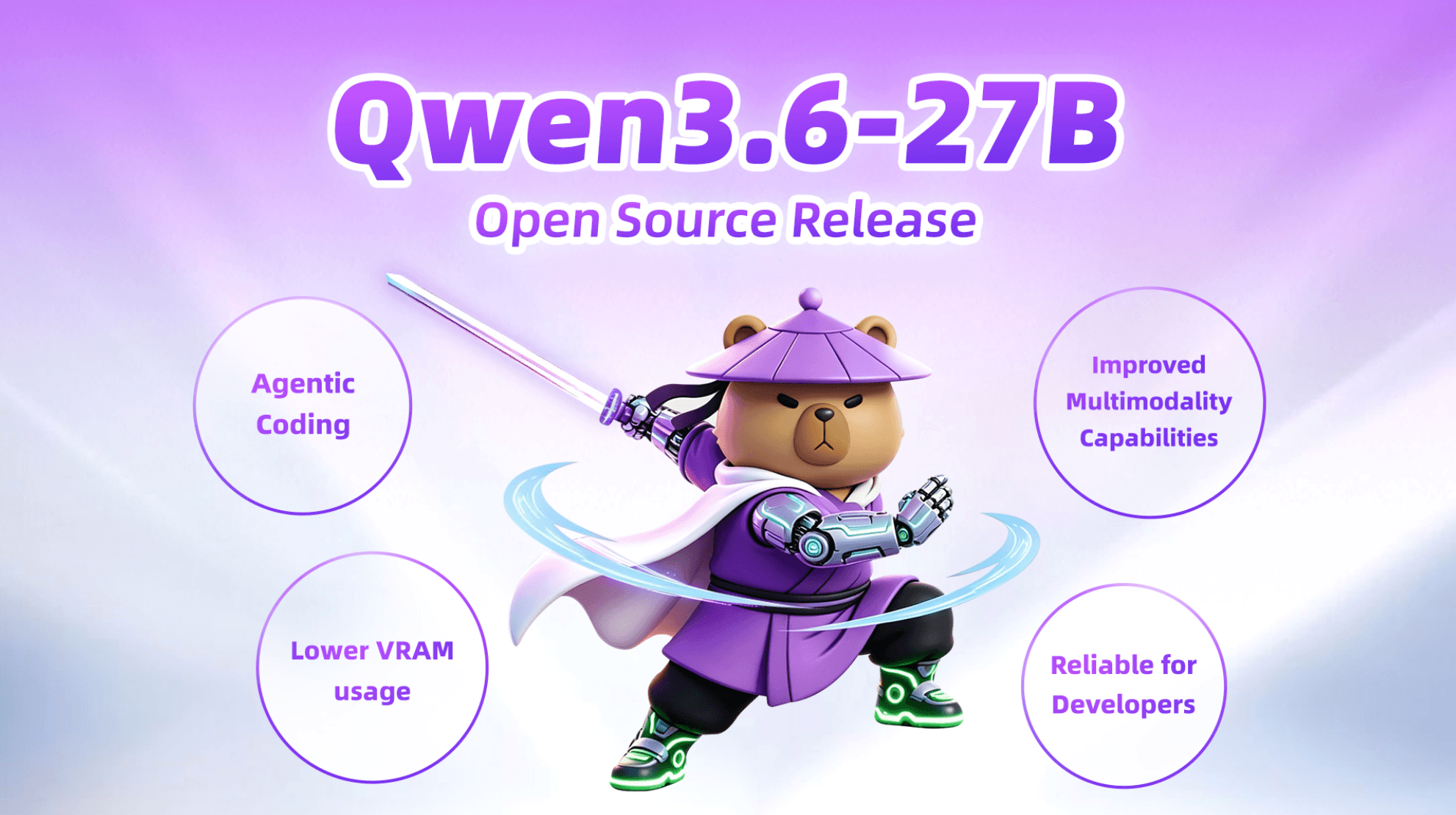
Overview
Qwen3.6-27B is a dense open-weight model from Alibaba's Qwen team. Although coding is its headline use case, it is not text-only: the model includes a vision encoder and can work with images, documents, and video frames alongside text. It supports thinking and non-thinking modes, tool calling, and a native 262,144-token context window, with an officially documented extension method up to roughly one million tokens.
The model is available as Apache 2.0 weights on Hugging Face and ModelScope, through Alibaba Cloud Model Studio's hosted API, and in Qwen Studio. Its 27B size is far more approachable than very large mixture-of-experts releases, but production self-hosting still requires serious accelerator memory and serving expertise—especially for vision inputs or the full context window.
Use cases
The strongest fit depends on the job you need the product to complete, not the size of its feature list.
Teams can connect the model to repository, terminal, and test tools while retaining control over the weights and inference environment.
The release is tuned for multi-file reasoning, frontend work, debugging, and iterative software tasks rather than isolated autocomplete alone.
The vision encoder lets a coding workflow inspect screenshots, diagrams, UI references, documents, or other visual inputs.
Thinking preservation can retain prior reasoning traces across turns to reduce repeated work in supported agent configurations.
Apache 2.0 weights and multiple supported serving engines make it practical to benchmark, adapt, and operate the model under your own controls.
Capabilities
Qwen highlights repository reasoning, frontend generation, tool use, and multi-step development as the core improvements in this release.
A built-in vision encoder enables analysis of images, documents, interface screenshots, diagrams, and sampled video content.
Developers can choose deeper reasoning for difficult tasks or direct answers when latency and token use matter more.
An optional preserve_thinking setting lets supported deployments retain reasoning context from earlier messages in an agent session.
Official examples cover function use through Qwen-Agent, MCP configurations, Alibaba Cloud APIs, vLLM, and SGLang.
The weights support 262,144 tokens natively and document an extension path up to 1,010,000 tokens, subject to memory and quality tradeoffs.
vLLM can skip the vision encoder to reserve more memory for text workloads and KV cache.
Both self-hosted examples and Model Studio support familiar chat-completions-style integrations.
The official model card documents Transformers, vLLM, SGLang, and KTransformers compatibility.
The Apache 2.0 license is straightforward for many research and commercial deployment scenarios.
Process
Step 1
Start with Model Studio for fast evaluation or deploy the weights when data control, customization, or infrastructure ownership is central.
Step 2
Use the shortest context that completes the task; very long contexts sharply increase memory, latency, and token costs.
Step 3
Enable thinking for difficult reasoning and agent work, and test non-thinking mode for simpler, latency-sensitive steps.
Step 4
Expose only the repository, terminal, browser, or application actions the task needs, with scoped credentials and explicit write boundaries.
Step 5
Capture tool calls, token use, latency, errors, and file changes so failed agent trajectories can be diagnosed and compared.
Step 6
Review diffs, run tests and security checks, validate visual output, and require human approval for consequential actions.
Cost
The model weights carry no per-token license fee. Alibaba Cloud Model Studio offers pay-as-you-go inference with region-specific pricing; the figures below use the international Singapore endpoint shown in current documentation.
Free to download
Apache 2.0 model weights for self-hosted inference and permitted adaptation.
$0.60 input / $3.60 output per 1M tokens
International pricing for qwen3.6-27b in Singapore, for requests up to 256K input tokens.
1M tokens
A model-specific introductory quota currently listed for eligible Model Studio users in Singapore.
Pricing checked . Check current pricing at the source ↗
Assessment
Compare
The right alternative depends on the specific output, workflow, controls and budget your project requires.
Consumer
Qwen's newer hosted flagship is the closer fit when maximum current capability matters more than downloadable weights.
Explore Qwen3.7-Max →Consumer
Google's open-weight model family offers multiple sizes for teams comparing deployment footprint, reasoning, and agent use.
Explore Gemma 4 →Coding
A newer open coding model candidate for long-context engineering workflows and model-to-model evaluation.
Explore GLM 5.2 →Consumer
An open-weight alternative aimed at long context and computer-use workflows when a larger model is acceptable.
Explore MiniMax M3 →Questions
Qwen3.6-27B is a 27-billion-parameter dense vision-language model released by Alibaba's Qwen team in April 2026. It is optimized for coding agents, repository reasoning, tool use, and multimodal tasks.
The model weights and code-facing artifacts are publicly available under Apache 2.0. Open-weight is the most precise description because access to training data and the full training process is not the same as access to the released weights.
Yes. The model includes a vision encoder and the official materials evaluate image, document, spatial, video, and visual-agent capabilities in addition to text and coding.
The model card lists 262,144 tokens natively and an extension method up to 1,010,000 tokens. Available memory, serving configuration, and the hosted endpoint can impose practical limits.
As of August 30, 2026, Alibaba Cloud lists international Singapore pricing at $0.60 per million input tokens and $3.60 per million output tokens for requests up to 256K input tokens. Check the selected region before estimating costs.
Yes, but full-precision and long-context serving is infrastructure-heavy. The official examples use SGLang or vLLM with tensor parallelism across multiple GPUs; quantization and shorter context can reduce requirements with tradeoffs.
It retains reasoning traces from earlier messages so an agent can reuse prior work across turns. This can improve continuity and caching, but it can also carry an earlier mistake forward, so evaluations should test both settings.
Not without controls. Use an isolated workspace, minimal tool permissions, secret protection, test gates, change review, and explicit approval before production writes, deployments, or other consequential actions.
Bottom line
Qwen3.6-27B is a compelling open-weight choice for teams that want coding-agent strength, vision input, long context, and a permissive license in a model smaller than many frontier releases. Its real value depends on disciplined evaluation: hardware costs, long-context behavior, multimodal errors, and agent safety can matter more than headline benchmark scores.
Visit Qwen3.6-27B website ↗
Windsurf 2.0 - Windsurf's updated agentic IDE with a new command center and embedded Devin cloud agent

Claude Security - Anthropic's code vulnerability scanner with scheduled scans, patches, and Jira/Slack export, now in public beta

SWE-1.6 - Cognition's updated coding model for Windsurf optimized for speed (950 tok/s) and smoother agent UX

Composer 2.5 - Cursor's upgraded in-house coding model for longer agent sessions and more reliable behavior

Get access to all our AI courses, hundreds of real-world AI use cases, live expert-led workshops, an exclusive network of AI early adopters, and more.
Get unlimited access to all of our current & upcoming industry-specific AI courses for the duration of your subscription.
To keep up with the rapid pace of AI, our team publishes AI implementation guides daily. Our library contains 300+ practical use cases to automate real-world work.
Join weekly, live, interactive sessions with industry leaders who are at the forefront of AI for hands-on implementation guidance and exclusive insights.
Network with an exclusive community of AI-first professionals who are working smarter with AI. Learn how early adopters are using AI in their work and businesses.