Fashion and editorial concepts
Soul 2.0 is explicitly tuned for art-directed composition, styling, contemporary references, and magazine-like visual treatment.
Independent tool overview
Higgsfield Soul 2.0 is an AI image model built for photorealistic, fashion-aware visuals, with character consistency, reference tools, and curated aesthetic presets.
Visit the official Higgsfield Soul 2.0 site ↗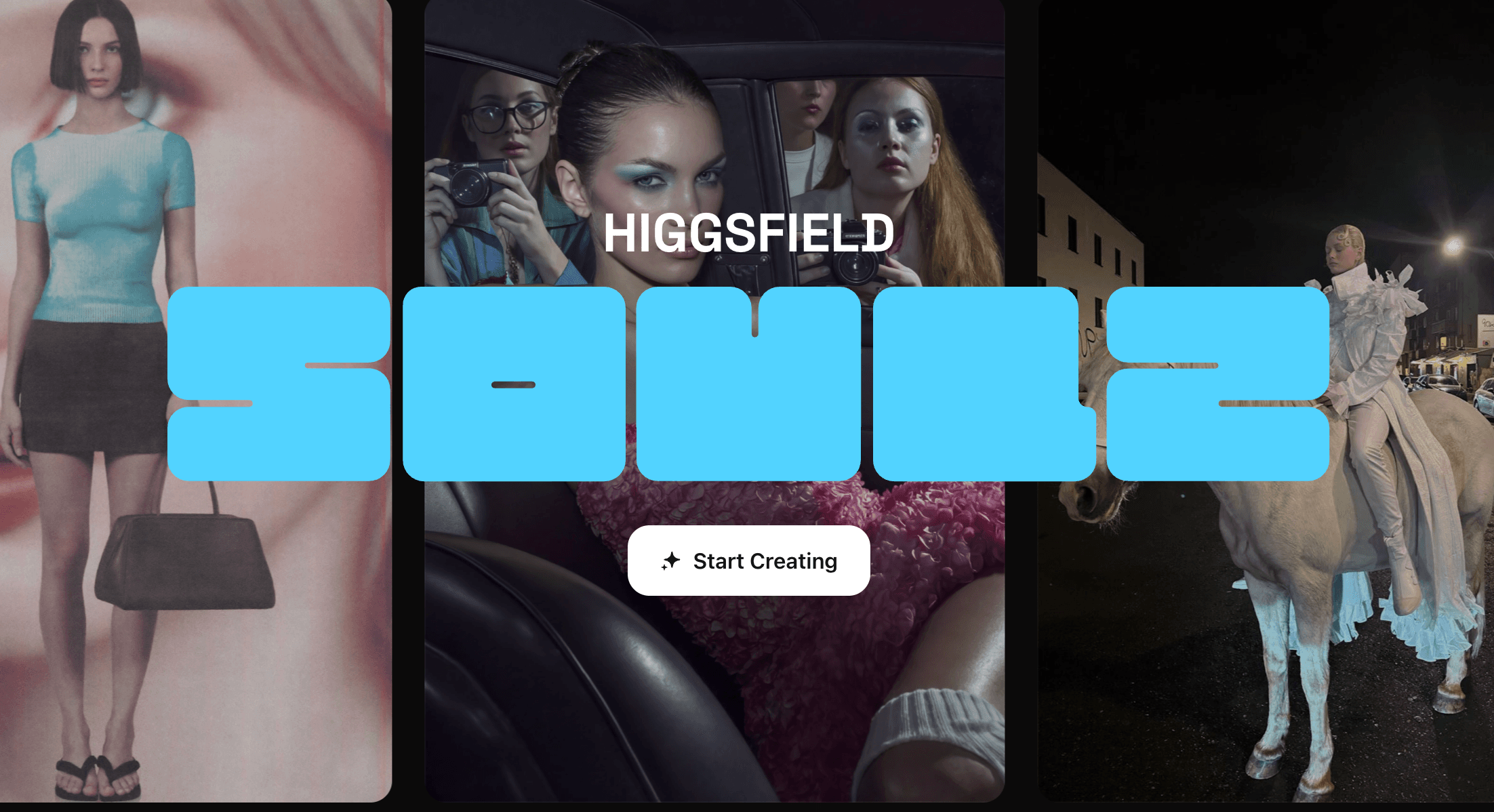
Overview
Higgsfield Soul 2.0 is the company's foundation image model for creators who want polished, culture-aware visuals without building every look from a long technical prompt. It supports generation from text or a reference image and emphasizes realistic texture, spontaneous posing, editorial composition, and contemporary styling.
The model sits inside the broader Higgsfield creative platform. Soul ID is its main consistency feature: a user trains a reusable identity from reference photos, then generates that character across different scenes, poses, lighting setups, and visual styles. Higgsfield says training requires at least 20 photos and takes about three minutes.
Soul 2.0 also includes tools for extracting a reference image's color palette, turning references into a focused moodboard, and applying more than 20 curated presets. The strongest fit is visual ideation and campaign production where a recognizable aesthetic or consistent person matters as much as literal prompt adherence.
Use cases
The strongest fit depends on the job you need the product to complete, not the size of its feature list.
Soul 2.0 is explicitly tuned for art-directed composition, styling, contemporary references, and magazine-like visual treatment.
Soul ID can preserve a trained person's identity across recurring portraits, social posts, personal-brand visuals, and campaign scenes.
Presets and fast variations can help teams explore several campaign directions, product-drop looks, or ad concepts before production.
Reference-image, HEX, and Moodboard tools support early-stage exploration of palette, tone, and creative direction.
Capabilities
Start from a written prompt or use an existing image to guide style and composition while retaining Soul 2.0's realism and aesthetic treatment.
Train a reusable character identity from at least 20 photos, then keep that identity consistent across new scenes, styles, poses, and lighting.
Upload a reference image and carry its color palette into a newly generated visual with a different subject or style.
Turn a collection of references into a more focused moodboard for defining creative tone and visual direction.
More than 20 launch presets cover looks such as editorial street style, old smartphone, theatrical light, Y2K, and warm ambient.
Higgsfield says the model understands fashion vocabulary, online slang, and contemporary cultural references used in creative briefs.
Process
Step 1
Begin with a prompt, upload a visual reference, or select a trained Soul ID when the same person must appear across outputs.
Step 2
Describe the subject and scene, then choose a preset or use HEX and Moodboard references to anchor palette and tone.
Step 3
Create multiple interpretations and compare composition, expression, styling, texture, and identity consistency.
Step 4
Adjust the prompt or references, change the preset, and regenerate details that do not support the brief.
Step 5
Use the selected result as a finished asset or move it into a campaign, social, image-editing, or video workflow.
Cost
Higgsfield uses subscriptions and credits across its image and video platform. An official July 2026 comparison lists Basic at $9/month, Plus at $49/month, and Ultra at $129/month; a limited free tier is also available. Generation cost varies by model and settings, and subscription credits do not roll over.
$0
A limited way to explore a subset of the platform before choosing a paid subscription.
$9 per month
The entry individual plan listed by Higgsfield in its July 2026 pricing comparison.
$49 per month
A higher-capacity individual plan for creators producing more image and video work.
$129 per month
A high-volume individual plan; business Team, Scale, and Enterprise plans are separate.
Pricing checked . Check current pricing at the source ↗
Assessment
Compare
The right alternative depends on the specific output, workflow, controls and budget your project requires.
Content Creator
Choose Midjourney for broad prompt-driven image exploration and a large ecosystem of visual styles.
Explore Midjourney →Content Creator
Choose Krea for an integrated real-time image workflow with generation, enhancement, and creative iteration tools.
Explore Krea →Design
Choose Recraft V4.1 when design taste, typography, illustration, and production-oriented visual outputs are the priority.
Explore Recraft V4.1 →Questions
Soul 2.0 is Higgsfield's foundation image model for realistic, fashion-aware, culture-aware visual generation from text prompts or reference images.
Soul ID is Higgsfield's character-consistency system. You train an identity from reference photos and reuse it across different scenes, styles, poses, and lighting setups.
Higgsfield says Soul ID requires a minimum of 20 photos and that training takes about three minutes. Input quality and variety can affect the usefulness of the identity.
Yes. Soul 2.0 supports both text-to-image generation and image-reference workflows, including palette and moodboard features.
Higgsfield's Soul page says generated images are available for commercial use. Teams should still review the current terms, plan rights, source-material permissions, and likeness consent for each project.
Bottom line
Higgsfield Soul 2.0 is most compelling when the brief calls for contemporary photographic taste and repeatable character identity, not merely a one-off generated image. Soul ID, presets, HEX, and Moodboard create a practical system for campaign exploration. The tradeoff is a credit-based platform where iteration volume matters, and identity-led work requires careful source-photo quality, consent, and human review.
Visit Higgsfield Soul 2.0 website ↗
Replit Animation - Create professional animated videos from text prompts with Replit's Agent
Nano Banana 2 - Google's new No.1 ranked AI image model at Flash speed and pricing
Audiobooks - ElevenLab's full production suite powered by AI-generated narration for authors to streamline audiobook creation and distribution.

LTX-2.3 - Lightricks' open-source video engine upgrade with sharper detail, native vertical, and cleaner audio

Get access to all our AI courses, hundreds of real-world AI use cases, live expert-led workshops, an exclusive network of AI early adopters, and more.
Get unlimited access to all of our current & upcoming industry-specific AI courses for the duration of your subscription.
To keep up with the rapid pace of AI, our team publishes AI implementation guides daily. Our library contains 300+ practical use cases to automate real-world work.
Join weekly, live, interactive sessions with industry leaders who are at the forefront of AI for hands-on implementation guidance and exclusive insights.
Network with an exclusive community of AI-first professionals who are working smarter with AI. Learn how early adopters are using AI in their work and businesses.