Local video-generation pipelines
Run, modify, and extend an audio-video model on owned infrastructure with available weights and workflows.
Independent tool overview
LTX-2.3 is Lightricks' open-weight multimodal video model for generating and editing synchronized video and audio locally or through an API, with native portrait, up to 4K API output, HDR, and production controls.
Visit the official LTX-2.3 site ↗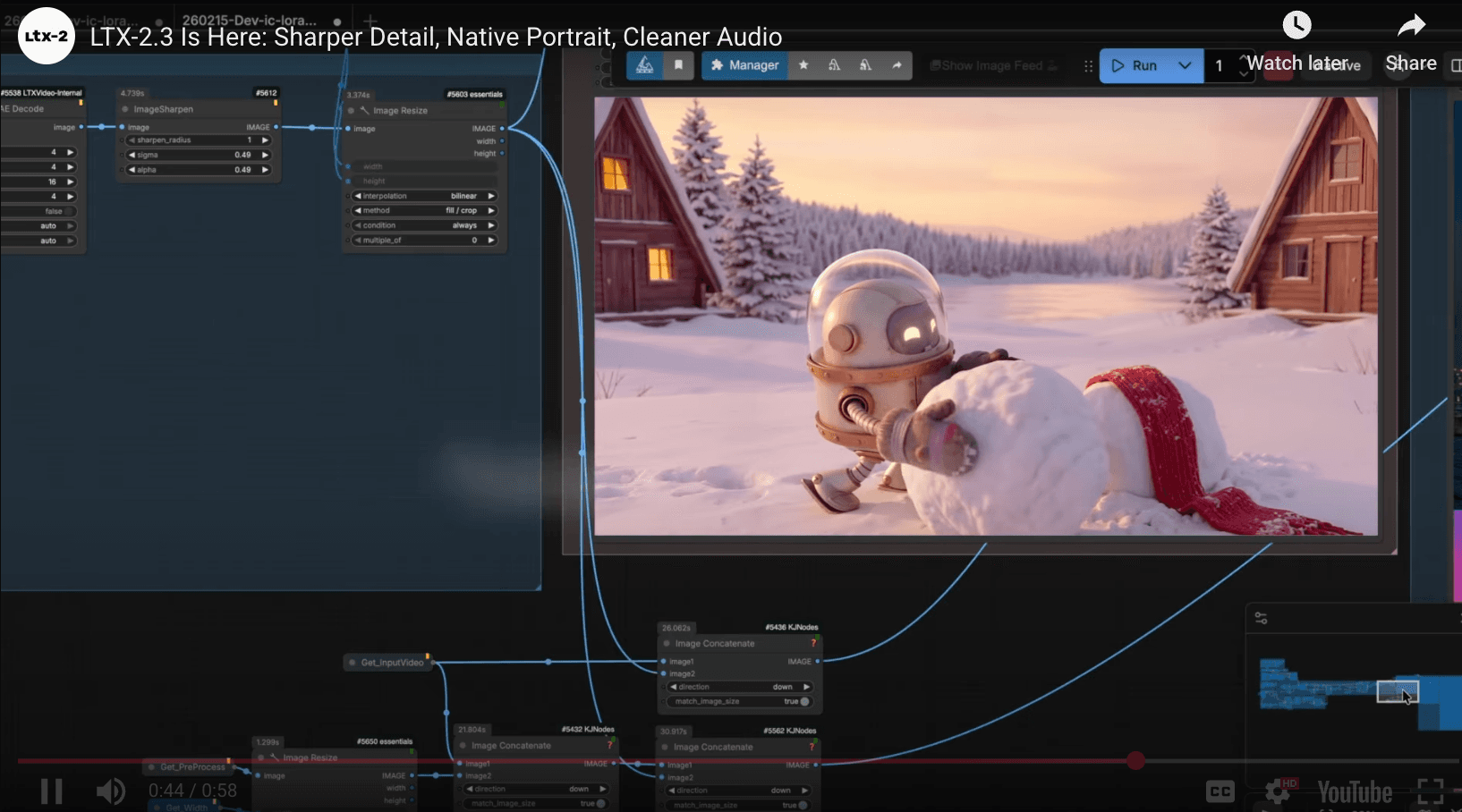
Overview
LTX-2.3 upgraded the LTX-2 family with sharper detail, stronger prompt adherence, more motion in image-to-video, cleaner synchronized audio, and native vertical generation. It supports text-to-video and image-to-video through Fast and Pro variants, while Pro also handles audio-to-video, retakes, extensions, reframing, and HDR workflows.
The model remains available for self-hosting and through the managed LTX API, even though LTX-2.5 is now the newer family. That makes this page most relevant to teams evaluating the proven 2.3 checkpoints, maintaining an existing integration, or using 2.3-only editing endpoints and local workflows.
Use cases
The strongest fit depends on the job you need the product to complete, not the size of its feature list.
Run, modify, and extend an audio-video model on owned infrastructure with available weights and workflows.
Integrate text, image, or audio-conditioned video without hosting the model stack.
Generate native 9:16 footage trained for portrait orientation instead of cropping landscape output.
Retake a selected section, extend a clip, reframe footage, or convert SDR footage to HDR.
Capabilities
Produces synchronized visuals and sound in one multimodal model instead of adding audio as a separate afterthought.
Supports text-to-video, image-to-video, and Pro-only audio-to-video workflows.
The API supports portrait and landscape generation from 720p through 4K, depending on model and endpoint.
Can interpolate motion between supplied first and final images in image-to-video workflows.
LTX-2.3 Pro supports retake, extend, reframe, and HDR conversion in addition to generation.
Provides base, distilled, and quantized checkpoints plus training code, ComfyUI nodes, LoRAs, reference workflows, and LTX Desktop.
Process
Step 1
Review the model license and available hardware before selecting self-hosted checkpoints or managed endpoints.
Step 2
Use Fast for lower-cost text and image iteration, or Pro when quality, audio conditioning, and editing endpoints matter.
Step 3
Provide the prompt and optional image, audio, last frame, camera motion, resolution, orientation, duration, and frame rate.
Step 4
Review synchronization and continuity, retake weak sections, reframe if needed, then complete editing and disclosure requirements.
Cost
Self-hosted weights have no per-generation fee but require infrastructure and compliance with the LTX model license. Managed API generation is billed per second, with cost increasing by model, endpoint, and resolution.
No per-generation fee
Run the checkpoints locally or on owned infrastructure.
$0.03-$0.24 per output second
Lower-cost text-to-video and image-to-video.
$0.04-$0.32 per output second
Higher-quality text-to-video and image-to-video.
$0.06-$0.34 per input second
Generates video synchronized to supplied audio.
$0.10-$0.80 per second
Retake, extend, reframe, and HDR operations have endpoint-specific rates.
Pricing checked . Check current pricing at the source ↗
Assessment
Compare
The right alternative depends on the specific output, workflow, controls and budget your project requires.
Content Creator
Choose LTX-2.5 for Lightricks' newer model family and the default direction for new integrations.
Explore LTX-2.5 →Content Creator
Choose Runway Gen-4.5 for a managed cinematic model inside Runway's broader creative suite.
Explore Runway Gen-4.5 →Content Creator
Choose Veo 3.1 for Google's high-end video generation and native audio workflows.
Explore Veo 3.1 →Questions
Yes. LTX-2.3 Fast and Pro remain supported in the LTX API and the checkpoints remain available for local use, although LTX-2.5 is now newer.
Lightricks releases weights, code, and workflows under its LTX community license. It is open-weight and modifiable, but the license includes use and commercial restrictions, including paid licensing for entities with at least $10 million in annual revenue.
Yes. It was trained for native portrait output and the API supports portrait resolutions from 720p through 4K.
Yes. The Pro model can jointly generate synchronized audio and video and can also create video driven by an input audio track.
Text-to-video and image-to-video currently range from $0.03 to $0.24 per second on Fast and $0.04 to $0.32 on Pro, depending on resolution. Audio and editing endpoints use separate rates.
Bottom line
LTX-2.3 remains a capable and unusually flexible open-weight video engine, especially for teams that need synchronized audio, local deployment, native portrait, or the Pro editing endpoints. New projects should compare it directly with LTX-2.5 before locking the model choice, and every commercial self-hosted deployment should review the license rather than assuming the weights are unrestricted.
Visit LTX-2.3 website ↗
Nano Banana 2 - Google's new No.1 ranked AI image model at Flash speed and pricing
Phota Studio - Phota's personalized photo editing and generation model that preserves your identity across edits
Higgsfield Soul 2.0 - New creative model built for aesthetics, realism, and culture-native generations
Veo 3.1 Lite - Google's new budget-friendly video generation mode

Get access to all our AI courses, hundreds of real-world AI use cases, live expert-led workshops, an exclusive network of AI early adopters, and more.
Get unlimited access to all of our current & upcoming industry-specific AI courses for the duration of your subscription.
To keep up with the rapid pace of AI, our team publishes AI implementation guides daily. Our library contains 300+ practical use cases to automate real-world work.
Join weekly, live, interactive sessions with industry leaders who are at the forefront of AI for hands-on implementation guidance and exclusive insights.
Network with an exclusive community of AI-first professionals who are working smarter with AI. Learn how early adopters are using AI in their work and businesses.