Established OpenClaw deployments
Use a model trained specifically around OpenClaw's skills, tools, scheduling, messaging, and persistent-agent task patterns.
Independent tool overview
GLM-5-Turbo is Z.AI's text-only agent model optimized specifically for OpenClaw-style tool use, command following, scheduled and persistent tasks, and high-throughput execution chains. It remains available through the Z.AI API and Coding Plan, but newer GLM-5.2 and GLM-5.3 models now provide broader long-context, coding, and multimodal capability.
Visit the official GLM-5-Turbo site ↗
Overview
GLM-5-Turbo is a purpose-built model rather than Z.AI's newest general flagship. Its 200K-token context window, unusually large 128K maximum output, thinking modes, function calls, structured output, MCP support, and context caching are aimed at agents that must decompose instructions and keep using tools across many steps.
The model's distinctive optimization target is OpenClaw, a personal-agent framework that runs on users' devices and connects to messaging platforms. Z.AI says Turbo was trained on representative environment setup, coding, retrieval, analysis, content, scheduling, and long-chain tasks rather than merely adapted to the harness after training.
The tradeoff is specialization and age within a fast-moving family. GLM-5-Turbo accepts text only and has 200K context, while GLM-5.2 moved to a 1M-token long-horizon context and GLM-5.3-Flash now combines 1M context with native image, video, file, and visual-feedback capability at an efficiency-focused price. Keep Turbo for an established OpenClaw workflow only after measuring it against the current models.
Use cases
The strongest fit depends on the job you need the product to complete, not the size of its feature list.
Use a model trained specifically around OpenClaw's skills, tools, scheduling, messaging, and persistent-agent task patterns.
Run text-based tasks that require repeated function calls, command following, intermediate state, and unusually large generated output.
Handle recurring triggers and long-running text workflows where time-related instructions and execution continuity matter.
Build OpenAI-compatible integrations with published per-token rates, caching, streaming, JSON output, and MCP connections.
Capabilities
Z.AI says the training data and optimization objectives include real OpenClaw task scenarios instead of treating OpenClaw as a generic chat client.
Plans multi-layered requests and can divide work across steps or collaborating agents.
Invokes external functions, skills, and services so an agent can execute rather than only answer.
Is tuned to understand time-based triggers and maintain progress across longer background workflows.
Targets faster, more stable execution on tool-heavy tasks with substantial data flow and extended logical chains.
Supports large text histories and exceptionally long responses, although larger limits also increase latency and cost risk.
Offers configurable reasoning behavior and real-time token streaming for different quality and responsiveness needs.
Provides discounted cached input, structured outputs, and Model Context Protocol integration for repeated context and external data sources.
Process
Step 1
Compare Turbo with GLM-5.3, GLM-5.3-Flash, and GLM-5.2 on your actual OpenClaw tools before choosing it for a new deployment.
Step 2
Use validated schemas, least-privilege credentials, bounded outputs, timeouts, and human approval for spending, deletion, publishing, or sensitive system changes.
Step 3
Have the model state the goal, dependencies, proposed calls, and stopping condition before beginning a long or expensive chain.
Step 4
Keep repeated system instructions and reference material byte-stable where possible so the API can detect cache hits and reduce input cost.
Step 5
Set maximum tokens, tool calls, wall time, retries, and budget instead of relying on the 128K output ceiling as a safe default.
Step 6
Check the external system and user-visible result, not only the model's final summary, because an agent can report success after a partial or failed tool call.
Cost
Direct API pricing is $1.20 per million input tokens, $0.24 per million cached-input tokens, and $4 per million output tokens. Cached-input storage is currently listed as free for a limited time, and built-in web search costs an additional $0.01 per use. GLM-5-Turbo is also included in Z.AI Coding Plans, but OpenClaw traffic on those plans uses best-effort secondary scheduling: coding-agent work has priority, and heavy load can trigger dynamic queues and rate limits. Compare API billing with the current Coding Plan allowance for your workload.
$1.20 input / $4 output per 1M tokens
Usage-based access through Z.AI's OpenAI-compatible API.
Subscription allowance
Includes GLM-5-Turbo in supported coding and OpenClaw workflows.
Not published for Turbo
The official GLM-5-Turbo page documents hosted API use and does not link a public Turbo checkpoint.
Pricing checked . Check current pricing at the source ↗
Assessment
Compare
The right alternative depends on the specific output, workflow, controls and budget your project requires.
Consumer
Use GLM-5.3 for Z.AI's newer flagship agentic and coding capability, especially when evaluating a new deployment.
Explore GLM-5.3 →Coding
Consider GLM-5.2 when a proven 1M-token context and stronger long-horizon task handling matter more than Turbo's OpenClaw-specific tuning.
Explore GLM 5.2 →Consumer
Consider MiniMax M2.7 for another cost-conscious agentic model focused on coding and long-running tool workflows.
Explore Minimax M2.7 →Consumer
Consider Claude Opus 4.8 for a higher-priced frontier model with strong coding and agentic performance across mature tool ecosystems.
Explore Claude Opus 4.8 →Questions
GLM-5-Turbo is a text-only Z.AI model optimized for OpenClaw tools, instructions, schedules, persistent tasks, and long execution chains. It is available through the Z.AI API and supported Coding Plans.
No. It remains active, but GLM-5.2 and the GLM-5.3 family are newer. GLM-5.3-Flash also adds native multimodal input and a 1M-token context.
Direct API pricing is $1.20 per million input tokens, $0.24 per million cached-input tokens, and $4 per million output tokens. Built-in web search is $0.01 per use.
The model supports 200K tokens of context and up to 128K output tokens. Set a much smaller output cap for ordinary agent tasks to control latency and cost.
No. Its official input and output modalities are text. Choose a newer multimodal GLM model when screenshots, documents, video, or visual self-verification are required.
Yes; that is its primary optimization target. Direct API usage and the GLM Coding Plan are supported, but Coding Plan OpenClaw traffic is best-effort and may be queued under load.
The official Turbo documentation provides API access but does not link public model weights. Related GLM releases have separate open-weight checkpoints and licenses, which should not be assumed to cover Turbo.
Bottom line
GLM-5-Turbo is still a practical fit for an existing OpenClaw deployment that values tool-chain behavior, large output, caching, and predictable API rates. It is no longer the obvious default for new work. Z.AI's newer 5.2 and 5.3 models bring 1M context, stronger general agent performance, and—in 5.3-Flash—native visual understanding. Run a controlled benchmark, account for best-effort plan scheduling, and keep Turbo only when its OpenClaw specialization produces a measurable advantage.
Visit GLM-5-Turbo website ↗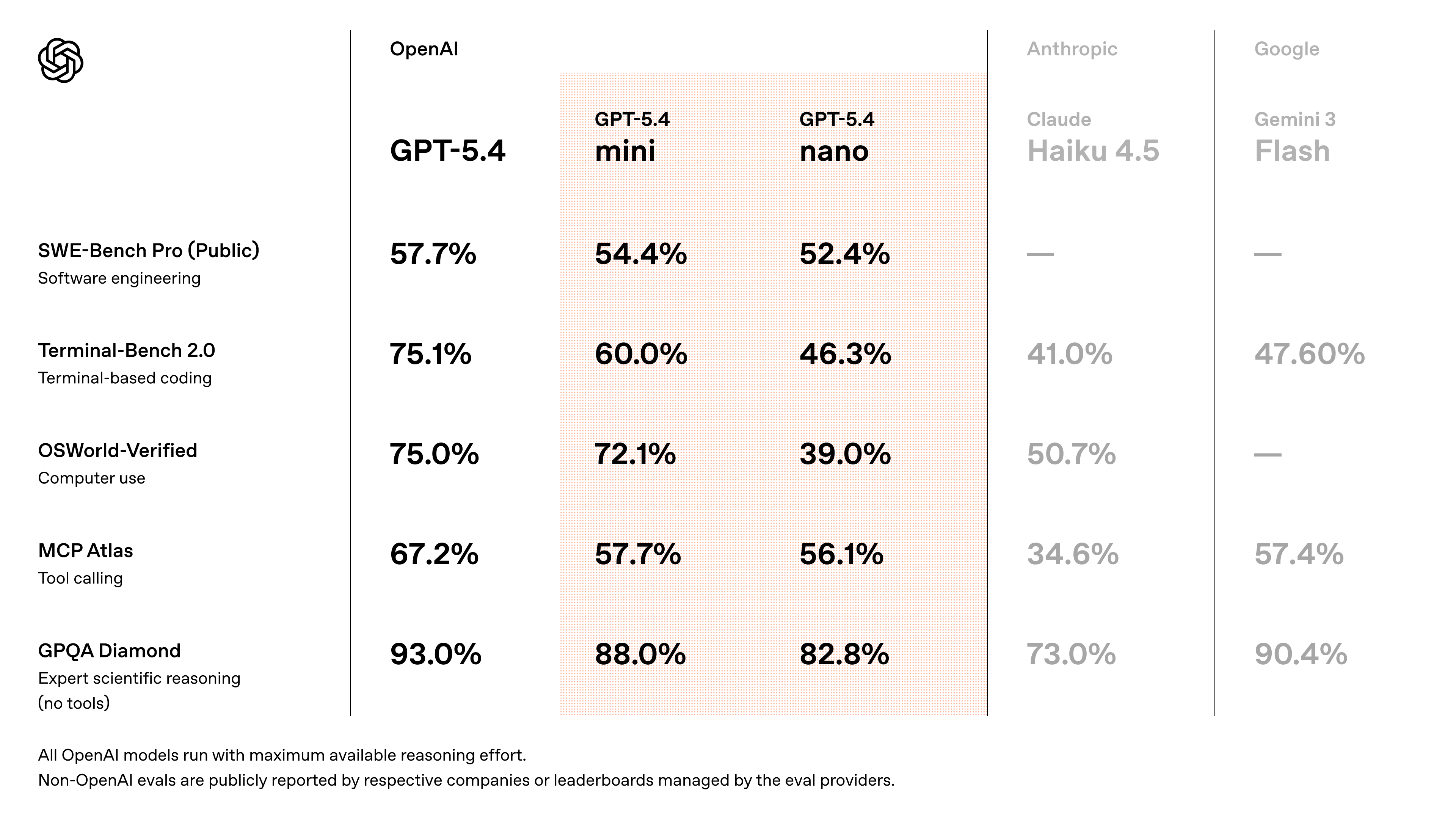
GPT-5.4 mini & nano - OpenAI's fast, cheap small models built for coding agents and subagent workflows
Cohere Transcribe- SOTA, free open-source speech recognition model

Mistral 4 Small - Mistral's open-source 119B MoE model combining reasoning, coding, and vision in one package

Qwen 3.5 Omni - Alibaba's native omnimodal model with text, image, audio, and video understanding across 113 languages

Get access to all our AI courses, hundreds of real-world AI use cases, live expert-led workshops, an exclusive network of AI early adopters, and more.
Get unlimited access to all of our current & upcoming industry-specific AI courses for the duration of your subscription.
To keep up with the rapid pace of AI, our team publishes AI implementation guides daily. Our library contains 300+ practical use cases to automate real-world work.
Join weekly, live, interactive sessions with industry leaders who are at the forefront of AI for hands-on implementation guidance and exclusive insights.
Network with an exclusive community of AI-first professionals who are working smarter with AI. Learn how early adopters are using AI in their work and businesses.