Responsive coding loops
Use mini for targeted edits, codebase navigation, front-end generation, test failures, review, and debugging where turnaround matters.
Independent tool overview
GPT-5.4 mini and GPT-5.4 nano are OpenAI's March 2026 small reasoning models for fast, high-volume work. Both offer a 400,000-token context window, 128,000 maximum output, image input, function calling, structured outputs, and reasoning effort from none to xhigh. Mini is the stronger coding, computer-use, and subagent option at $0.75 input and $4.50 output per million tokens; nano targets classification, extraction, ranking, and simple subagents at $0.20 and $1.25. Both remain active, though new systems should also benchmark the newer GPT-5.6 family.
Visit the official GPT-5.4 mini & nano site ↗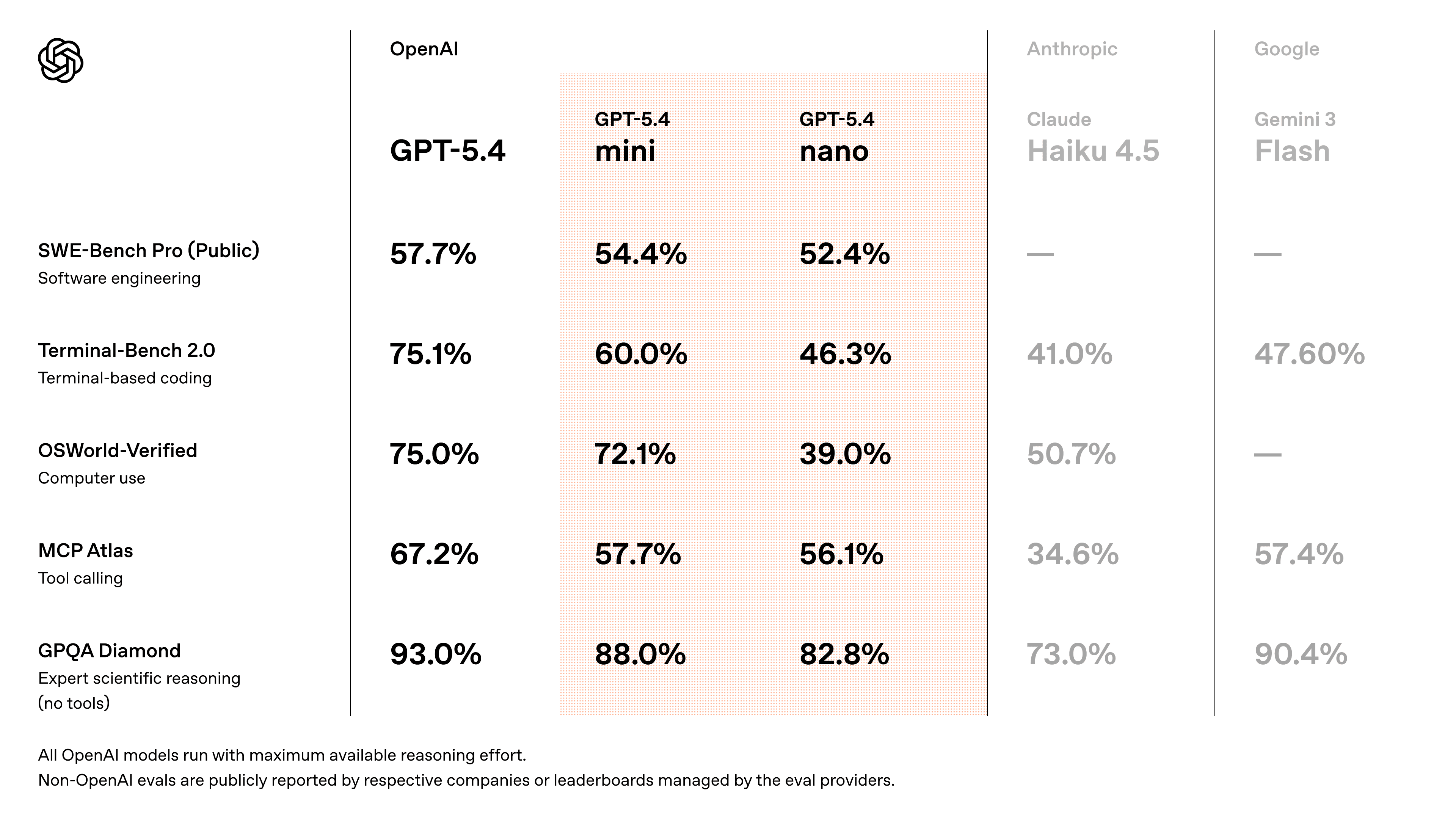
Overview
GPT-5.4 mini and nano compress many GPT-5.4 capabilities into faster, cheaper models. OpenAI positions mini for coding, multimodal understanding, computer use, and subagents, while nano is the smallest GPT-5.4 option for classification, extraction, ranking, and other bounded, high-volume tasks.
The API specifications are unusually generous for small models: both have a 400,000-token context window, 128,000-token maximum output, an August 31, 2025 knowledge cutoff, text and image input, text output, streaming, function calling, structured outputs, and a fixed March 17, 2026 snapshot.
Their tool sets differ. Mini supports web and file search, image generation, code interpreter, hosted shell, apply patch, skills, computer use, MCP, and tool search in the Responses API. Nano supports most of the same tools but does not support computer use or tool search, making it better as a bounded worker than a general interface agent.
Availability also differs. Mini is available in the API, Codex, and ChatGPT; in ChatGPT it is exposed to Free and Go users through Thinking and used as a rate-limit fallback for other plans rather than appearing as an ordinary selectable model. Nano is API-only.
These models are active but no longer the newest cost-optimized OpenAI generation. The current comparison page lists GPT-5.6 Luna at $0.20 input and $1.20 output per million tokens with a 1.05-million-token context and newer cutoff. Developers should benchmark actual task quality, tool reliability, latency, and total cost before defaulting to GPT-5.4 nano or mini.
Use cases
The strongest fit depends on the job you need the product to complete, not the size of its feature list.
Use mini for targeted edits, codebase navigation, front-end generation, test failures, review, and debugging where turnaround matters.
Use mini or nano for narrow, independently checked supporting tasks while a stronger model handles planning, coordination, and final judgment.
Use mini for screenshot interpretation and bounded interface actions when the workflow has least-privilege access and confirmation gates.
Use nano for high-volume tagging, ranking, routing, field extraction, and short transformations with a strict schema and measurable accuracy target.
Use either model to sort, summarize, or flag large collections before an expert or stronger model reviews the consequential subset.
Build and evaluate tool workflows at lower token cost before promoting only the difficult cases to a larger model.
Capabilities
Both models support none, low, medium, high, and xhigh reasoning effort; none is the default.
A 400K-token context can hold substantial documents, repositories, or agent state, though long-context accuracy still degrades on difficult retrieval.
Up to 128K output tokens supports substantial code, structured data, and document generation, subject to cost and reliability controls.
Both accept images alongside text for screenshots, charts, diagrams, document pages, and visual classification.
Both can choose developer-defined tools and populate arguments in multi-step workflows.
Both support schema-constrained responses for classification, extraction, routing, and machine-consumed results.
Mini can use the Responses API computer-use tool and interpret dense interface screenshots; nano does not support computer use.
Both support web search, file search, image generation, code interpreter, hosted shell, apply patch, skills, and MCP in the Responses API.
Mini can dynamically discover relevant tools through tool search, while nano does not support that feature.
Pin gpt-5.4-mini-2026-03-17 or gpt-5.4-nano-2026-03-17 for repeatable evaluations and controlled releases.
OpenAI says mini uses 30% of GPT-5.4 quota in Codex and can serve as a delegated worker across app, CLI, IDE, and web.
Process
Step 1
Define which steps are bounded enough for nano, which need mini's stronger coding or computer use, and which require a current flagship or human expert.
Step 2
Include representative inputs, edge cases, adversarial instructions, expected schema, source truth, and acceptable error thresholds for every route.
Step 3
Try nano on classification, extraction, ranking, and transformation first. Promote failures or low-confidence cases to mini or a larger model.
Step 4
Route code edits, multimodal interpretation, tool discovery, and computer-use steps to mini, but keep final approval outside the model.
Step 5
Begin with none or low for simple tasks and increase only when evaluation gains justify added latency and generated-token cost.
Step 6
Use structured outputs, enums, bounds, allowlists, and server-side validation. Reject missing, extra, malformed, or impossible values.
Step 7
Defend against prompt injection in documents, websites, repositories, screenshots, and tool responses. Never let retrieved text expand permissions.
Step 8
Use read-only access and isolated environments by default. Require confirmation for communication, money movement, deletion, publishing, credentials, identity, or production changes.
Step 9
Run tests, reconcile extracted fields, sample classifications, inspect citations, compare screenshots, and independently recalculate consequential numbers.
Step 10
Measure input, cached input, reasoning, output, tools, retries, failures, reviewer time, and escalation rate—not only the advertised token price.
Step 11
Compare against GPT-5.6 Luna and other current candidates on the same task set. Migrate with shadow traffic, canaries, pinned snapshots, and rollback.
Cost
API pricing is per million text tokens. GPT-5.4 mini costs $0.75 input, $0.075 cached input, and $4.50 output; GPT-5.4 nano costs $0.20 input, $0.02 cached input, and $1.25 output. Regional-processing endpoints add a 10% uplift. Tool calls can add separate charges. In Codex, mini uses 30% of GPT-5.4 quota. ChatGPT access to mini is plan- and routing-dependent; nano is not available there.
$0.75 input / $4.50 output per 1M tokens
Stronger small model for coding, computer use, multimodal analysis, tools, and subagents.
$0.20 input / $1.25 output per 1M tokens
Cheapest GPT-5.4-class model for bounded classification, extraction, ranking, and simple subagents.
30% of GPT-5.4 quota
Mini is available in Codex as a direct model and delegated subagent option.
Included with eligible access
Mini is available through Thinking for Free and Go and as a fallback for GPT-5.4 Thinking on other plans.
Pricing checked . Check current pricing at the source ↗
Assessment
Compare
The right alternative depends on the specific output, workflow, controls and budget your project requires.
Consumer
Choose full GPT-5.4 when difficult planning, long-context reasoning, and computer-use quality matter more than mini-model cost and latency.
Explore GPT 5.4 →Consumer
Choose GPT-5.5 for a newer frontier model when professional reasoning and coding quality outweigh higher token cost.
Explore GPT 5.5 →Coding
Choose GPT-5.3 Codex Spark for a coding-specific low-latency workflow where its specialized interaction model is the better fit.
Explore GPT-5.3-Codex-Spark →Project Management
Choose Claude when Anthropic's models perform better on your document, coding, safety, or tool-use evaluations.
Explore Claude →Consumer
Choose GLM-5.1 when an open-weight option, self-hosting path, or its current API economics better match the deployment.
Explore GLM-5.1 →Questions
Mini is the stronger model for coding, multimodal work, computer use, and capable subagents. Nano is cheaper and intended for bounded high-volume tasks such as classification, extraction, ranking, and simple supporting agents.
The API price is $0.75 per million input tokens, $0.075 per million cached input tokens, and $4.50 per million output tokens. Regional processing adds 10%, and tool fees can apply.
The API price is $0.20 per million input tokens, $0.02 per million cached input tokens, and $1.25 per million output tokens. Regional processing and tool charges can add to the total.
Both have a 400,000-token context window and a 128,000-token maximum output. That capacity does not guarantee perfect retrieval or reasoning across the entire context.
Yes. Both accept text and image input and return text. Native audio and video modalities are not supported.
Both support function calling, structured outputs, web and file search, image generation, code interpreter, hosted shell, apply patch, skills, and MCP in the Responses API. Mini additionally supports computer use and tool search.
Mini is available to Free and Go users through Thinking and as a GPT-5.4 Thinking fallback for other plans, but it generally is not a selectable picker model. Nano is API-only.
GPT-5.4 mini is available across Codex surfaces and uses 30% of GPT-5.4 quota. It can also be used for delegated subagent tasks. OpenAI describes nano as API-only.
Both support none, low, medium, high, and xhigh, with none as the default. Evaluate the lowest setting that meets the route's accuracy target.
No. First compare it with GPT-5.6 Luna and other current small models. Route only tasks that meet measured accuracy, latency, cost, and safety thresholds, and escalate ambiguous cases.
It can use the computer-use tool, but that does not make actions safe. Isolate the environment, minimize permissions, preview steps, defend against prompt injection, and require confirmation for consequential changes.
OpenAI says API inputs and outputs are not used to train models by default unless the customer opts in. Default abuse-monitoring retention and feature-specific application state still apply, with approved additional controls available.
Bottom line
GPT-5.4 mini is the more versatile choice: it offers capable coding, broad tools, computer use, and strong subagent economics without paying full-frontier prices. GPT-5.4 nano is useful when the job is narrow, high-volume, schema-constrained, and easy to audit. Neither should be selected from price alone. The newer GPT-5.6 Luna changes the cost comparison, and small-model mistakes can become expensive when multiplied across thousands of tool calls or records. Benchmark on real traffic, route by difficulty, pin snapshots, validate outputs, sandbox tools, and keep humans responsible for consequential results.
Visit GPT-5.4 mini & nano website ↗
Mistral 4 Small - Mistral's open-source 119B MoE model combining reasoning, coding, and vision in one package

GLM-5-Turbo - Z AI's high-speed agentic model built specifically for OpenClaw

Nemotron 3 Super - NVIDIA's open 120B reasoning model with 1M token context for agentic workflows

MiniMax M2.7 - MiniMax's new 'self-evolving' model with strong coding and agentic benchmarks

Get access to all our AI courses, hundreds of real-world AI use cases, live expert-led workshops, an exclusive network of AI early adopters, and more.
Get unlimited access to all of our current & upcoming industry-specific AI courses for the duration of your subscription.
To keep up with the rapid pace of AI, our team publishes AI implementation guides daily. Our library contains 300+ practical use cases to automate real-world work.
Join weekly, live, interactive sessions with industry leaders who are at the forefront of AI for hands-on implementation guidance and exclusive insights.
Network with an exclusive community of AI-first professionals who are working smarter with AI. Learn how early adopters are using AI in their work and businesses.