Repository-scale coding agents
Engineering teams evaluating an agent for multi-file implementation, debugging, refactoring, tests, command-line work, and long tasks with explicit verification.
Independent tool overview
GLM-5.3 is Z.ai's 753-billion-parameter open-weight reasoning model for long-horizon coding, tool-using agents, and authorized vulnerability research. It uses the same base model as GLM-5.2 but receives stronger post-training, mandatory thinking, and low, high, or max reasoning effort. It is available through Z.ai's API, GLM Coding Plan and ZCode, and self-hosted weights; pay-as-you-go API pricing is $1.40 per million input tokens, $0.26 per million cached input tokens, and $4.40 per million output tokens.
Visit the official GLM-5.3 site ↗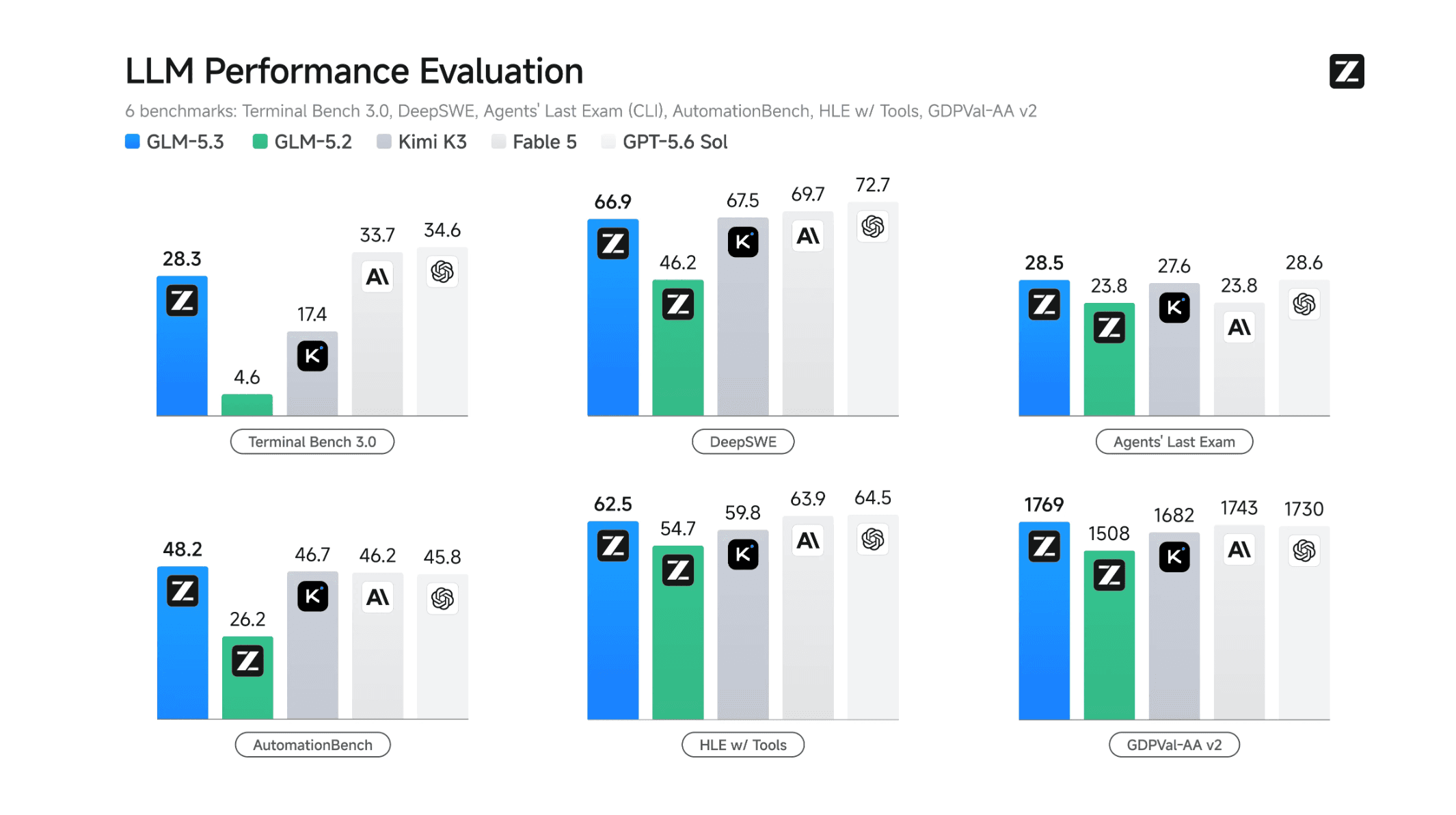
Overview
GLM-5.3 focuses on substantial engineering work rather than short code completion. Z.ai trained it on executable environments that resemble production debugging, infrastructure optimization, repository-scale implementation, research, tool use, and multi-stage verification. The company reports large gains over GLM-5.2 on Terminal-Bench 3.0, DeepSWE v1.1, Agents' Last Exam, cyber benchmarks, and its private Z.ai Code Bench.
The release is a post-training upgrade: Z.ai says GLM-5.3 shares GLM-5.2's base model and receives its improvements from further reinforcement-learning environments and scaling. It supports long contexts used at up to one million tokens in the published evaluations and can emit very long reasoning and coding trajectories, which makes cost, compaction, timeouts, state, and verification important parts of the application design.
Thinking cannot be disabled. The API supports low, high, and max reasoning effort and defaults to max. An existing integration that sends thinking.type as disabled will fail after a direct model swap; Z.ai instructs teams to enable thinking and use low effort first during migration if they previously relied on a non-thinking path.
The model is available as a Z.ai API endpoint, through a points-based GLM Coding Plan in tools such as ZCode, Claude Code and OpenCode, and as downloadable weights on Hugging Face. The weight repository is roughly 756 GB and lists 753 billion parameters, so self-hosting the full model is an accelerator-cluster project rather than a normal laptop workflow.
Z.ai openly emphasizes GLM-5.3's vulnerability-discovery and exploitation capability. That can help authorized defensive teams find and reproduce flaws, but it also raises the consequence of excessive network, credential, shell, repository, or deployment access. Use isolated environments, explicit written scope, allowlisted targets, non-production credentials, command review, output screening, and coordinated disclosure.
Use cases
The strongest fit depends on the job you need the product to complete, not the size of its feature list.
Engineering teams evaluating an agent for multi-file implementation, debugging, refactoring, tests, command-line work, and long tasks with explicit verification.
Developers seeking a capable agentic model at lower token prices than many closed frontier APIs and able to benefit from cached repeated repository context.
Organizations with accelerator infrastructure and model-serving expertise that need open weights, an OpenAI-compatible serving layer, and greater control over code and runtime data.
Internal security teams and maintainers performing scoped code review, vulnerability reproduction, patch development, and disclosure in isolated, permissioned environments.
Workflows that combine code, tools, experiments, logs, and iteration over hours, provided humans define success checks and review evidence.
Capabilities
Post-trained on larger executable environments representing complex engineering and research workflows with multi-step dependencies and verifiers.
Supports low, high, and max reasoning effort. Thinking remains enabled and max is the default and Z.ai's recommended level for difficult coding tasks.
Z.ai evaluates the model with contexts up to one million tokens on repository, agent, and software tasks, although applications still need context selection and compaction.
Designed for agent harnesses that inspect repositories, edit files, run commands, execute tests, collect evidence, and iterate toward a verified result.
Shows strong vendor-reported performance in vulnerability discovery and multi-stage exploitation benchmarks, making defensive governance a core deployment requirement.
Available as a hosted endpoint with token-based input, cached-input, and output pricing plus context caching and optional paid built-in web search.
Runs in a points-based coding subscription with integrations for ZCode and multiple agent tools, five-hour and weekly quotas, cache-aware consumption, and off-peak discounts.
Official weights can be served through frameworks listed by Z.ai, including SGLang, vLLM, Transformers, KTransformers, and TokenSpeed.
The GLM-5.3 License broadly permits use, modification, distribution, fine-tuning, and sale while imposing attribution, legal-compliance, warranty, and large Model-as-a-Service conditions.
Process
Step 1
Use the pay-as-you-go API for product integration, a Coding Plan for supported interactive agents, or self-host only when the organization can operate a very large model and has reviewed the custom license.
Step 2
Change any thinking.type disabled configuration to enabled, begin with reasoning_effort low, update the model code to glm-5.3, and then test high or max where the quality gain justifies latency and output cost.
Step 3
Use private, versioned tasks from the real codebase covering implementation, regression repair, tests, build systems, tool calls, security, documentation, and refusal boundaries. Score completed artifacts, not persuasive explanations.
Step 4
Run in an isolated branch or ephemeral container with least-privilege credentials, a domain and command allowlist, protected secrets, no default production access, bounded CPU and time, and explicit approval for network, package, deployment, or destructive actions.
Step 5
Provide the objective, relevant repository context, constraints, tests, prohibited actions, acceptance criteria, budget, and required evidence. Do not send an undifferentiated million-token repository when a smaller verified context is enough.
Step 6
Require the agent to inspect before editing, keep changes scoped, run tests and security checks, explain failures, and present the final diff and evidence for human approval. Treat generated terminal commands as untrusted input.
Step 7
Obtain written authorization and target scope; isolate the lab; prohibit unrelated scanning, persistence, credential harvesting, lateral movement, or data access; document findings; and follow the maintainer's coordinated-disclosure process.
Step 8
Log model version, effort, token categories, cache hit rate, tool calls, wall time, retries, test outcome, revert rate, and reviewer acceptance. Use output caps, timeouts, and circuit breakers for long trajectories.
Step 9
Start with suggestions or draft pull requests, then allow low-risk autonomous steps only after evidence shows they are reliable. Keep protected branches, code review, CI, audit logs, kill switches, and rollback in place.
Cost
Z.ai offers GLM-5.3 through pay-as-you-go API tokens, a separate GLM Coding Plan, and self-hosted weights. The hosted API is $1.40 per million input tokens, $0.26 per million cached input tokens, and $4.40 per million output tokens; cache storage is listed as limited-time free and built-in web search is $0.01 per use. The current ZCode page displays promotional Coding Plan rates, while the docs describe five-hour and weekly credit caps and 50% off-peak consumption. Self-hosted weights have no per-token license fee but require substantial hardware and operations.
$1.40 input / $0.26 cached input / $4.40 output per 1M tokens
Hosted model access for applications and custom agent integrations.
$12.60/month promotional; $18 shown as list
Entry subscription for lighter interactive agent work.
$56/month promotional; $80 shown as list
Higher-volume coding plan for regular development on mid-sized repositories.
$117.60/month promotional; $168 shown as list
Largest individual coding quota for advanced and long-running work.
No per-token license fee; infrastructure extra
Download and operate GLM-5.3 under its custom license.
Pricing checked . Check current pricing at the source ↗
Assessment
Compare
The right alternative depends on the specific output, workflow, controls and budget your project requires.
Consumer
Choose GLM-5.1 only for compatibility comparisons; GLM Coding Plan requests are now routed toward GLM-5.3 and the newer model is the current flagship.
Explore GLM-5.1 →Consulting
Choose Kimi K3 to compare another current open-weight frontier model focused on agentic reasoning and coding.
Explore Kimi K3 →Consumer
Choose Qwen3.7-Max when Alibaba's current long-horizon agent model, ecosystem, and commercial terms fit better.
Explore Qwen3.7-Max →Coding
Choose Qwen3-Coder-Next when a much smaller open-weight model is easier to operate than GLM-5.3's 753B footprint.
Explore Qwen3-Coder-Next →Coding
Choose Claude Code when a polished supported coding-agent product and Anthropic's model ecosystem matter more than open weights or Z.ai pricing.
Explore Claude Code →Questions
GLM-5.3 is Z.ai's flagship 753B open-weight reasoning model for long-horizon coding, agent tools, and authorized vulnerability research. It is a post-training upgrade over the same base model used by GLM-5.2.
Z.ai calls it open source, but the weights use a custom GLM-5.3 License. The license broadly permits use, modification, distribution, fine-tuning, and commercial work, with attribution, compliance, warranty, and large Model-as-a-Service conditions. Review the actual license for your use.
Z.ai lists $1.40 per million input tokens, $0.26 per million cached input tokens, and $4.40 per million output tokens. Built-in web search is $0.01 per use and cache storage is listed as limited-time free.
Z.ai's published evaluations use contexts up to one million tokens on several repository and agent benchmarks. Verify the exact endpoint and harness limit, and still curate and compact context rather than filling the window by default.
The weights are downloadable and Z.ai documents SGLang, vLLM, Transformers, KTransformers, and TokenSpeed. At 753B parameters with roughly 756 GB of files, full self-hosting requires substantial accelerator infrastructure and is not an ordinary laptop setup.
No. GLM-5.3 requires thinking to be enabled. You can set reasoning_effort to low, high, or max; max is the default.
Remove any thinking.type disabled setting, enable thinking, begin with low effort, switch to glm-5.3, and regression-test tool calls, output length, cost, latency, compaction, safety, and task success before expanding traffic.
It is a separate subscription for using GLM models in supported coding tools. It uses model and tool credits with both rolling five-hour and weekly caps, different token multipliers, and a 50% off-peak consumption rate.
Z.ai reports strong vulnerability-discovery and exploitation benchmark results. Use it only for systems and code you are authorized to test, inside an isolated and logged environment with target allowlists, human review, and coordinated disclosure.
No. Benchmarks are controlled tasks and cannot establish reliability on your production environment. Begin with draft changes, protected branches, CI, security review, scoped credentials, approvals, and rollback.
Bottom line
GLM-5.3 is a serious option for teams that need long-horizon coding, low hosted token prices, or open weights and can provide a strong agent harness. Its most notable strengths—very long trajectories, mandatory reasoning, extensive tool use, and advanced security capability—also make unconstrained deployment risky. Benchmark it on private tasks, use low effort for routine work, exploit caching carefully, keep the agent isolated and least-privileged, and require human evidence review. Self-hosting is viable only for organizations prepared for a 753B-class operational footprint and the custom license.
Visit GLM-5.3 website ↗
Gemini Flash 3.7 - Google’s upgraded fast, cheap and capable mid-class model
ChatGPT for Teens - OAI's new teen experience pairing guided learning with default safety limits
.jpeg)
Grok 4.6 - SpaceXAI's new near-frontier model with strong agentic capabilities
Perplexity's agent that runs fully on personal Nvidia hardware

Get access to all our AI courses, hundreds of real-world AI use cases, live expert-led workshops, an exclusive network of AI early adopters, and more.
Get unlimited access to all of our current & upcoming industry-specific AI courses for the duration of your subscription.
To keep up with the rapid pace of AI, our team publishes AI implementation guides daily. Our library contains 300+ practical use cases to automate real-world work.
Join weekly, live, interactive sessions with industry leaders who are at the forefront of AI for hands-on implementation guidance and exclusive insights.
Network with an exclusive community of AI-first professionals who are working smarter with AI. Learn how early adopters are using AI in their work and businesses.