Existing Opus 4.8 applications
Keep a stable, evaluated production baseline while testing whether Opus 5 materially improves the workload.
Independent tool overview
Claude Opus 4.8 is a supported previous-generation Anthropic model for complex coding, agentic workflows and professional analysis. It offers a one-million-token context window and 128,000-token output limit, but Claude Opus 5 is now the direct upgrade at the same standard API price.
Visit the official Claude Opus 4.8 site ↗
Overview
Anthropic released Claude Opus 4.8 in May 2026 as an upgrade focused on reliability, coding, long-running agents and professional work. It added adaptive thinking improvements, mid-conversation system messages, documented refusal details and an optional faster inference mode.
The model remains available through the Claude API and supported cloud platforms with the ID claude-opus-4-8. Its published specifications include a one-million-token context window, up to 128,000 output tokens, text and image input, prompt caching, batch processing, PDF support, computer use and other tool integrations.
Claude Opus 5 replaced it as the current Opus generation in July 2026 at the same $5-per-million input and $25-per-million output standard rates. Existing 4.8 applications do not need to migrate blindly: regression-test quality, tool behavior, thinking-token use and feature availability first, because Opus 5 changes the default thinking behavior and lacks some 4.8 platform features.
Use cases
The strongest fit depends on the job you need the product to complete, not the size of its feature list.
Keep a stable, evaluated production baseline while testing whether Opus 5 materially improves the workload.
Use the model for multi-step software work that needs long context, tool calls and sustained reasoning.
Process large document sets, PDFs and professional material when a high-capability model and a large context window are worth the cost.
Capabilities
Accepts up to one million tokens of context on the Claude API and supported cloud platforms.
Can allocate reasoning effort when a turn needs it instead of requiring a fixed thinking budget for every request.
Supports function tools, computer use, prompt caching, batch processing, files, PDFs and vision for complex workflows.
An API research preview can deliver up to 2.5 times higher output speed using the same model at premium token rates.
Process
Step 1
Capture task-success, latency, token use and human-review results from the current Opus 4.8 implementation.
Step 2
Set an appropriate effort level, trim irrelevant context and use prompt caching for repeated large prefixes.
Step 3
Test not only answer quality but also tool selection, argument accuracy, recovery behavior and final task completion.
Step 4
Evaluate Opus 5 on the same cases and review its thinking defaults and feature differences before changing the production model ID.
Cost
Claude Opus 4.8 costs $5 per million input tokens and $25 per million output tokens at standard API speed. Fast mode costs $10 input and $50 output per million tokens. Prompt caching, batches and third-party cloud platforms have separate rates or discounts.
$5 input / $25 output
Claude API rates per one million tokens.
$10 input / $50 output
Premium research-preview inference for higher output speed.
Plan-dependent
Availability and limits in Claude, Claude Code and related apps depend on the user's subscription.
Pricing checked . Check current pricing at the source ↗
Assessment
Compare
The right alternative depends on the specific output, workflow, controls and budget your project requires.
Consumer
Choose Claude Sonnet 5 when lower cost and faster execution matter more than maximum Opus-class capability.
Explore Claude Sonnet 5 →Consumer
Consider the Gemini 3 family for a broader range of multimodal, media and cost-optimized model endpoints.
Explore Gemini 3 →Consumer
Consider GPT-5.4 when the application is already built around OpenAI's API and tool ecosystem.
Explore GPT 5.4 →Questions
Yes. Anthropic's current platform documentation still lists claude-opus-4-8 as an available model, though Claude Opus 5 is its direct successor.
Standard API pricing is $5 per million input tokens and $25 per million output tokens. Fast mode is $10 input and $50 output per million tokens.
Anthropic lists a one-million-token context window and a 128,000-token maximum output for the model on its current platform comparison.
Opus 5 is the stronger direct successor at the same standard price, but test it on your own evaluation set first. Review thinking-token behavior and feature differences before changing a production model ID.
Bottom line
Claude Opus 4.8 remains a strong and supported model for production systems that already depend on its behavior and broad tool support. New projects should compare it directly with Opus 5 and Sonnet 5; at equal standard pricing, 4.8 mainly wins when its evaluated stability or specific feature support matters.
Visit Claude Opus 4.8 website ↗
Qwen 3.7 Max- Alibaba's new flagship model for long-horizon agentic tasks
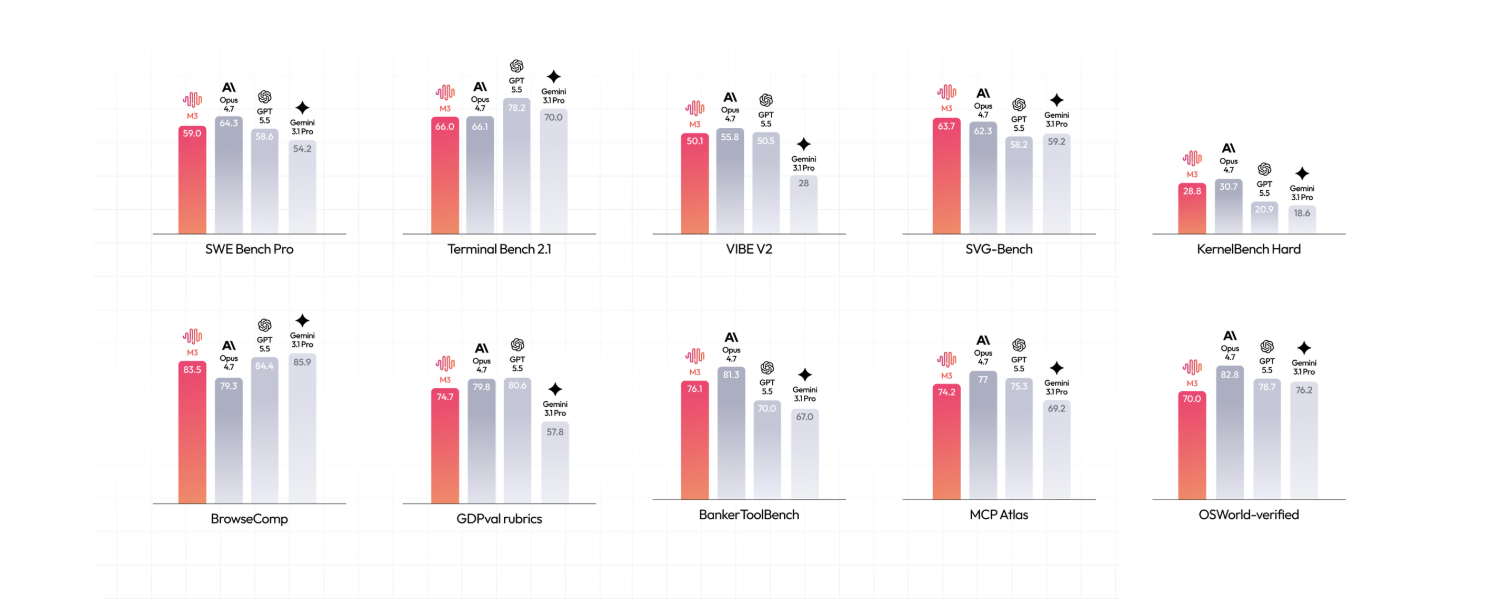
MiniMax M3 - Open-weight model with 1M context and computer use
Gemini 3.5 Flash - Google's new frontier model, 4x faster at half price

Nemotron 3 Ultra - Nvidia’s open 550B reasoning model for agents

Get access to all our AI courses, hundreds of real-world AI use cases, live expert-led workshops, an exclusive network of AI early adopters, and more.
Get unlimited access to all of our current & upcoming industry-specific AI courses for the duration of your subscription.
To keep up with the rapid pace of AI, our team publishes AI implementation guides daily. Our library contains 300+ practical use cases to automate real-world work.
Join weekly, live, interactive sessions with industry leaders who are at the forefront of AI for hands-on implementation guidance and exclusive insights.
Network with an exclusive community of AI-first professionals who are working smarter with AI. Learn how early adopters are using AI in their work and businesses.