Non-technical founders
Move from a detailed product idea to a working web or mobile MVP without assembling a full engineering stack first.
Independent tool overview
Emergent 2.0 is an active conversational app-building platform that uses specialized agents to design, code, test, and deploy full-stack web and mobile products. It is strongest for founders and operators who want more than a static prototype, but its credit system, deployment charges, generated-code quality, security, and ongoing runtime costs need deliberate review before calling an app production-ready.
Visit the official Emergent 2.0 site ↗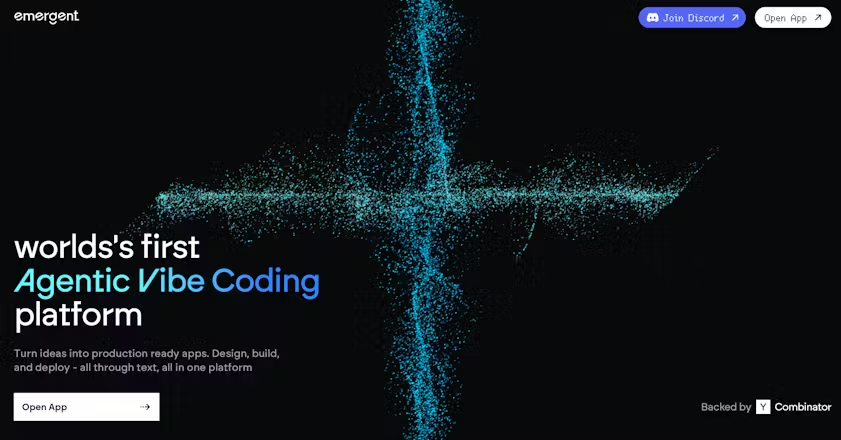
Overview
Emergent turns a plain-language product description into screens, application logic, backend services, integrations, and a deployable web or mobile project. Users refine the result through conversation rather than a traditional drag-and-drop builder.
The platform's value is breadth: it can work across interface design, frontend and backend code, authentication, databases, API integrations, testing, debugging, GitHub, and managed deployment from one workspace.
Paid individual plans include private projects, mobile development, deployment access, custom domains, and GitHub integration. The Pro tier adds a one-million-token context window, Ultra Thinking, editable system prompts, custom agents, larger machines, and priority support.
Emergent describes its output as production-ready, but that is a workflow goal rather than a guarantee. Real products still need human review of requirements, security, privacy, payments, data migrations, accessibility, performance, observability, backups, and store or regulatory requirements.
Use cases
The strongest fit depends on the job you need the product to complete, not the size of its feature list.
Move from a detailed product idea to a working web or mobile MVP without assembling a full engineering stack first.
Build dashboards, CRMs, schedulers, workflow tools, and integrations around existing services and data.
Generate a broad first implementation, sync it to GitHub, and hand the code to engineers for review, hardening, and continued development.
Capabilities
Builds interfaces, application logic, APIs, data models, and infrastructure rather than stopping at a visual mockup.
Coordinates build, backend, testing, debugging, mobile, and other agent roles across a project.
Supports web projects and Expo or React Native mobile development from the same platform.
Documents workflows for payments, email, AI providers, databases, calendars, Slack, Google services, and other API-based products.
Paid users can sync generated code to GitHub, continue in an external editor, and retain the code if they leave the platform.
Provides built-in hosting, databases, uptime monitoring, SSL, custom domains, environment variables, and redeployment workflows.
Adds one-million-token context, Ultra Thinking, system-prompt editing, custom agents, and higher-performance machines.
Process
Step 1
Specify users, permissions, screens, data model, integrations, failure states, design references, security constraints, and acceptance criteria.
Step 2
Start with a complete critical path such as signup to purchase or intake to dashboard before expanding the feature list.
Step 3
Preview each increment, test it, sync stable checkpoints to GitHub, and use branches or rollbacks before large changes.
Step 4
Review authentication, authorization, secrets, input validation, payments, privacy, accessibility, backups, monitoring, performance, and rollback behavior.
Step 5
Model build credits, per-app deployment credits, runtime AI usage, third-party APIs, payment fees, domains, app stores, and support.
Cost
Emergent currently offers 10 monthly credits free. Its dedicated pricing page lists Standard at $20 per month with 100 credits and Pro at $200 per month with 750 credits, while Business and Enterprise are custom. The page presents the paid figures under its annual selection, so confirm the billing term and checkout total. Subscription credits reset; top-ups do not expire. Managed deployments consume 50 credits per app per month, and runtime services or external APIs can add separate costs.
$0/month
Explore the core builder with a small recurring allowance.
$20/month listed
Individual plan for private MVPs and small projects.
$200/month listed
Power-user plan for larger and more controlled builds.
Custom
Organization plans with collaboration, governance, support, and deployment options.
Usage-based
Additional credits for building and keeping hosted apps running.
Pricing checked . Check current pricing at the source ↗
Assessment
Compare
The right alternative depends on the specific output, workflow, controls and budget your project requires.
Coding
Choose Lovable for a design-forward conversational builder with a strong web-app workflow.
Explore Lovable →Coding
Choose Bolt for a browser-based prompt-to-code workflow with fast prototyping and direct code access.
Explore Bolt.new →Coding
Choose Rork Max when native SwiftUI and Apple-platform delivery are the primary requirement.
Explore Rork Max →Questions
Yes. Emergent supports web projects plus mobile development through Expo and React Native, and it also documents conversion between deployed web and mobile projects.
Emergent says users own the generated code. Paid individual plans include GitHub integration, which is important for backups, review, handoff, and moving to another host.
Credits pay for AI generation, modifications, testing, debugging, deployments, and other work. Subscription credits reset each billing cycle; purchased top-up credits do not expire.
Emergent's current plans documentation says managed deployments consume 50 credits per app per month. External APIs, payment providers, domains, app stores, and runtime AI can add separate costs.
No. The platform can generate a deployable application, but real production use still requires review of security, permissions, data, payments, privacy, accessibility, performance, monitoring, backups, and failure recovery.
Bottom line
Emergent 2.0 is one of the broader prompt-to-app platforms because it can take a project from idea through full-stack web or mobile code and managed deployment. It is a strong fit for founders who value speed and an integrated workflow, provided they save work to GitHub and budget for expert hardening. The biggest purchasing risk is treating the plan price or the phrase production-ready as the total cost and final quality bar.
Visit Emergent 2.0 website ↗
Deep SWE - An open-source, SOTA software engineering agent from Together AI

Devstral - Mistral's open model family for agentic coding

Cursor Agents - Work with a powerful coding assistant anywhere with the Cursor Agent on web and mobile

Kiro - The AI IDE for prototype to production

Get access to all our AI courses, hundreds of real-world AI use cases, live expert-led workshops, an exclusive network of AI early adopters, and more.
Get unlimited access to all of our current & upcoming industry-specific AI courses for the duration of your subscription.
To keep up with the rapid pace of AI, our team publishes AI implementation guides daily. Our library contains 300+ practical use cases to automate real-world work.
Join weekly, live, interactive sessions with industry leaders who are at the forefront of AI for hands-on implementation guidance and exclusive insights.
Network with an exclusive community of AI-first professionals who are working smarter with AI. Learn how early adopters are using AI in their work and businesses.