Coding-agent research
Study reinforcement learning for long-horizon repository work with published weights, data, logs and training code.
Independent tool overview
DeepSWE-Preview is a 32-billion-parameter open-weight coding-agent model created by Agentica and Together AI on top of Qwen3-32B. It is a research release for repository-scale software-engineering tasks, not a hosted coding app or a current Together AI serverless model.
Visit the official Deep SWE site ↗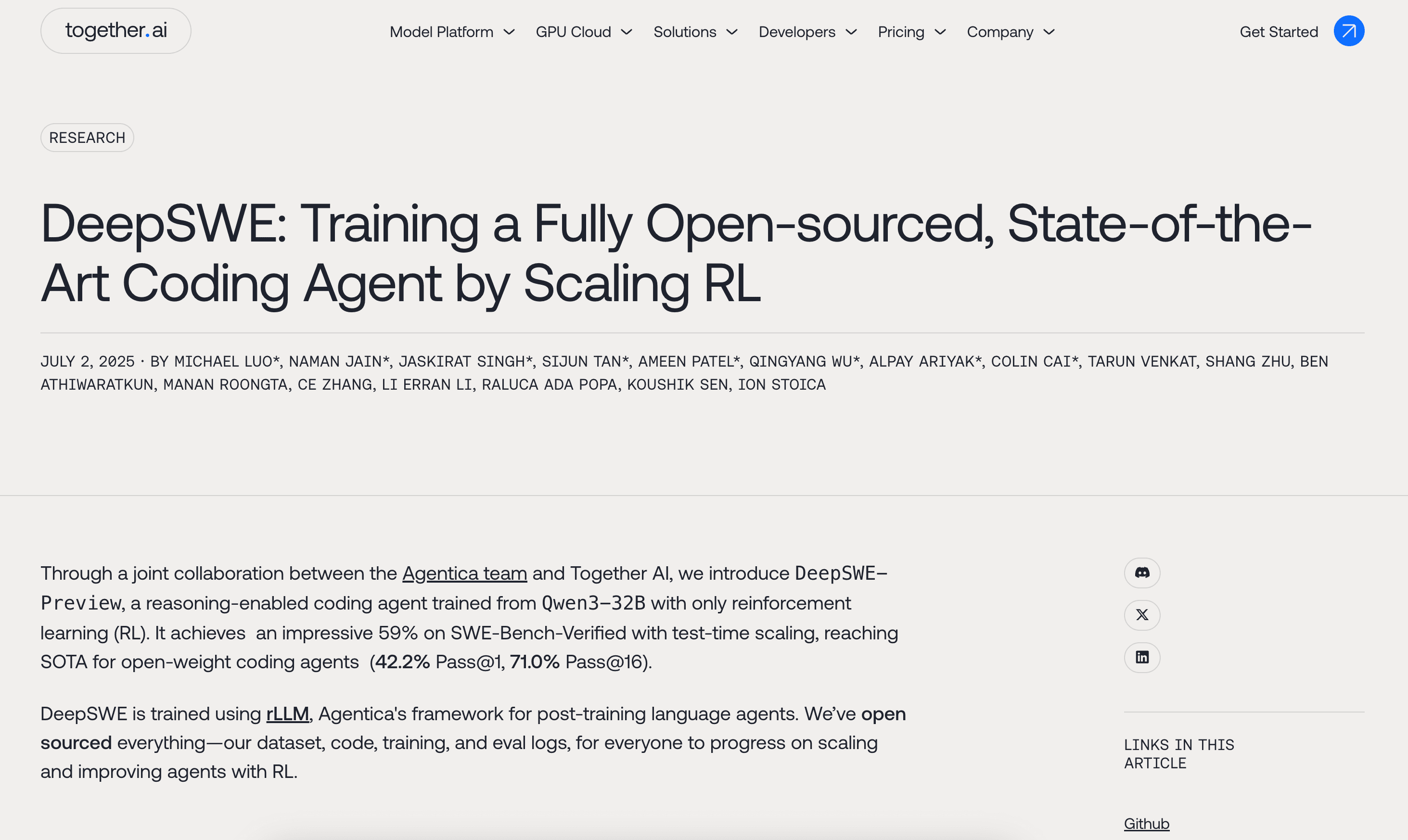
Overview
DeepSWE-Preview was trained with reinforcement learning to inspect repositories, search files, edit code, run shell commands and submit a patch. The team released the model weights, a 4,500-task training subset, training code and evaluation logs, making it most useful to researchers and engineering teams building their own coding-agent stack.
At launch, the authors reported 42.2% Pass@1 on SWE-bench Verified averaged across 16 runs. The headline 59% result used hybrid test-time scaling to generate and select among 16 candidate trajectories, so it should not be read as the success rate of one ordinary run. The model card recommends temperature 1, 32K–64K output capacity and the R2E-Gym prompt and tool scaffold.
The weights remain downloadable under an MIT license, but DeepSWE-Preview is still labeled Preview and requires substantial infrastructure and agent plumbing. Teams that want an everyday coding assistant will generally be better served by a maintained hosted agent; DeepSWE is stronger as a reproducible research baseline or a starting checkpoint for further work.
Use cases
The strongest fit depends on the job you need the product to complete, not the size of its feature list.
Study reinforcement learning for long-horizon repository work with published weights, data, logs and training code.
Build a controlled coding system around an open 32B checkpoint and your own sandbox, tools and review gates.
Re-run or extend the published R2E-Gym and SWE-bench experiments instead of relying only on a closed product score.
Capabilities
The training scaffold lets the agent search a codebase and inspect relevant files across a multi-step task.
DeepSWE can create and modify files through the R2E-Gym file-editor interface.
The agent can run commands and tests inside an isolated software-engineering environment.
It was trained with outcome rewards based on whether generated patches passed selected tests.
The release includes weights, a filtered training dataset, training scripts, experiment logs and evaluation traces.
The model card documents Transformers, vLLM and SGLang paths for teams operating their own inference stack.
Process
Step 1
Treat DeepSWE as a model component. Define the agent scaffold, repositories, permitted commands and review boundary before deployment.
Step 2
Serve the 32B model on suitable GPU infrastructure and run generated commands in disposable, least-privilege sandboxes without production secrets.
Step 3
Start with the R2E-Gym system prompt and search, file-editor, shell and finish tools used by the published evaluation.
Step 4
Measure first-attempt pass rate, regressions, latency, token use and cost on your own repositories rather than importing the launch headline.
Step 5
Inspect the diff, run the full test and security suite, and merge only through the same protections used for human contributions.
Cost
The DeepSWE-Preview weights and associated open-source artifacts do not carry a software subscription fee. Real cost comes from GPU inference, storage, sandboxes, repeated candidate runs and engineering operations. Together AI does not currently list DeepSWE-Preview in its public serverless model catalog, so there is no official per-token DeepSWE endpoint price.
$0 license fee
Download the MIT-licensed checkpoint from Hugging Face.
Variable GPU cost
Run with Transformers, vLLM, SGLang or another compatible stack.
From published GPU rates
Use dedicated inference or GPU clusters where supported; this is infrastructure pricing, not a DeepSWE serverless SKU.
Pricing checked . Check current pricing at the source ↗
Assessment
Compare
The right alternative depends on the specific output, workflow, controls and budget your project requires.
Coding
Qwen3-Coder-Next is a newer open-weight coding model designed for agentic workloads and may be a more current self-hosted baseline.
Explore Qwen3-Coder-Next →Coding
Devstral 2 is a newer coding-focused model family for teams comparing open agentic coding checkpoints.
Explore Devstral 2 →Coding
Cursor Agents is a managed product for teams that want a usable remote coding workflow without building the model and sandbox stack themselves.
Explore Cursor Agents →Questions
No. DeepSWE-Preview is an open-weight 32B model and research release. You need to supply inference infrastructure, an agent scaffold, repository access, tools and sandboxing.
The model weights are available under an MIT license with no subscription fee. GPU inference, storage, execution sandboxes and operations still cost money.
DeepSWE-Preview is not listed in Together AI's current public serverless catalog. You can self-host the weights or investigate compatible custom and dedicated deployment options.
It is the authors' 2025 SWE-bench Verified result using hybrid test-time scaling to choose among 16 trajectories. Their average single-run Pass@1 result was 42.2%.
The model card recommends temperature 1, at least 32K–64K maximum output tokens and the R2E-Gym prompt and tools used during evaluation.
Not without controls. Use an isolated environment, least-privilege credentials, command restrictions, full automated tests and mandatory human review before any merge or deployment.
Bottom line
DeepSWE-Preview is still a useful open research artifact for teams studying or building coding agents, especially because its weights, data, training code and logs are available together. It is not the simplest route to a production coding assistant, and its launch benchmark headline needs the best-of-16 context. Choose it when openness and experimentation matter more than turnkey usability.
Visit Deep SWE website ↗
Bolt.new: Lets you spin up AI-powered web apps instantly using natural language.

Emergent 2.0 - Agentic vibe coding platform for production-ready apps

Gemini CLI - Google's open-source terminal agent with high free usage limits

Devstral - Mistral's open model family for agentic coding

Get access to all our AI courses, hundreds of real-world AI use cases, live expert-led workshops, an exclusive network of AI early adopters, and more.
Get unlimited access to all of our current & upcoming industry-specific AI courses for the duration of your subscription.
To keep up with the rapid pace of AI, our team publishes AI implementation guides daily. Our library contains 300+ practical use cases to automate real-world work.
Join weekly, live, interactive sessions with industry leaders who are at the forefront of AI for hands-on implementation guidance and exclusive insights.
Network with an exclusive community of AI-first professionals who are working smarter with AI. Learn how early adopters are using AI in their work and businesses.