Interactive agentic coding
Iterate quickly through a write, run, inspect and fix loop without waiting on a slower reasoning model for routine work.
Independent tool overview
Composer 2.5 is Cursor's current fast, cost-focused agentic coding model for searching repositories, editing files, running commands and completing long software tasks.
Visit the official Cursor Composer site ↗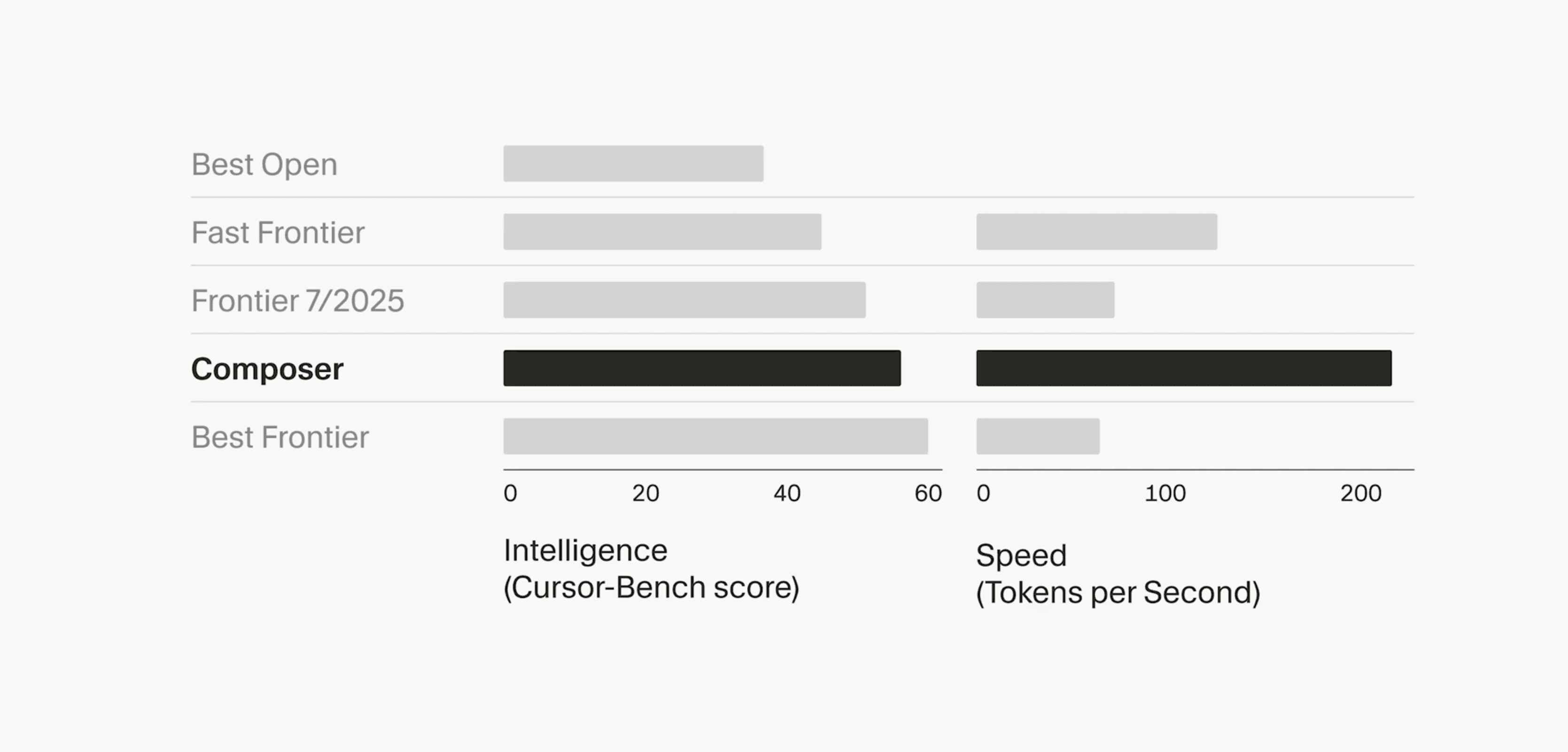
Overview
The Composer model introduced with Cursor 2.0 in October 2025 has been superseded by Composer 2.5. The current version has a 200,000-token context window and is tuned for long-horizon coding, tool selection, file edits and terminal operations inside Cursor's local, cloud, web, CLI, mobile and SDK agent surfaces. Older Composer 2 model IDs are routed to 2.5 for compatibility.
Composer's value proposition is the combination of capable coding and fast iteration at relatively low token prices. It can search a repository, read and edit files, run commands, browse and use connected tools through Cursor's agent harness. It still needs the same engineering controls as any coding agent: a narrow brief, tests, secret protection, diff review and explicit approval before destructive commands, deployments or changes to production data.
Use cases
The strongest fit depends on the job you need the product to complete, not the size of its feature list.
Iterate quickly through a write, run, inspect and fix loop without waiting on a slower reasoning model for routine work.
Search a large codebase, trace related files and apply coordinated edits across multiple modules.
Handle multi-step work that needs repeated tool calls, test runs and corrections over an extended session.
Run work against connected repositories in Cursor's managed environment and return branches, pull requests or demos for review.
Build local or cloud agents with the Cursor SDK while selecting Composer 2.5 explicitly.
Capabilities
Composer 2.5 is trained and tuned to sustain multi-step software tasks with many tool actions.
Searches files, folders and text patterns to assemble relevant code context.
Creates and applies changes across source, configuration, tests and documentation.
Runs commands, follows process output and uses the results to continue debugging or implementation.
Can operate a browser for screenshots and visual checks when used through supported Cursor agent tools.
Can search the web and connect to approved MCP servers or Cursor Marketplace plugins.
Offers a lower-cost standard tier and a higher-throughput Fast tier with the same model positioning.
Works in a local repository or a durable Cursor cloud agent connected to source control.
Public-beta TypeScript and Python SDKs expose agent lifecycle, streaming, cancellation and local or cloud execution.
Prevents code from being used for training; team admins can enforce it across members.
Process
Step 1
Specify the desired behavior, allowed files, non-goals, acceptance tests and actions that require approval.
Step 2
Point to project rules, architecture notes and canonical commands while excluding secrets and irrelevant generated files.
Step 3
Have Composer identify the current path, dependencies and likely change surface before applying a broad edit.
Step 4
Prefer reviewable steps with focused tests over one unbounded request that touches the entire repository.
Step 5
Run formatting, type checks, tests and browser or runtime checks, then inspect the actual diff and generated artifacts.
Step 6
Keep merges, deployments, migrations, credential changes and production writes under explicit human control.
Cost
Composer 2.5 consumes Cursor's first-party model usage pool on eligible plans, with additional use billed by tokens. The lower-cost standard variant is $0.50 per million input tokens and $2.50 per million output tokens; Fast is the product default and costs $3 and $15 respectively. Cache-read rates are lower.
$0.50/M input · $0.20/M cached input · $2.50/M output
Token-based standard variant optimized for lower cost per task.
$3/M input · $0.50/M cached input · $15/M output
Higher-throughput variant and the default Composer experience in the product.
$0
Free editor plan with limited Agent requests and access to Composer.
$20, $60 or $200/month
Pro, Pro+ and Ultra plans with progressively larger Agent usage pools.
$40 or $120/user/month
Standard and Premium team plans with administration and enforced privacy controls.
Pricing checked . Check current pricing at the source ↗
Assessment
Compare
The right alternative depends on the specific output, workflow, controls and budget your project requires.
Coding
OpenAI's broader agentic coding environment for local and cloud tasks, long-running work and programmatic workflows.
Explore Codex →Coding
A terminal-centered coding agent that is a strong fit for deep repository reasoning and developer-controlled workflows.
Explore Claude Code →Coding
Cursor's automatic model selection when cost, intelligence or reliability matters more than pinning Composer.
Explore Cursor Router →Coding
A competing agentic development environment now integrated with Devin's broader software-engineering platform.
Explore Devin Desktop (formerly Windsurf) →Questions
Composer is Cursor's first-party agentic coding model family. The current version is Composer 2.5, which searches repositories, edits files, runs commands and works through Cursor's agent runtime.
No. The October 2025 announcement introduced Composer 1. Cursor later released Composer 2 and 2.5; older Composer 2 identifiers now route to 2.5.
Standard costs $0.50 per million input tokens, $0.20 per million cached input tokens and $2.50 per million output tokens. Fast costs $3, $0.50 and $15 respectively. Eligible Cursor plans include usage pools before on-demand billing.
Yes. Cursor's Hobby plan lists access to Composer with limited Agent requests. Paid individual plans start at $20 per month.
Yes, through Cursor's web, CLI, mobile, cloud-agent and public-beta Agent SDK surfaces. Cursor does not document Composer as a standalone raw model-inference API.
The current official model page lists a 200,000-token context window for Composer 2.5.
With Privacy Mode enabled, Cursor says code is not used for training by Cursor or model providers. AI requests still send selected prompts and code context through Cursor's backend and inference infrastructure.
Only after the team has established strong tests, scoped credentials, approvals and rollback. Start with human-reviewed branches and treat agent output like code from an untrusted contributor.
Bottom line
Composer 2.5 is a compelling default inside Cursor when developers want a quick agent loop and predictable token economics without jumping to the most expensive frontier model. Its advantage comes from the surrounding search, editing and execution harness as much as the model. Teams should compare it on real tasks and keep production authority behind tests and review.
Visit Cursor Composer website ↗
Get access to all our AI courses, hundreds of real-world AI use cases, live expert-led workshops, an exclusive network of AI early adopters, and more.
Get unlimited access to all of our current & upcoming industry-specific AI courses for the duration of your subscription.
To keep up with the rapid pace of AI, our team publishes AI implementation guides daily. Our library contains 300+ practical use cases to automate real-world work.
Join weekly, live, interactive sessions with industry leaders who are at the forefront of AI for hands-on implementation guidance and exclusive insights.
Network with an exclusive community of AI-first professionals who are working smarter with AI. Learn how early adopters are using AI in their work and businesses.

.png)