Developers comparing Composer generations
Understand the adaptive reasoning and self-summarization capabilities introduced before the Composer 2 series.
Independent tool overview
Composer 1.5 was Cursor's February 2026 agentic coding model; it has since been superseded by Composer 2 and the current Composer 2.5 model.
Visit the official Composer 1.5 site ↗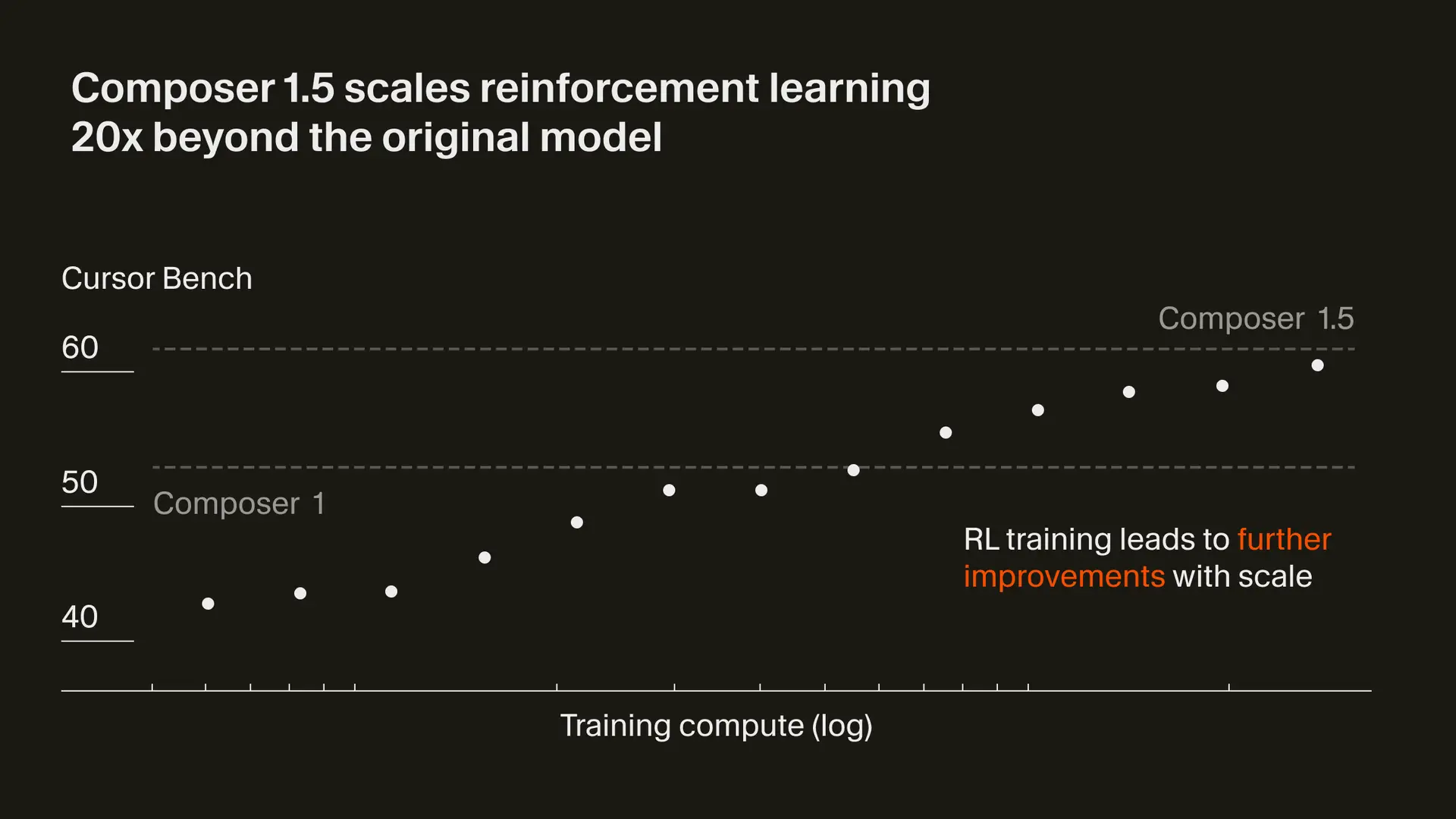
Overview
Cursor released Composer 1.5 in February 2026 as a faster, more capable update to its first in-house agentic coding model. It used adaptive reasoning for difficult work and could summarize its own context to continue longer tasks. Cursor said its reinforcement-learning post-training used more than 20 times the scale applied to Composer 1.
Composer 1.5 is no longer the current version to choose. Cursor released Composer 2 in March and Composer 2.5 in May 2026, and its current model catalog lists Composer 2.5 rather than 1.5. The newer model is designed for sustained agent work and more reliable instruction following, so this page is most useful as an explanation of the earlier model and a route to the active Composer family.
Use cases
The strongest fit depends on the job you need the product to complete, not the size of its feature list.
Understand the adaptive reasoning and self-summarization capabilities introduced before the Composer 2 series.
Use the 1.5 history as context, then test Composer 2.5 on representative repositories and workflows.
Identify what the Composer 1.5 label meant in saved conversations, usage reports or February 2026 documentation.
Capabilities
Composer 1.5 was trained to respond quickly to easier work and spend more time reasoning through difficult codebase tasks.
The model could create a working summary when context ran out, allowing an agent to continue exploring longer tasks.
Cursor positioned 1.5 for day-to-day agentic coding where responsiveness mattered alongside problem-solving ability.
Cursor reported scaling reinforcement-learning post-training more than 20 times beyond Composer 1 on the same pretrained base model.
Composer 2.5 now carries the product forward with stronger long-horizon work, complex instruction following and collaboration behavior.
Process
Step 1
Install or open Cursor, start an agent session and select Composer 2.5 from the current model picker.
Step 2
Describe the goal, relevant constraints and verification requirements, and let the agent inspect the codebase before editing.
Step 3
Watch tool use, inspect the proposed diff and interrupt or redirect the agent if it moves outside the intended scope.
Step 4
Treat generated code as a draft: run tests, linting, builds and a manual review before merging.
Cost
Composer 1.5 is not sold as a separate current plan. Composer 2.5 usage is available through Cursor and is metered by tokens: Standard is $0.50 per million input tokens and $2.50 per million output tokens; Fast is $3 and $15 respectively. Cursor subscriptions include usage pools, with additional usage billed according to the selected model.
Free
For trying Cursor with limited agent requests and Tab completions.
$20/month
The entry individual plan with extended agent limits and frontier-model access.
$60/month
For developers who use agents daily and need a larger included usage pool.
$200/month
For individual power users running substantially more agent work.
$40/user/month
For organizations that need centralized management and team-wide controls.
Pricing checked . Check current pricing at the source ↗
Assessment
Compare
The right alternative depends on the specific output, workflow, controls and budget your project requires.
Coding
Use the main Cursor page for a broader view of the editor, agents, supported models and current plans.
Explore Cursor →Coding
Consider Claude Code for Anthropic's terminal-centered coding-agent workflow.
Explore Claude Code →Coding
Consider OpenAI Codex for parallel cloud and local coding-agent workflows outside the Cursor model family.
Explore Codex →Questions
Composer 1.5 was Cursor's February 2026 in-house agentic coding model. It focused on interactive speed, adaptive reasoning and self-summarization for longer coding tasks.
No. Cursor released Composer 2 and then Composer 2.5, which is the Composer version listed in the current model catalog.
Composer 2 directly replaced 1.5 in March 2026, followed by Composer 2.5 in May. Cursor says 2.5 improves sustained long-running work, complex instruction following and collaboration behavior.
Composer 2.5 Standard is listed at $0.50 per million input tokens and $2.50 per million output tokens. Fast is $3 per million input tokens and $15 per million output tokens. Usage is accessed through a Cursor plan.
Choose Composer 2.5 for current work. Composer 1.5 is useful mainly for historical comparison or understanding older Cursor sessions and documentation.
Bottom line
Composer 1.5 was an important step in Cursor's in-house model development, especially for adaptive reasoning and long-task continuity. For new work, use the current Composer 2.5 model and evaluate its quality, speed and token cost on your own codebase rather than seeking out 1.5.
Visit Composer 1.5 website ↗
GPT-5.3-Codex - OpenAI's new SOTA agentic coding model
Oz - Warp's cloud platform for orchestrating hundreds of coding agents in parallel
Qwen3-Coder-Next - Alibaba's open-weight, small hybrid model for agentic coding

Orchids 1.0 - AI app builder for any stack with BYO model subscriptions

Get access to all our AI courses, hundreds of real-world AI use cases, live expert-led workshops, an exclusive network of AI early adopters, and more.
Get unlimited access to all of our current & upcoming industry-specific AI courses for the duration of your subscription.
To keep up with the rapid pace of AI, our team publishes AI implementation guides daily. Our library contains 300+ practical use cases to automate real-world work.
Join weekly, live, interactive sessions with industry leaders who are at the forefront of AI for hands-on implementation guidance and exclusive insights.
Network with an exclusive community of AI-first professionals who are working smarter with AI. Learn how early adopters are using AI in their work and businesses.