Exploratory research
Map a broad topic, competing perspectives, terminology, and follow-up questions before narrowing a research plan.
Independent tool overview
Co-STORM is Stanford OVAL's research system for collaborative knowledge exploration, using multiple source-grounded AI agents, a moderator, human steering, and a dynamic mind map to develop a cited long-form report.
Visit the official Co-STORM site ↗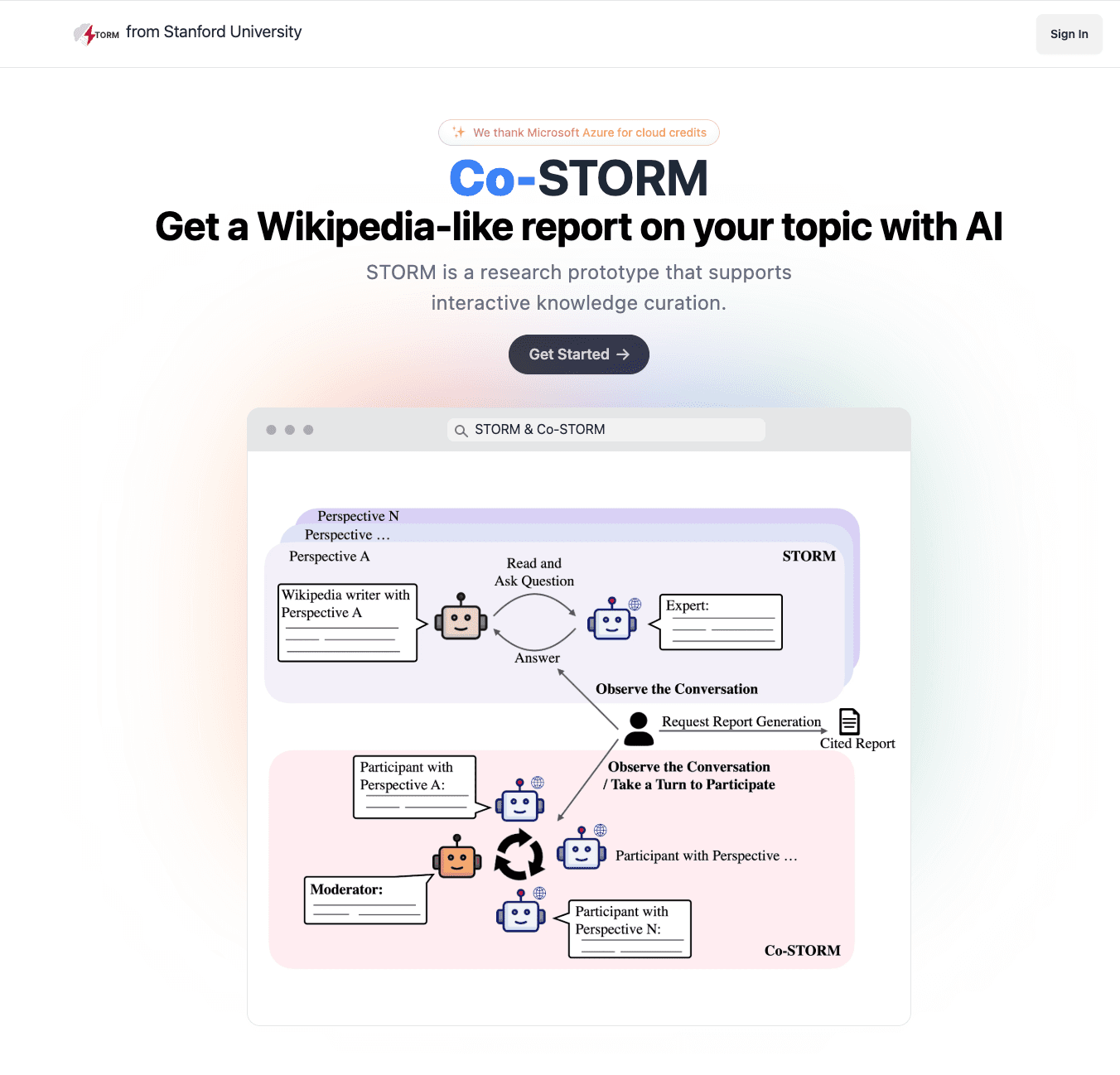
Overview
Co-STORM extends Stanford's STORM article-generation project from a mostly automated research pipeline into a collaborative discourse. Several AI experts retrieve information and discuss a topic, a moderator raises underexplored questions, and the human can either observe or inject new directions. A live concept hierarchy updates as the conversation develops, then the curated material can be reorganized into a Wikipedia-like report with citations.
The design is useful for discovering subtopics and questions a researcher did not know to ask, but it remains a research preview and pre-writing tool. Retrieval can miss authoritative sources, citations may not support the exact sentence, several agents can amplify the same error or source bias, and the generated report is not publication-ready. Every important claim needs source-level verification and editorial revision.
Use cases
The strongest fit depends on the job you need the product to complete, not the size of its feature list.
Map a broad topic, competing perspectives, terminology, and follow-up questions before narrowing a research plan.
Use the moderator and expert discourse to surface angles a single query or linear chatbot exchange may miss.
Create a source-backed outline and rough report that an editor will substantially verify and rewrite.
Follow a structured discussion and concept map while asking clarifying or redirecting questions.
Identify disagreements, evidence gaps, related fields, and candidate questions for deeper investigation.
Customize agent policies, models, retrievers, turn management, and output structure in the open-source package.
Capabilities
Runs an initial mini-STORM process to collect background and establish a shared conceptual space.
Uses agents that answer from retrieved sources and raise follow-up questions based on the discourse.
Introduces thought-provoking questions from discovered but underexplored information.
Lets the user observe the agent discussion or inject a turn to change focus.
Coordinates experts, moderator, and user so the discourse can progress without relying on one agent.
Organizes collected snippets into an evolving hierarchical concept structure.
Connects agent responses to internet search or a configured document retriever.
Reorganizes the knowledge base and drafts a long-form report with linked references.
Exposes a CoStormRunner and configurable language-model, retriever, logging, and agent components.
The example code supports services such as Bing, You.com, Brave, DuckDuckGo, Serper, Tavily, and SearXNG.
LiteLLM integration allows developers to configure supported language and embedding models.
The project publishes papers, code, the WildSeek evaluation dataset, and reproducibility branches.
Process
Step 1
Write a bounded question, audience, date range, geography, definitions, and desired decision or learning outcome.
Step 2
Identify primary documents, official data, peer-reviewed work, and excluded low-quality source types before starting.
Step 3
Let Co-STORM build initial perspectives and inspect the early mind map for obvious gaps or bad assumptions.
Step 4
Inject corrections, request opposing evidence, narrow ambiguous terms, and ask agents to distinguish fact from inference.
Step 5
Open citations as they appear and reject material that is outdated, secondary when primary evidence exists, or unrelated.
Step 6
Check whether prominent branches reflect evidence quality rather than repetition or search popularity.
Step 7
Treat the final report as a structured research memo for review, not a finished article.
Step 8
Confirm that each source exists, is authoritative, is represented fairly, and supports the exact nearby statement.
Step 9
Correct synthesis, add missing evidence and uncertainty, apply the publisher's voice, and disclose AI assistance where required.
Cost
Stanford presents the hosted site as a free research preview and does not publish a commercial subscription. The open-source code is MIT-licensed, but self-hosting is not cost-free: developers supply and pay for model inference, embeddings, search or retrieval APIs, storage, compute, and maintenance. Hosted availability and quotas are not guaranteed like a paid service.
Free preview
Public web experience provided for experimentation and feedback.
MIT license; infrastructure costs extra
Python package for developers who want to run or customize STORM and Co-STORM.
Pricing checked . Check current pricing at the source ↗
Assessment
Compare
The right alternative depends on the specific output, workflow, controls and budget your project requires.
Consumer
Choose Gemini Deep Research Agent for a current production-oriented long-running research API in Google's ecosystem.
Explore Gemini Deep Research Agent →Educators
Choose Consensus for research questions centered on finding and synthesizing academic papers.
Explore ResearchGPT (now Consensus) →Data Analysis
Choose Perplexity for a simpler consumer answer engine with web citations and fewer multi-agent research controls.
Explore Perplexity →Questions
Co-STORM is Stanford OVAL's collaborative AI research system. Multiple source-grounded agents and a moderator discuss a topic while the user steers the conversation and a dynamic mind map organizes findings.
STORM primarily researches, outlines, and drafts a cited article. Co-STORM adds live human participation, multiple expert agents, a moderator, turn management, and a dynamic concept map.
The Stanford site is offered as a free research preview with no published paid plan. The MIT-licensed code is free to use, but self-hosting requires paid or local models, retrieval, compute, and maintenance.
It can generate a long Wikipedia-style report with citations after the discourse. The project says these outputs are not publication-ready and require significant editing.
They provide traceability, not a guarantee. Open every source and verify authority, date, context, and whether it supports the exact claim.
Yes. A user can observe agent turns or inject an utterance to redirect, correct, narrow, or deepen the discourse.
It is a dynamically updated hierarchy of concepts and collected information intended to create shared structure between the user and agents.
Yes. The knowledge-storm package and source code are available under the MIT license, with configurable models, embeddings, retrievers, agents, and turn policies.
Do not use the public preview for confidential material without approved terms. A private deployment still requires review of every model, retriever, log, database, retention rule, and credential.
No. It can broaden pre-writing exploration, but humans must select authoritative evidence, verify claims, resolve contradictions, assess uncertainty, and produce the final accountable work.
Bottom line
Co-STORM is a thoughtful research prototype for broadening a topic before writing, especially when its agents and mind map help expose questions a user had not considered. Its best use is exploratory and human-led. Treat the resulting report as an evidence map and rough draft, then rebuild important conclusions from primary sources rather than trusting the apparent consensus of several related agents.
Visit Co-STORM website ↗
HeyGen Video Agent - Create video content with scripts, actors, edits, and more

Veo 3 - Google's SOTA video generation model

Higgsfield Soul - A new “high-aesthetic” photo model with advanced realism and 50+ presets for easy style optimization

Genspark AI Docs - an agentic creator allowing users to generate and edit a variety of document times via natural language prompts.

Get access to all our AI courses, hundreds of real-world AI use cases, live expert-led workshops, an exclusive network of AI early adopters, and more.
Get unlimited access to all of our current & upcoming industry-specific AI courses for the duration of your subscription.
To keep up with the rapid pace of AI, our team publishes AI implementation guides daily. Our library contains 300+ practical use cases to automate real-world work.
Join weekly, live, interactive sessions with industry leaders who are at the forefront of AI for hands-on implementation guidance and exclusive insights.
Network with an exclusive community of AI-first professionals who are working smarter with AI. Learn how early adopters are using AI in their work and businesses.