Research applications
Add cited, multi-step web research to a product without building the entire search-and-synthesis loop.
Independent tool overview
Gemini Deep Research Agent is Google's preview API agent for autonomously planning, searching, reading, reasoning, and producing detailed cited reports from long-running research tasks.
Visit the official Gemini Deep Research Agent site ↗
Overview
Gemini Deep Research Agent is the developer-facing version of Google's autonomous research workflow. A single request can trigger an iterative loop that builds a plan, searches and reads sources, reasons across the collected material, and synthesizes a cited report rather than returning a normal one-shot model response.
Developers access it through the Gemini Interactions API in Google AI Studio or the Gemini API. It is designed for research-heavy applications such as market landscapes, due diligence, technical reviews, and knowledge synthesis, with optional collaborative planning, document inputs, visualizations, and remote MCP connections.
Use cases
The strongest fit depends on the job you need the product to complete, not the size of its feature list.
Add cited, multi-step web research to a product without building the entire search-and-synthesis loop.
Gather and compare companies, products, markets, or technical approaches across many sources.
Produce an initial evidence map and cited briefing for a human analyst to verify.
Combine trusted documents, external research, and connected data sources into a structured narrative.
Capabilities
Plans, searches, reads, and reasons through a question over multiple agent steps.
Returns detailed research with citations that applications can expose for source verification.
Can return a proposed research plan for review, editing, and approval before execution.
Offers a faster Deep Research preview and a more comprehensive Deep Research Max preview.
Supports document inputs, generated visualizations, and external tools or data through remote MCP servers.
Runs long tasks asynchronously and can be polled or streamed so applications can show progress.
Process
Step 1
State the question, scope, source preferences, decision criteria, and how the agent should handle missing information.
Step 2
For complex work, enable collaborative planning and refine the proposed approach before approving execution.
Step 3
Create an Interactions API task with background execution and poll or stream its progress.
Step 4
Inspect citations, check important claims against the original sources, and review cost and token usage.
Cost
Pricing is usage-based rather than a fixed per-report charge. Google bills the underlying Gemini inference, including intermediate reasoning tokens, plus the tools and search grounding the agent uses.
Estimated $1-$3 per typical task
Designed for speed and efficient research that can be streamed into an application.
Estimated $3-$7 per deep task
Designed for more comprehensive research and automated context gathering.
Usage-based / contact sales
Google Cloud deployment with enterprise security, support, compliance, and throughput options.
Pricing checked . Check current pricing at the source ↗
Assessment
Compare
The right alternative depends on the specific output, workflow, controls and budget your project requires.
Data Analysis
Choose Perplexity for an end-user research experience with fast web answers and citations.
Explore Perplexity →Agents
Choose Manus for a broader general-purpose agent that can research and complete operational tasks.
Explore Manus →Educators
Choose Consensus when the research question should be answered primarily from scientific papers.
Explore ResearchGPT (now Consensus) →Questions
It is a managed Gemini API agent that autonomously plans, searches, reads, reasons, and produces a cited report for complex research requests.
The agent is available through the Gemini Interactions API in Google AI Studio and the Gemini API. Long tasks must run with background execution.
Google estimates about $1 to $3 for a typical moderate Deep Research task and $3 to $7 for a heavier Deep Research Max task during preview. Actual cost depends on tokens, searches, caching, and tools.
The standard preview is designed for faster and more efficient research, while Max prioritizes comprehensiveness for larger evidence-gathering and synthesis tasks.
Yes. It can accept documents and connect to external tools through remote MCP servers, but developers should treat both files and web content as potential prompt-injection sources.
Bottom line
Gemini Deep Research Agent is compelling for developers who need a managed research engine rather than a consumer chat feature. The combination of planning, citations, background execution, documents, charts, and MCP can remove substantial orchestration work. Its preview status, variable cost, safety risks, and lack of structured output mean it should launch behind careful review, observability, and spending controls.
Visit Gemini Deep Research Agent website ↗
GPT-5.2 - OpenAI's most advanced model family
Disco - Google's experimental browser that uses Gemini 3 to generate custom web applications based on your open tabs and browsing tasks
Purpose - AI mentor for deep, personalized guidance on-demand
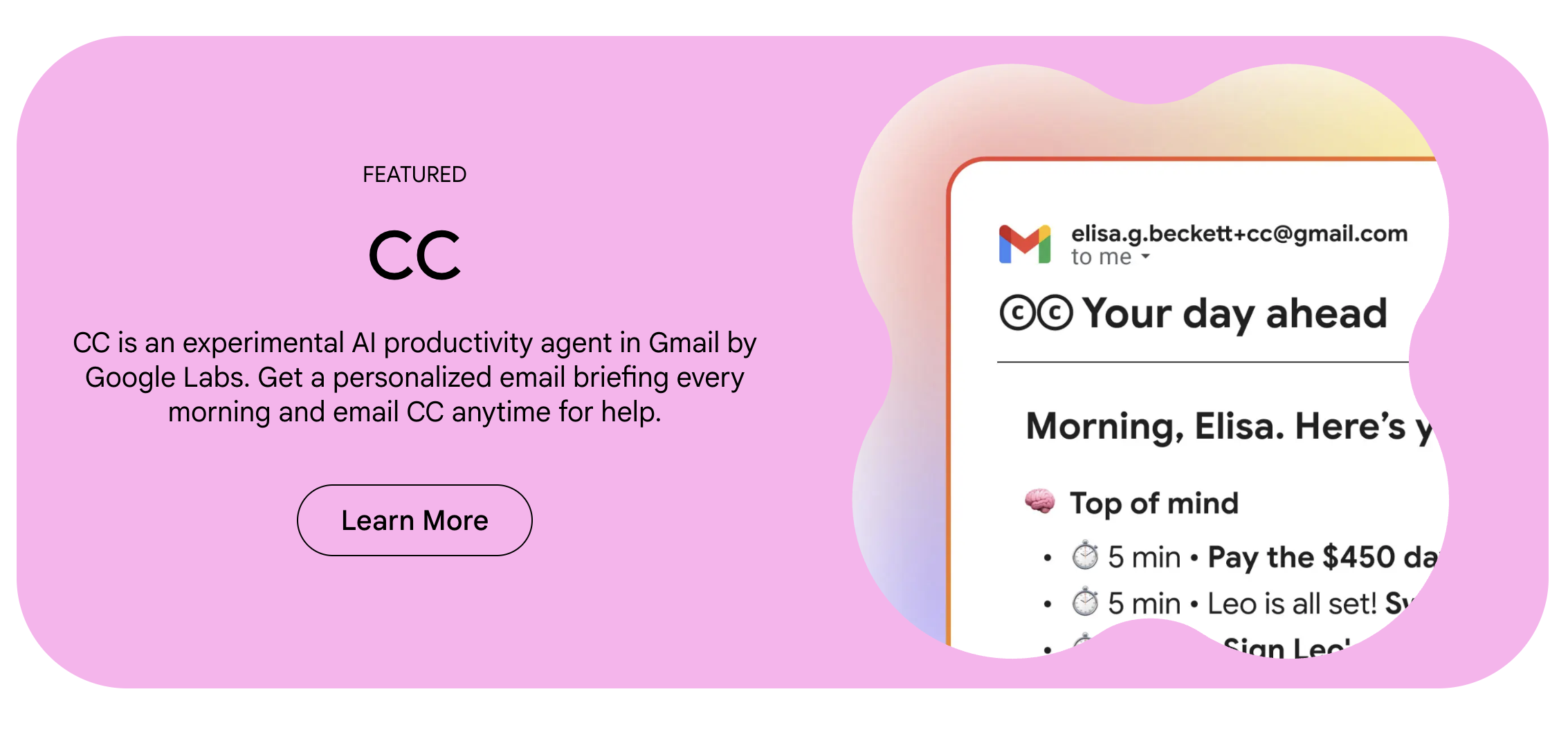
CC - Google Labs’ experimental AI productivity agent in Gmail

Get access to all our AI courses, hundreds of real-world AI use cases, live expert-led workshops, an exclusive network of AI early adopters, and more.
Get unlimited access to all of our current & upcoming industry-specific AI courses for the duration of your subscription.
To keep up with the rapid pace of AI, our team publishes AI implementation guides daily. Our library contains 300+ practical use cases to automate real-world work.
Join weekly, live, interactive sessions with industry leaders who are at the forefront of AI for hands-on implementation guidance and exclusive insights.
Network with an exclusive community of AI-first professionals who are working smarter with AI. Learn how early adopters are using AI in their work and businesses.