Existing production workloads
Maintain a pinned model behavior while a team evaluates and validates migration to a newer Claude model.
Independent tool overview
Claude Opus 4.5 is Anthropic's November 2025 frontier model for coding, agents, computer use, research, and complex knowledge work; it remains API-active but is no longer the newest Opus model.
Visit the official Claude 4.5 Opus site ↗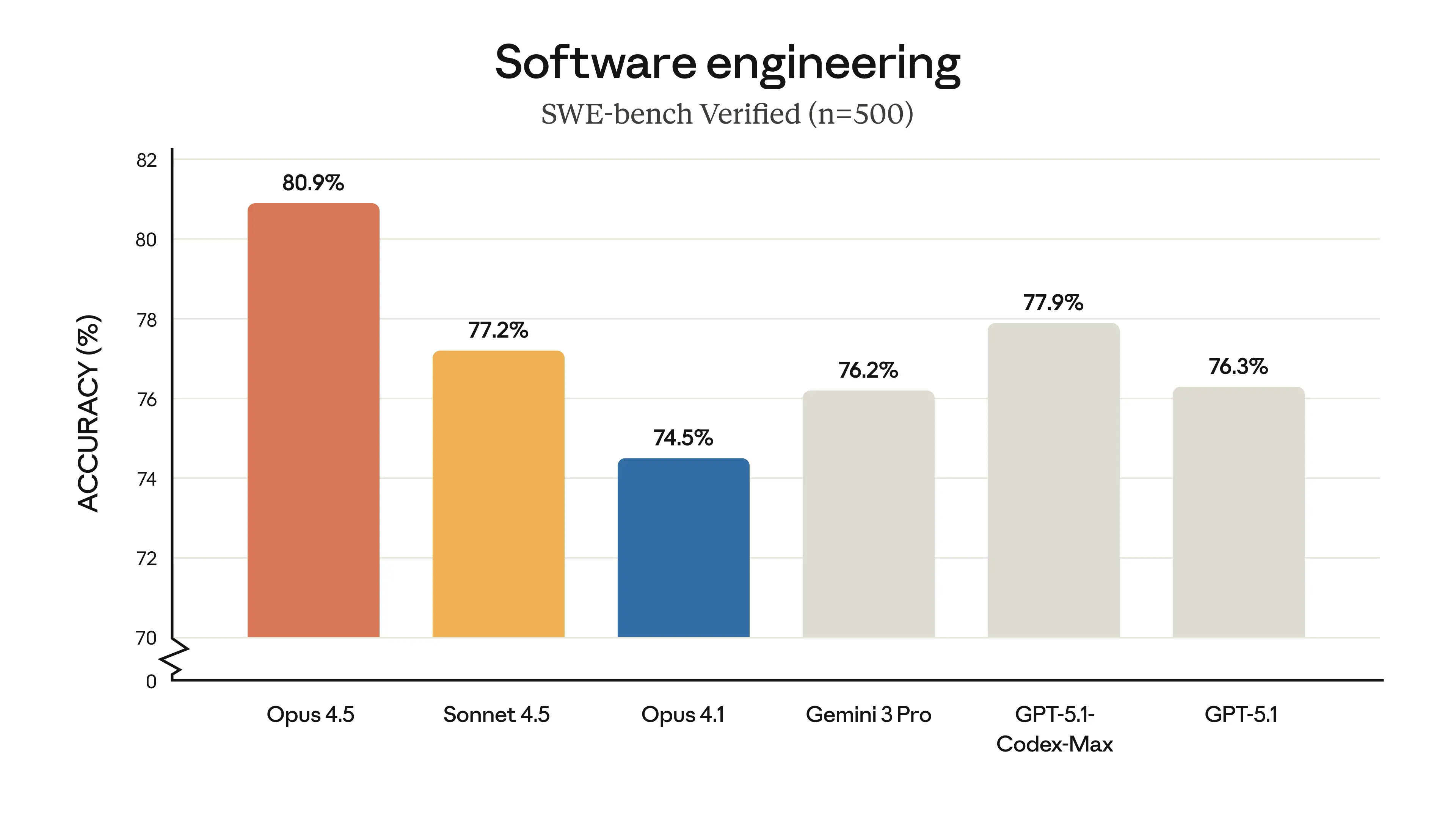
Overview
Claude Opus 4.5 launched in November 2025 as Anthropic's highest-capability model for software engineering, agentic workflows, computer use, research, and document-heavy knowledge work. Its pinned Claude API model ID is claude-opus-4-5-20251101, with availability also originally announced across Anthropic's apps and major cloud platforms.
The model introduced materially lower Opus pricing than earlier Opus releases at $5 per million input tokens and $25 per million output tokens. It supports text and image input, tool use, prompt caching, batch processing, structured outputs, and manual extended thinking. Its launch also emphasized better token efficiency on difficult coding and agent tasks.
Opus 4.5 remains active on Anthropic-operated API platforms as of this review, with retirement listed as no sooner than November 24, 2026. However, it has been superseded by later Opus generations, and Anthropic's current model guidance points new complex workloads to newer models. Existing teams should keep 4.5 only when regression results, behavior stability, or migration timing justify it.
Use cases
The strongest fit depends on the job you need the product to complete, not the size of its feature list.
Maintain a pinned model behavior while a team evaluates and validates migration to a newer Claude model.
Handle repository-scale reasoning, debugging, refactoring, and multi-step tasks that were core targets of the release.
Reproduce or compare results from systems and evaluations originally built around the November 2025 model snapshot.
Capabilities
The dated model ID preserves a consistent underlying Opus 4.5 version for the lifetime of that API model.
Designed for difficult software-engineering tasks, longer tool-using workflows, and planning across multiple systems.
Supports the legacy thinking configuration with an explicit token budget rather than the adaptive-thinking interface used by newer models.
Accepts text and image inputs and can be integrated with client and server tools for application and computer-use workflows.
Supports prompt caching and 50%-discounted batch processing, with structured outputs available for schema-constrained responses.
Process
Step 1
Use Opus 4.5 only when pinned behavior, validated quality, or migration constraints matter more than access to the newest model capabilities.
Step 2
Use claude-opus-4-5-20251101 in the API and avoid assuming that newer adaptive-thinking configuration is compatible.
Step 3
Track accuracy, tool-call reliability, latency, input and output tokens, cache use, and failure cases on representative workloads.
Step 4
Run the same evaluation set against a newer Opus or a lower-cost Sonnet model, then migrate only after checking behavior and API differences.
Cost
Claude Opus 4.5 API usage is metered by tokens. Standard global pricing is $5 per million input tokens and $25 per million output tokens; cache reads are cheaper, cache writes cost more than base input, and Batch API jobs receive a 50% input/output discount.
$5 input / $25 output per MTok
Base global Claude API pricing for synchronous Opus 4.5 requests.
$6.25 5-minute write / $10 1-hour write / $0.50 hit per MTok
Reduces repeated-input cost when stable prompt content can be cached.
$2.50 input / $12.50 output per MTok
For asynchronous workloads that do not require immediate responses.
Pricing checked . Check current pricing at the source ↗
Assessment
Compare
The right alternative depends on the specific output, workflow, controls and budget your project requires.
Consumer
A newer active Opus generation with a 1M-token context window, adaptive thinking, and the same standard $5/$25 token price.
Explore Claude Opus 4.8 →Consumer
A newer, lower-cost Claude option for teams that prioritize speed and scale while retaining strong coding and agentic capability.
Explore Claude Sonnet 5 →Questions
Yes. Anthropic lists claude-opus-4-5-20251101 as active on its operated API platforms, with retirement no sooner than November 24, 2026. Availability and timelines on partner cloud platforms can differ.
No. Anthropic has released multiple newer Opus models and now recommends newer generations for new high-capability workloads.
Standard global API pricing is $5 per million input tokens and $25 per million output tokens. Prompt caching and batch processing have separate rates, and partner-cloud charges can differ.
The pinned Claude API model ID is claude-opus-4-5-20251101. Earlier Claude model IDs include a snapshot date so the underlying version remains fixed.
Usually not as the default choice. Start with Anthropic's current model guidance, then compare quality, latency, cost, and API behavior on your own evaluation set. Opus 4.5 is mainly compelling for compatibility with an existing validated deployment.
Bottom line
Claude Opus 4.5 remains a supported and capable API model, but it is now best understood as a pinned compatibility option rather than the default frontier choice. Keep it when an existing application has proven behavior that has not yet been safely migrated; for new work, benchmark a current Opus and a cost-efficient Sonnet model first.
Visit Claude 4.5 Opus website ↗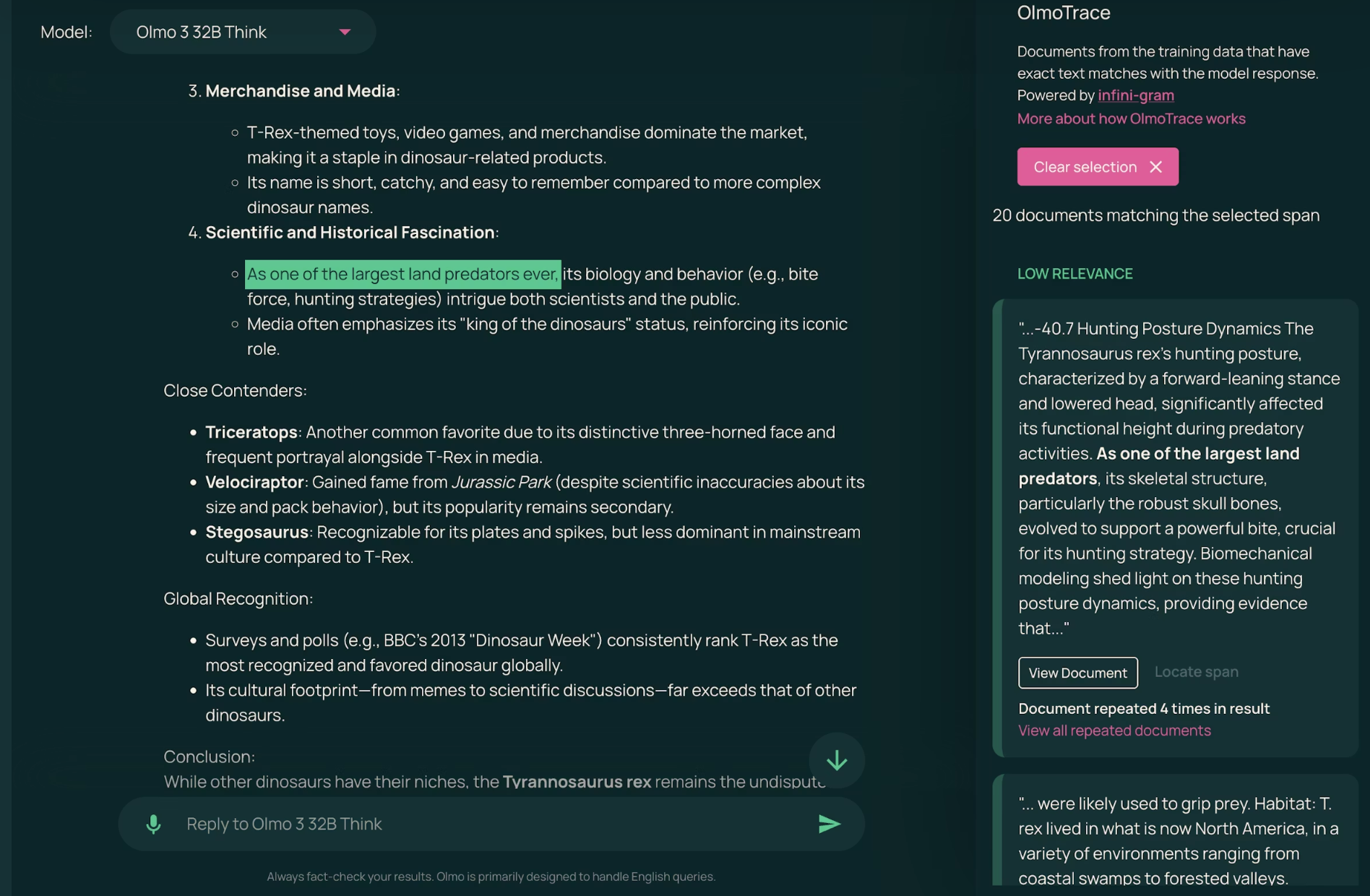
Olmo 3 - AI2's new family of open-source models — including the 32B 3-Think and Base that top benchmarks for open models of its size.

Shopping Research - Personalized, interactive shopping experience directly in ChatGPT to find the perfect products
Gemini 3 - Google's most intelligent model release to date, taking the top spot industry-wide across major benchmarks for multimodal understanding, agentic abilities, reasoning, and more.

Mistral 3 - Mistral's next generation of open-source models including Small, Large, and Ministral variants.

Get access to all our AI courses, hundreds of real-world AI use cases, live expert-led workshops, an exclusive network of AI early adopters, and more.
Get unlimited access to all of our current & upcoming industry-specific AI courses for the duration of your subscription.
To keep up with the rapid pace of AI, our team publishes AI implementation guides daily. Our library contains 300+ practical use cases to automate real-world work.
Join weekly, live, interactive sessions with industry leaders who are at the forefront of AI for hands-on implementation guidance and exclusive insights.
Network with an exclusive community of AI-first professionals who are working smarter with AI. Learn how early adopters are using AI in their work and businesses.