Open-model research
Study how data, training stages and post-training choices influence behavior using released artifacts.
Independent tool overview
OLMo 3 is Ai2's fully open family of 7B and 32B language models, released with weights, training data, code, checkpoints and detailed development artifacts.
Visit the official Olmo 3 site ↗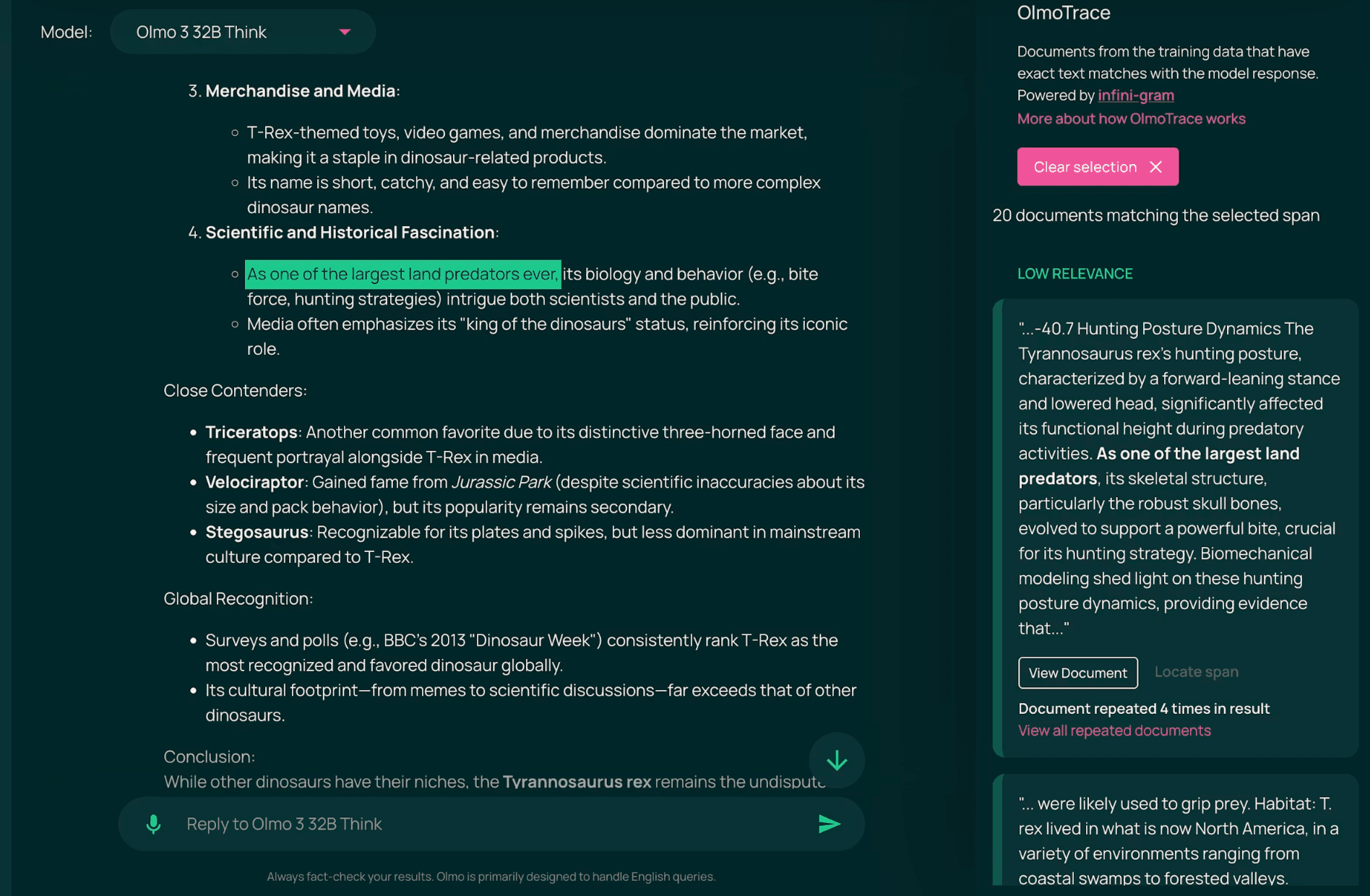
Overview
OLMo 3 is a family of open language models from the Allen Institute for AI (Ai2). Unlike releases that provide model weights but little visibility into how the model was made, OLMo 3 exposes the broader model flow: training data, code, intermediate checkpoints, evaluation tooling and post-training recipes.
The family includes Base models for continued training, Think models for multi-step reasoning, and Instruct models for chat, tool use and instruction following. The original release covered 7B and 32B sizes; Ai2 later added OLMo 3.1 32B Think and Instruct checkpoints with stronger reasoning and instruction-following results.
OLMo 3 is primarily for researchers, model engineers and organizations that need inspectable, modifiable models. People who simply want a hosted chatbot will usually find a managed assistant easier, while teams that self-host OLMo must supply suitable compute, serving infrastructure, evaluation and safety controls.
Use cases
The strongest fit depends on the job you need the product to complete, not the size of its feature list.
Study how data, training stages and post-training choices influence behavior using released artifacts.
Continue pretraining, fine-tune or apply a new post-training recipe to a transparent base.
Use Think and RL Zero checkpoints for math, coding, reinforcement-learning and inference-time reasoning work.
Self-host an Apache-licensed model when an organization needs more control over weights and infrastructure.
Capabilities
Ai2 publishes model weights, training data, code, checkpoints and extensive training details rather than only an endpoint model.
The smaller family is more approachable for experimentation, while 32B targets stronger research and production-grade capability.
General pretrained checkpoints support continued pretraining, domain adaptation and custom post-training.
Reasoning-focused variants are post-trained for longer multi-step work across math, code and general problem solving.
Instruction-tuned checkpoints support chat, multi-turn interaction, tool use and quicker responses.
Released checkpoint series help researchers study reinforcement learning from verifiable rewards across specific capability areas.
Ai2 reports that OLMo 3 Base maintains performance at extended context lengths of roughly 65,000 tokens.
The Ai2 Playground can connect generated text to relevant training data, supporting inspection of where behavior may have originated.
Process
Step 1
Choose Base for training, Instruct for chat and tool use, or Think for reasoning; prefer the 3.1 32B update when it fits the task.
Step 2
Confirm license, intended use, language, context, recommended generation settings, risks and model-specific requirements.
Step 3
Test in the Ai2 Playground or a suitable hosted environment before committing to local infrastructure.
Step 4
Serve through Transformers, vLLM or another supported stack and measure quality, latency, memory use and cost on representative tasks.
Step 5
Implement access controls, output validation, monitoring and domain-specific safety measures before production use.
Cost
Ai2 releases OLMo 3 weights under Apache 2.0 with no model license fee. Actual use is not necessarily free: self-hosting requires compute and operations, while third-party inference providers set their own prices.
$0 license fee
Downloadable under Apache 2.0, subject to the license and Ai2's responsible-use guidance.
Compute costs vary
You supply the hardware, serving stack, storage and operations.
Provider pricing
Some inference partners offer API access with their own rates and limits.
Pricing checked . Check current pricing at the source ↗
Assessment
Compare
The right alternative depends on the specific output, workflow, controls and budget your project requires.
Consumer
Another open model family with multiple sizes and a stronger focus on broad deployment options.
Explore Mistral 3 →Business Operations
An alternative ecosystem of open-weight models known for reasoning and developer use cases.
Explore DeepSeek →Consumer
A newer Qwen option for teams prioritizing frontier agentic capability over a fully exposed training flow.
Explore Qwen3.7-Max →Questions
OLMo 3 is Ai2's family of 7B and 32B open language models released with the data, code, checkpoints and training details needed to inspect and modify the model flow.
Base is intended for continued training and customization. Think is optimized for multi-step reasoning. Instruct is designed for chat, instruction following and tool use.
Ai2 extended the 32B line with stronger Think and Instruct checkpoints, reporting gains in reasoning, instruction following, coding and complex tasks.
Ai2 describes it as fully open because it releases weights, data, code and training artifacts. The published model cards list the model license as Apache 2.0.
The released weights have no license fee, but running them can incur hardware, cloud, storage and engineering costs. Hosted providers may charge separately.
Yes, with compatible software and enough memory and compute. A 7B checkpoint or quantized build is more practical on modest hardware than a full-precision 32B model.
Choose Instruct for general chat and tool use, Think for reasoning-heavy tasks, and Base for further training. Test both 7B and 32B against your own quality, latency and cost requirements.
No language model is safe for every application by default. Ai2 warns that the models can produce inaccurate, biased, harmful or sensitive content, so production systems need evaluation and safeguards.
Bottom line
OLMo 3 is a standout choice when transparency and the ability to inspect or modify the entire model-development path matter more than turnkey convenience. OLMo 3.1 32B is the strongest starting point in the family for capable reasoning or chat, while 7B is the more practical entry for constrained research and local experimentation.
Visit Olmo 3 website ↗
Gemini 3 - Google's most intelligent model release to date, taking the top spot industry-wide across major benchmarks for multimodal understanding, agentic abilities, reasoning, and more.
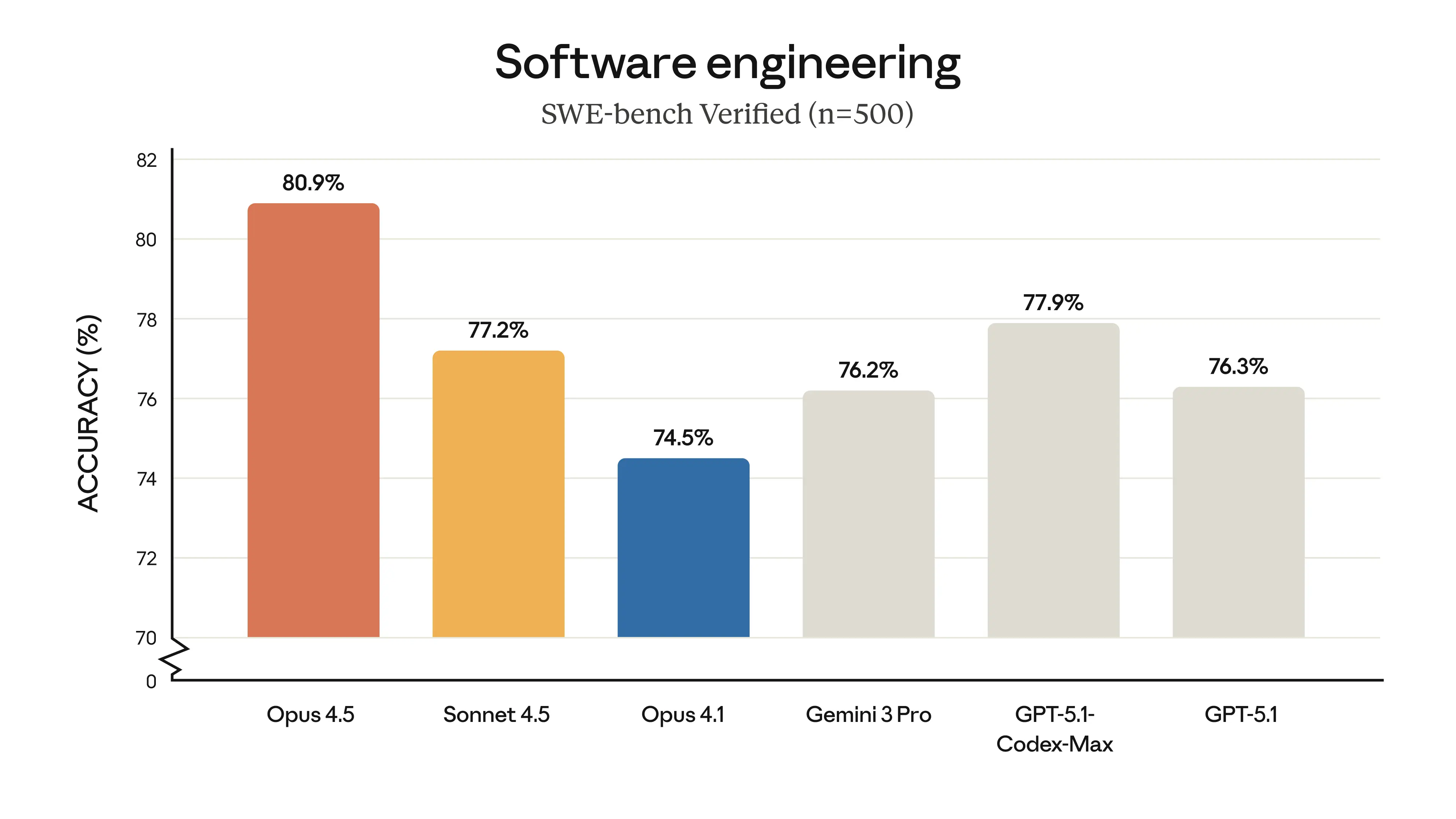
Claude 4.5 Opus - Anthropic's frontier model with SOTA coding, agentic, and computer use capabilities.
Grok 4.1 - xAI's latest update to Grok with improved creative abilities, emotional intelligence, and real-world usability.

Shopping Research - Personalized, interactive shopping experience directly in ChatGPT to find the perfect products

Get access to all our AI courses, hundreds of real-world AI use cases, live expert-led workshops, an exclusive network of AI early adopters, and more.
Get unlimited access to all of our current & upcoming industry-specific AI courses for the duration of your subscription.
To keep up with the rapid pace of AI, our team publishes AI implementation guides daily. Our library contains 300+ practical use cases to automate real-world work.
Join weekly, live, interactive sessions with industry leaders who are at the forefront of AI for hands-on implementation guidance and exclusive insights.
Network with an exclusive community of AI-first professionals who are working smarter with AI. Learn how early adopters are using AI in their work and businesses.