Customer support teams
Build agents that answer grounded questions, look up customer data, complete common tasks, and hand off when needed.
Independent tool overview
Voiceflow is a collaborative platform for designing, testing, deploying, and monitoring customer-facing AI agents across chat and voice channels.
Visit the official Voiceflow site ↗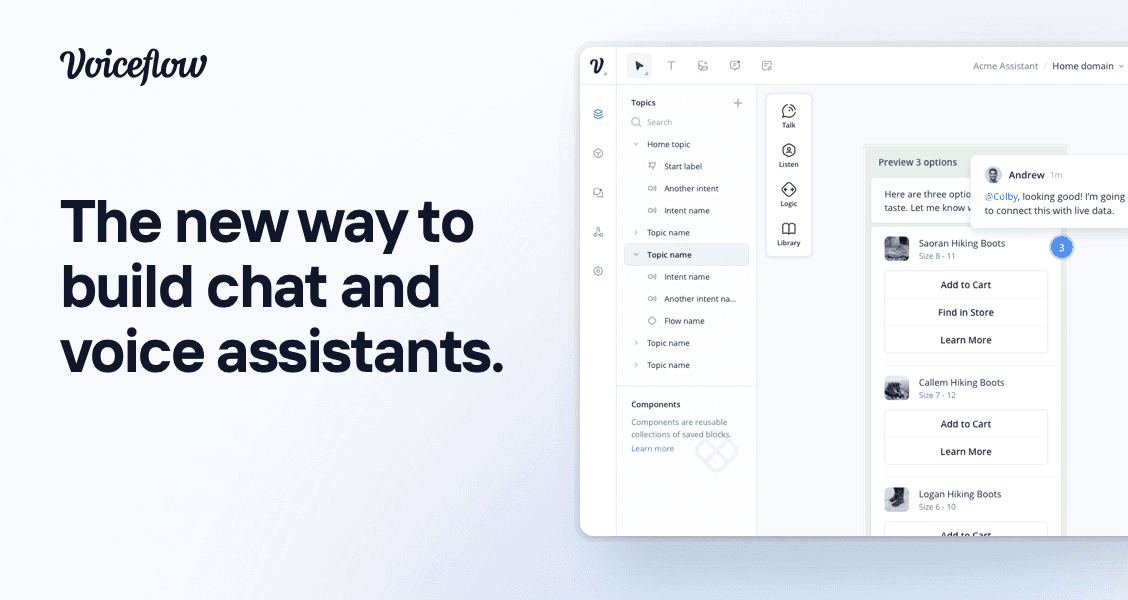
Overview
Voiceflow gives product, support, and engineering teams a shared visual workspace for building AI agents. It combines flexible playbooks for goal-driven conversations with deterministic workflows for processes that must follow a fixed sequence.
Agents can answer from a managed knowledge base, call external APIs, run JavaScript functions, connect to MCP servers, and use prebuilt integrations such as Salesforce, HubSpot, Zendesk, Shopify, Twilio, Gmail, and Google Sheets. Voiceflow can deploy agents to web chat, phone, or custom interfaces through its APIs.
The platform is strongest for teams that want more control and collaboration than a simple chatbot generator. That flexibility also means production success depends on careful conversation design, evaluation, permissions, monitoring, and usage-cost management.
Use cases
The strongest fit depends on the job you need the product to complete, not the size of its feature list.
Build agents that answer grounded questions, look up customer data, complete common tasks, and hand off when needed.
Map structured flows visually while preserving agentic behavior for open-ended customer requests.
Manage multiple client workspaces, deployments, usage, and handoffs from one platform.
Collaborate across design, operations, and engineering with environments, roles, observability, and integrations.
Capabilities
Use goal-driven playbooks for flexible conversations and visual workflows for predictable multi-step logic.
Ground answers in URLs, sitemaps, documents, tables, and connected sources with retrieval settings and metadata filters.
Connect REST APIs, JavaScript functions, MCP servers, and prebuilt business-app integrations.
Publish customer agents to web chat and phone experiences or use Voiceflow's runtime APIs in a custom interface.
Use environments, conversation logs, analytics, and evaluations to improve agents after launch.
Select from major model providers or bring a supported model to reduce dependence on a single LLM vendor.
Process
Step 1
Choose a narrow customer outcome, escalation rule, and success metric before building the conversation.
Step 2
Connect approved content and only the business systems the agent needs to complete its task.
Step 3
Use playbooks for open-ended goals and deterministic workflows for authentication, disclosures, and fixed processes.
Step 4
Evaluate retrieval gaps, ambiguous requests, tool errors, policy boundaries, and live-agent handoff paths.
Step 5
Move through development and production environments, then track quality, containment, latency, and credit usage.
Cost
Voiceflow combines a monthly plan with credit-based agent usage and optional add-ons. Exact current plan prices and credit bundles are shown inside the Voiceflow billing dashboard; enterprise pricing is customized.
Free
A limited plan for learning and prototyping, not intended for production usage.
See in-app pricing
For individual builders who need more agents, credits, and access to all supported LLM models.
See in-app pricing
For growing teams that need collaboration, fallback models, and priority support.
Custom
For large deployments requiring advanced security, support, hosting, or custom credit commitments.
Pricing checked . Check current pricing at the source ↗
Assessment
Compare
The right alternative depends on the specific output, workflow, controls and budget your project requires.
Sales
A developer-focused platform for assembling programmable voice agents.
Explore Vapi →Business Operations
A voice-agent platform focused on natural phone conversations and call operations.
Explore Retell AI →Sales
A phone automation platform for teams prioritizing outbound and inbound voice workflows.
Explore Bland AI →Questions
Voiceflow is used to design, deploy, and monitor AI agents for customer support, sales, and other conversational experiences across chat, phone, and custom interfaces.
Many agents can be built visually, but custom APIs, functions, authentication, and advanced production integrations often benefit from developer involvement.
Yes. Voiceflow's Starter plan is free and intended for learning and prototypes, with limited features and credits. Voiceflow says it is not suitable for production usage.
Your bill can include a monthly plan fee, credit-based usage, and optional add-ons such as extra editor seats or phone capacity. Enterprise terms are negotiated separately.
Yes. Voiceflow supports web chat and phone agents, as well as API-based deployment into custom experiences.
Yes. Agents can use prebuilt integrations, REST APIs, JavaScript functions, and MCP servers. Limit every connection to the minimum permissions required.
Bottom line
Voiceflow is a strong choice for organizations that want a shared, visual platform for sophisticated customer-facing agents across chat and voice. It offers more control than a turnkey bot, but teams should budget for both platform and usage costs and plan for serious testing and governance.
Visit Voiceflow website ↗
Get access to all our AI courses, hundreds of real-world AI use cases, live expert-led workshops, an exclusive network of AI early adopters, and more.
Get unlimited access to all of our current & upcoming industry-specific AI courses for the duration of your subscription.
To keep up with the rapid pace of AI, our team publishes AI implementation guides daily. Our library contains 300+ practical use cases to automate real-world work.
Join weekly, live, interactive sessions with industry leaders who are at the forefront of AI for hands-on implementation guidance and exclusive insights.
Network with an exclusive community of AI-first professionals who are working smarter with AI. Learn how early adopters are using AI in their work and businesses.