Employee operations
Automate recruiting, onboarding, HR support, benefits, payroll coordination and employee-service workflows across existing systems.
Independent tool overview
Ema is an enterprise agent platform for building and deploying governed AI Employees that execute multi-step work across HR, IT, finance and connected business systems.
Visit the official Ema site ↗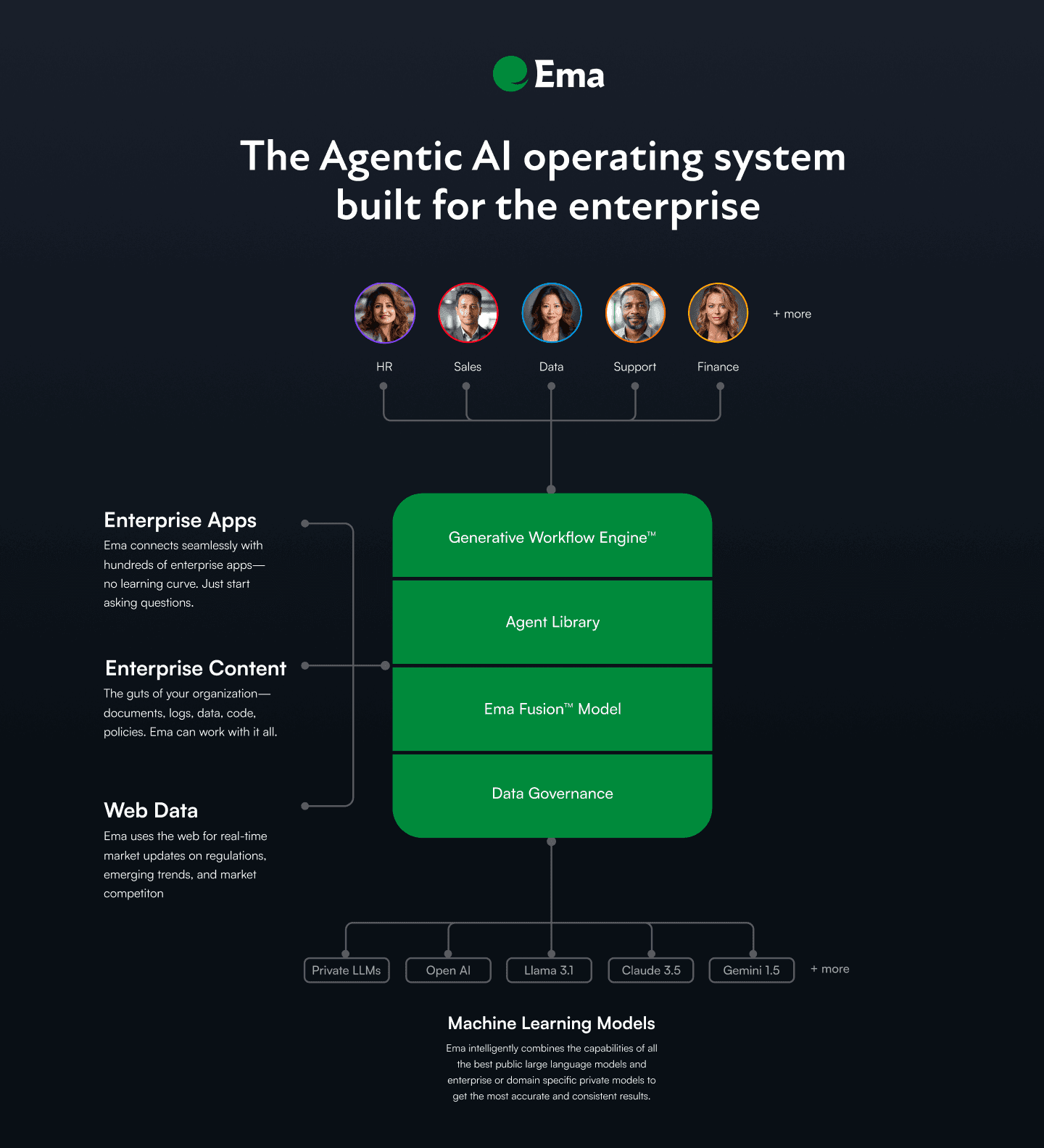
Overview
Ema is an enterprise automation platform that packages coordinated AI agents as “AI Employees.” These agents are intended to do operational work across systems—not simply answer questions—including recruiting, onboarding, employee support, IT service management and finance processes.
Organizations can start with prebuilt AI Employees or describe a workflow in plain language. Ema's Generative Workflow Engine orchestrates the steps, while EmaFusion combines and routes work across more than 100 models based on accuracy, cost and availability.
The product is built for enterprise deployment, with more than 250 integrations, real-time two-way sync, granular permissions, audit trails, human approval chains and on-premises or air-gapped options. It is sold through a demo-led, outcome-based process rather than self-serve public plans.
Use cases
The strongest fit depends on the job you need the product to complete, not the size of its feature list.
Automate recruiting, onboarding, HR support, benefits, payroll coordination and employee-service workflows across existing systems.
Provide a shared front door for support, resolve routine requests and coordinate actions across ticketing, identity and collaboration tools.
Build governed multi-step workflows that gather data, route approvals and take actions across financial and operational systems.
Capabilities
Turns a plain-language workflow intent into a working AI Employee without requiring every team to build its own agent infrastructure.
Coordinates specialized agents and enterprise actions across multi-step business processes.
Combines more than 100 public, private and specialized models to balance accuracy, cost, latency and resilience.
Offers role-specific starting points for employee experience, IT, finance, recruiting and other enterprise functions.
Connects with more than 250 applications using two-way sync, field-level controls and a Push API for custom systems.
Includes RBAC and ABAC, PII detection and redaction, immutable audit trails, human approvals and isolated deployment options.
Process
Step 1
Start with a bounded HR, IT or finance workflow that has clear inputs, actions, approvals and success metrics.
Step 2
Integrate the necessary enterprise apps and restrict each AI Employee to the data and actions required for its job.
Step 3
Use a prebuilt role or describe the desired workflow in plain language, then ground it in organizational context.
Step 4
Define approvals, escalation rules, audit requirements and sensitive-data handling before production use.
Step 5
Monitor results and audit trails, then refine the workflow against business outcomes rather than raw agent activity.
Cost
Ema does not publish self-serve plan prices. Its site describes outcome-based pricing and directs buyers to book a demo, so cost depends on the workflows, integrations, deployment and agreed results.
Custom quote
Outcome-based commercial arrangement scoped to the organization's AI Employees and workflows.
Pricing checked . Check current pricing at the source ↗
Assessment
Compare
The right alternative depends on the specific output, workflow, controls and budget your project requires.
Business Operations
A strong enterprise-agent option for organizations centered on Google Cloud, Workspace and Gemini.
Explore Gemini Enterprise →Business Operations
A more natural fit for companies that want AI assistance embedded throughout Microsoft 365.
Explore Microsoft Copilot →Business Operations
A more accessible agent builder for teams that want to automate business workflows without a large enterprise platform rollout.
Explore Lindy →Questions
Ema is an enterprise AI-agent platform that creates and runs AI Employees for multi-step workflows across HR, IT, finance and other business functions.
It is a coordinated agent workflow configured for a business role or outcome, such as recruiting, onboarding, employee support or IT service management.
Ema says it offers more than 250 native integrations, plus a Push API and support for custom connectors.
EmaFusion is Ema's model layer, which combines more than 100 models and selects or fuses them for accuracy, cost, latency and fault tolerance.
Ema does not publish fixed plan prices. It promotes outcome-based pricing and asks prospective customers to book a demo for a scoped quote.
Yes. Ema advertises on-premises and air-gapped deployment alongside access controls, redaction and audit trails.
Bottom line
Ema is best evaluated as an enterprise automation platform, not a general AI assistant. Its integrations, multi-model architecture and governance make it compelling for complex employee and back-office workflows, but buyers need a tightly scoped pilot and explicit outcome definitions to judge value.
Visit Ema website ↗
Get access to all our AI courses, hundreds of real-world AI use cases, live expert-led workshops, an exclusive network of AI early adopters, and more.
Get unlimited access to all of our current & upcoming industry-specific AI courses for the duration of your subscription.
To keep up with the rapid pace of AI, our team publishes AI implementation guides daily. Our library contains 300+ practical use cases to automate real-world work.
Join weekly, live, interactive sessions with industry leaders who are at the forefront of AI for hands-on implementation guidance and exclusive insights.
Network with an exclusive community of AI-first professionals who are working smarter with AI. Learn how early adopters are using AI in their work and businesses.


