Customer-service call automation
Handle structured inbound questions, routing, status checks, and simple service workflows with a reliable escalation path.
Independent tool overview
Bland AI is a platform for building and operating AI voice agents across inbound and outbound calls, with workflow, testing, integration, and enterprise controls.
Visit the official Bland AI site ↗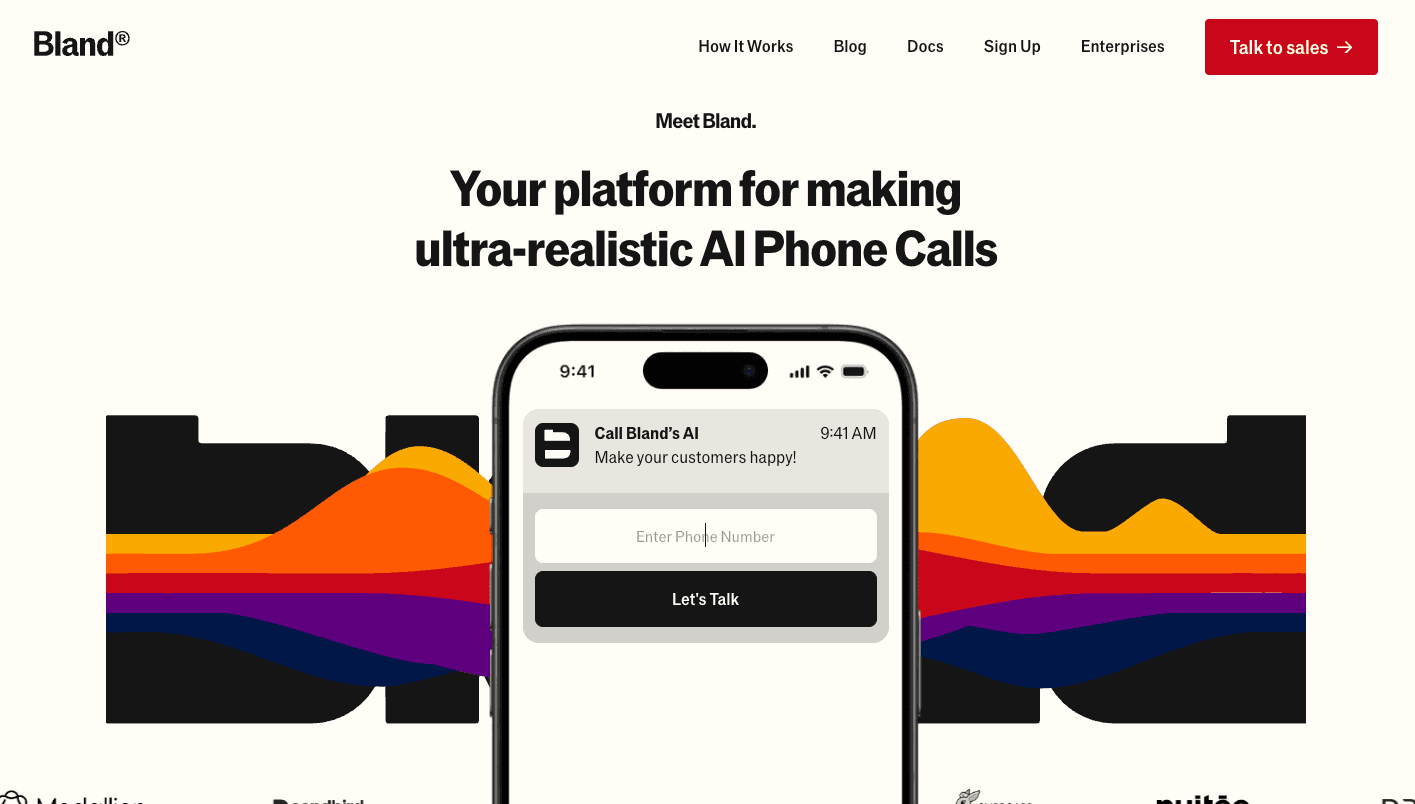
Overview
Bland AI is a voice-agent platform for automating inbound and outbound phone conversations. Teams can build conversational pathways and personas, connect knowledge and business systems, transfer calls to people, test behavior, and monitor production interactions.
The platform is increasingly positioned for regulated and operationally sensitive use cases in healthcare, insurance, financial services, and logistics. That makes design discipline more important, not less: organizations still need a lawful calling basis, accurate disclosures, recording consent, opt-out handling, narrowly scoped tools, human escalation, security review, and continuous quality assurance.
Use cases
The strongest fit depends on the job you need the product to complete, not the size of its feature list.
Handle structured inbound questions, routing, status checks, and simple service workflows with a reliable escalation path.
Qualify the request, check an approved scheduling system, book or reschedule, and send a confirmation.
Run consented conversations with defined questions and transfer eligible callers to a human sales representative.
Place narrowly scoped calls for reminders, confirmations, logistics updates, or follow-up where the organization has permission.
Evaluate enterprise controls when legal, security, compliance, and operations owners can jointly design and monitor the deployment.
Capabilities
Organizations can provision or connect phone numbers to answer calls with a configured AI agent.
The API and dashboard can dispatch individual or batch calls, subject to legal permission, carrier rules, and account limits.
A graph-based workflow represents stages of a call, routing conditions, prompts, variable extraction, and actions.
Teams can configure agent behavior and voice options, with plan-based limits and separate consent obligations for voice cloning.
Agents can use approved reference material, with the number of knowledge bases varying by plan.
Calls can connect to CRMs, calendars, telephony systems, webhooks, and custom APIs to retrieve information or perform constrained actions.
Live and warm-transfer workflows can route callers to a person when the AI reaches a configured boundary or escalation.
Bland documents a testbed, scenarios, evals, and node-level regression standards for checking behavior before and after changes.
Required and forbidden conditions can monitor disclosures, opt-outs, safety events, and custom policy violations during calls.
Call logs, transcripts, outcomes, alerts, and production monitoring help teams inspect what happened and identify failure patterns.
Norm can help build, edit, test, debug, and analyze Bland agents through natural-language instructions while working from account context.
Enterprise packaging advertises dedicated infrastructure, on-premises or VPC options, SSO, data residency, and BAA availability.
Process
Step 1
Document who may be called, why, the consent or other legal basis, applicable jurisdictions, hours, disclosures, opt-out rules, and prohibited outcomes.
Step 2
Define the agent's allowed topics, decision boundaries, required wording, data access, transfer triggers, failure states, and maximum call duration.
Step 3
Grant only the data and API actions needed for the task, with authentication, authorization, validation, logging, and reversible operations.
Step 4
Configure AI identity, caller identity, recording notices, opt-out handling, sensitive-topic blocks, and automatic transfer or termination rules.
Step 5
Run realistic scenarios covering accents, interruptions, silence, wrong-party answers, angry callers, ambiguity, prompt injection, sensitive data, and system failures.
Step 6
Start with a consented cohort, strict concurrency and duration limits, human monitoring, and a rollback plan.
Step 7
Review transcripts and outcomes, opt-outs, complaints, handoffs, latency, task success, false statements, cost, and disparate failure rates before expanding.
Cost
Bland combines a plan-based platform fee with connected-minute usage. Its listed rate includes the LLM, speech-to-text, and text-to-speech; telephony, transfer time, SMS, phone numbers, and some enterprise controls can add cost.
$0 platform fee + $0.14/connected minute
Developer entry tier with 100 calls per day and 10 concurrent calls.
$299/month + $0.12/connected minute
Team tier with higher capacity and a lower usage rate.
$499/month + $0.11/connected minute
High-volume self-serve tier with the lowest listed standard minute rate.
Custom pricing
Contracted capacity and infrastructure for organizations with advanced security, compliance, deployment, and support requirements.
Pricing checked . Check current pricing at the source ↗
Assessment
Compare
The right alternative depends on the specific output, workflow, controls and budget your project requires.
Sales
Consider Vapi when you want a developer-oriented voice-agent orchestration layer with freedom to choose model, speech, and telephony providers.
Explore Vapi →Business Operations
Consider Retell AI for another developer platform focused on production conversational voice agents and call infrastructure.
Explore Retell AI →Business Operations
Consider Synthflow AI when a more no-code, lead-conversion-oriented phone-agent workflow is the priority.
Explore Synthflow AI →Questions
Bland AI is a platform for building, testing, deploying, and monitoring AI agents that handle inbound and outbound phone conversations and connected workflows.
Yes. Bland supports individual and batch outbound calls. Organizations remain responsible for consent, do-not-call rules, caller identification, disclosures, calling hours, carrier policies, and all applicable laws.
Yes. Teams can configure inbound phone numbers or telephony connections for support, scheduling, routing, and other approved use cases.
Yes. Bland documents live and warm-transfer workflows. Every production design should define when a transfer is required and what happens if the transfer fails.
Bland documents required guard rails for disclosures and forbidden guard rails for opt-outs and policy violations, with actions such as ending the call, transferring to a person, or moving to another pathway node.
Bland advertises HIPAA eligibility with a signed BAA on Enterprise. That does not make every deployment compliant automatically; the contract, configuration, data flows, access controls, retention, vendors, and operating practices all need review.
The current self-serve plans list connected-minute rates from $0.14 on Start to $0.11 on Scale, with $0, $299, and $499 monthly platform fees respectively. Transfers, telephony, SMS, phone numbers, failed attempts, and enterprise options can add cost.
Bland says its listed connected-minute rate includes the LLM, speech-to-text, and text-to-speech. Telephony is separate, either through the customer's carrier or Bland at pass-through cost.
Test task success, disclosures, opt-outs, transfers, wrong-party answers, accents, interruptions, silence, sensitive requests, prompt injection, system outages, API errors, incorrect facts, maximum duration, and the human escalation path.
Bottom line
Bland AI offers a substantial production toolkit for teams that need voice agents, including pathways, integrations, transfers, testing, monitoring, and compliance-oriented controls. Its bundled minute rate can simplify cost modeling compared with assembling several providers. The real adoption threshold is governance: do not deploy high-volume or regulated calls without legal review, consent controls, least-privilege integrations, adversarial testing, human escalation, and ongoing transcript and outcome monitoring.
Visit Bland AI website ↗
Automate LinkedIn outreach for continuous customer acquisition.

Engage prospects through personalized cold emails.

AI sales agent for qualified leads generation.

Find your dream outfit instantly with visual search technology.

Get access to all our AI courses, hundreds of real-world AI use cases, live expert-led workshops, an exclusive network of AI early adopters, and more.
Get unlimited access to all of our current & upcoming industry-specific AI courses for the duration of your subscription.
To keep up with the rapid pace of AI, our team publishes AI implementation guides daily. Our library contains 300+ practical use cases to automate real-world work.
Join weekly, live, interactive sessions with industry leaders who are at the forefront of AI for hands-on implementation guidance and exclusive insights.
Network with an exclusive community of AI-first professionals who are working smarter with AI. Learn how early adopters are using AI in their work and businesses.