Discovery interviews
Explore customer problems and decision criteria with adaptive follow-up questions rather than a rigid survey alone.
Independent tool overview
User Evaluation is an AI-powered qualitative research platform for planning studies, recruiting real participants, running adaptive interviews and analyzing source-linked evidence.
Visit the official User Evaluation site ↗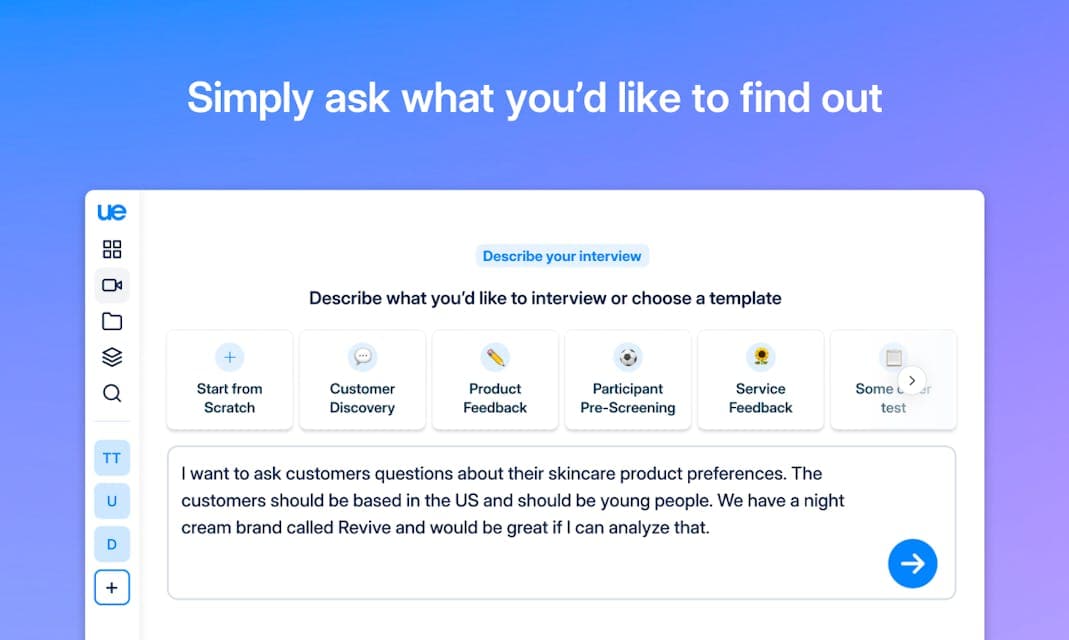
Overview
User Evaluation brings study planning, participant recruitment, AI-moderated interviews and evidence-based analysis into one research workspace. Teams can recruit from the platform's consumer or B2B panels, invite their own participants, or upload existing recordings and documents for analysis.
Its core differentiator is an AI researcher that can draft screeners and interview guides, conduct adaptive audio interviews, follow up on participant answers, and turn transcripts into cited themes, clips, reports and presentation decks. It can reduce the operational work around qualitative research, but the quality of the result still depends on sound study design, informed consent, representative recruiting and human review of the underlying evidence.
Use cases
The strongest fit depends on the job you need the product to complete, not the size of its feature list.
Explore customer problems and decision criteria with adaptive follow-up questions rather than a rigid survey alone.
Collect structured reactions from target participants and preserve the transcript or clip behind each finding.
Give a product or insights team a repeatable workflow for recruiting, interviewing, tagging and reporting.
Upload interviews, calls, documents and CSV data, then search and synthesize evidence across a project.
Automate moderation and first-pass analysis while keeping a human owner responsible for methods and conclusions.
Capabilities
Turn a research brief into a proposed plan, audience definition, screener, interview script and study settings.
Conduct audio interviews with real participants, follow a guide and ask adaptive follow-up questions based on responses.
Run AI-curated interviews, conversational surveys, fixed-question surveys or scheduled human-led live interviews.
Invite an existing contact list or recruit eligible consumer and business participants through the platform's pools.
Listen during supported sessions, follow captions and receive bounded moderator suggestions without replacing the participant-facing consent process.
Process uploaded audio, video, documents and CSV files, then search the indexed material from the project workspace.
Ask questions across transcripts and inspect citations that link an answer or proposed insight back to its source.
Organize recurring themes, save supporting video or audio moments and retain researcher-authored context alongside AI outputs.
Generate source-linked reports and export presentations, charts, clips and structured data for stakeholders.
Higher-level workflows include shared workspaces, viewer access, roles, audit history, retention controls, SSO and SCIM options.
Process
Step 1
Write the research question, intended audience and decision the study needs to inform before generating a guide.
Step 2
Edit the proposed screener and script for neutral language, logical sequencing, accessibility and appropriate handling of sensitive topics.
Step 3
Invite consented contacts or configure consumer or B2B recruitment criteria, incentive and participant cap.
Step 4
Run a small test and compare AI moderation with a skilled human on adherence, probing depth, leading questions and participant drop-off.
Step 5
Collect interviews or surveys, watch completion quality and replace invalid sessions under the platform's stated policy when applicable.
Step 6
Check citations, transcripts and clips before accepting themes, then document sample limits and export the final report or deck.
Cost
User Evaluation combines subscriptions with one-time interview credits. Participant incentives are separate, and the official pricing page should be checked before purchase because quotas and bundle rates can change.
$0
A limited workspace for trying the research agent, processing and exports.
$49/month
For an individual researcher running recurring studies with their own participants.
$199/month
For a research team that needs pooled usage, shared workspaces and viewer access.
From $90 one time
Non-expiring interview credits when you supply the participants.
From $240 one time
Recruit eligible consumer participants from the platform's pool.
From $440 one time
Recruit professionals who match business-role criteria.
From $990
A more service-led option for recruited interviews and a completed research deliverable.
Pricing checked . Check current pricing at the source ↗
Assessment
Compare
The right alternative depends on the specific output, workflow, controls and budget your project requires.
Data Analysis
Choose Survicate when lightweight multi-channel surveys and automated feedback analysis matter more than AI-moderated interviews.
Explore Survicate AI Surveys →Marketing
Choose SurveyMonkey AI for a mature survey workflow, broad question formats and conventional quantitative feedback collection.
Explore SurveyMonkey AI →Business Operations
Choose Fireflies when the main need is recording, transcribing and searching calls rather than recruiting and moderating research participants.
Explore Fireflies AI →Project Management
Choose Fathom for simpler meeting transcription and summaries when a full qualitative-research platform would be excessive.
Explore Fathom →Questions
User Evaluation is a qualitative-research platform that uses AI to help plan studies, recruit real participants, moderate interviews or surveys, analyze transcripts and produce source-linked reports.
Its interview workflow is built around real participants. You can invite your own contacts or recruit from consumer and B2B pools; the AI acts as moderator and analyst rather than pretending to be the customer.
The official pricing page lists a Free plan, Pro at $49 per month and Team at $199 per month, plus one-time own-participant, consumer-panel and B2B interview bundles. Incentives and some services cost extra.
Yes. You can use platform recruitment pools or bring your own participant list. Carefully review screener criteria, feasibility, participant quality and incentives before launching.
No. It can automate study setup, moderation and first-pass analysis, but a qualified human still needs to own methodology, consent, sampling, bias review, sensitive-topic handling and final conclusions.
The platform says answers and proposed insights can link back to source files. Researchers should still open those citations, read the surrounding transcript and look for contradictory evidence.
Avoid unnecessary personal, confidential or regulated data. Before using recordings or transcripts, confirm participant notices, legal basis, access controls, retention, deletion and the vendor's current subprocessors and security terms.
Run a small pilot using a known research question. Compare AI and human moderation on completion, question adherence, probing depth, leading behavior, transcript accuracy, evidence fidelity, participant experience and total cost.
Bottom line
User Evaluation is most compelling for product and insights teams that need to run more real-participant qualitative research without staffing every interview live. Its integrated recruiting, adaptive moderation and source-linked analysis can save substantial coordination time. Treat it as research infrastructure, not an autonomous truth machine: pilot the moderator, protect participant data, inspect every important citation and keep a skilled researcher accountable for the study design and conclusions.
Visit User Evaluation website ↗
Get access to all our AI courses, hundreds of real-world AI use cases, live expert-led workshops, an exclusive network of AI early adopters, and more.
Get unlimited access to all of our current & upcoming industry-specific AI courses for the duration of your subscription.
To keep up with the rapid pace of AI, our team publishes AI implementation guides daily. Our library contains 300+ practical use cases to automate real-world work.
Join weekly, live, interactive sessions with industry leaders who are at the forefront of AI for hands-on implementation guidance and exclusive insights.
Network with an exclusive community of AI-first professionals who are working smarter with AI. Learn how early adopters are using AI in their work and businesses.