Neuroimaging experiment design
Pre-screen video, audio, image, or language stimuli before committing scanner time and participant resources.
Independent tool overview
TRIBE v2 is Meta FAIR's research model for predicting high-resolution fMRI brain responses to video, audio, and language. Meta released the code and pretrained weights for noncommercial use, but this is a neuroscience toolkit for researchers—not a consumer app, diagnostic product, or mind-reading system.
Visit the official TRIBE v2 site ↗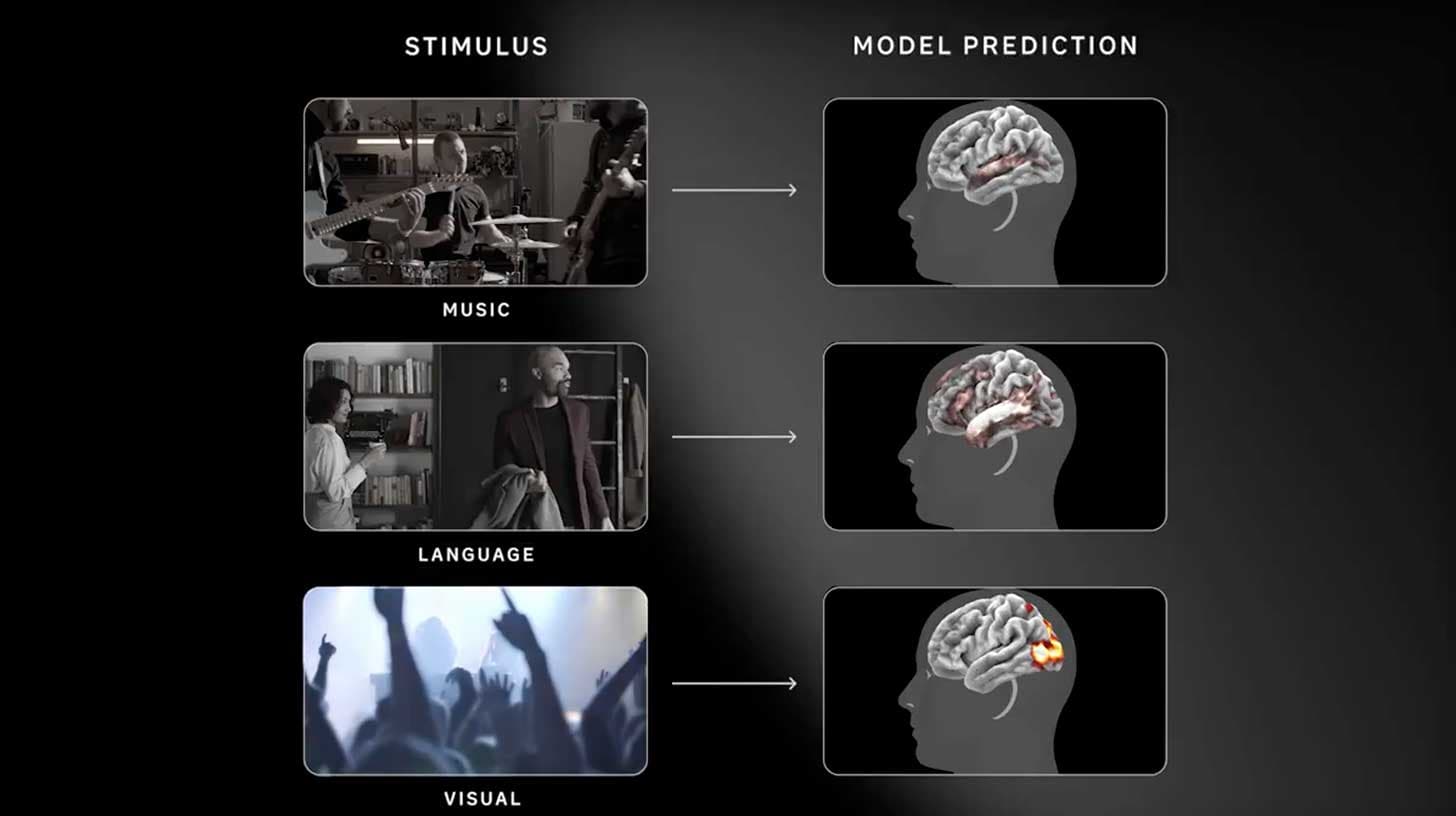
Overview
TRIBE v2 maps representations from video, audio, and text onto predicted activity across the brain. Researchers can supply a media file, generate a time-aligned event representation, and receive predicted responses on a standard cortical mesh.
The research used more than 1,000 hours of fMRI across 720 subjects, combining deep datasets with extensive observations per participant and wider datasets covering larger groups. The released checkpoint predicts an average subject and can generalize to unseen subjects and tasks without collecting individual calibration data.
The model is built for in-silico neuroscience: piloting stimuli, reproducing known response patterns, studying multisensory integration, and testing research hypotheses before expensive scanning. Its outputs remain model predictions and must not be presented as measured responses from a specific person.
Use cases
The strongest fit depends on the job you need the product to complete, not the size of its feature list.
Pre-screen video, audio, image, or language stimuli before committing scanner time and participant resources.
Test whether predicted cortical patterns reproduce established visual, language, and multisensory effects.
Compare a deep multimodal encoder with linear baselines on held-out fMRI datasets and new experimental conditions.
Analyze learned components and spatial response maps to study how modalities contribute across cortical regions.
Capabilities
Combines video, audio, and language representations in one Transformer-based brain-response model.
The public quick start produces predictions on the fsaverage5 cortical mesh with roughly 20,000 vertices.
Predicts group-average responses for unseen participants without requiring a personalized scan during inference.
The paper describes adapting the model with limited participant data to improve subject-specific prediction.
Meta provides the training and evaluation code on GitHub and a pretrained checkpoint through Hugging Face.
Optional dependencies support cortical plotting and region-of-interest analysis with standard neuroimaging tools.
Process
Step 1
Use TRIBE v2 only for permitted noncommercial work and complete the appropriate ethics and data-governance review for any human-subject research.
Step 2
Clone the repository, use Python 3.11 or later, and install the inference or optional plotting dependencies.
Step 3
Download facebook/tribev2 through the repository's TribeModel helper and select a local cache directory.
Step 4
Pass a video, audio, or text input through the provided event-dataframe utility so modalities have the timing information needed by the model.
Step 5
Run inference to produce the subject-average cortical time series, accounting for the documented five-second hemodynamic offset.
Step 6
Compare predictions with measured data, preregister hypotheses where appropriate, report uncertainty, and avoid individual or clinical claims unsupported by the model.
Cost
Meta publishes the TRIBE v2 repository and pretrained weights without a subscription fee under CC BY-NC 4.0. Users pay their own compute, storage, engineering, and research costs. The license does not grant commercial use, so organizations considering a paid product need separate permission from Meta.
Free
Self-hosted model release for permitted noncommercial use.
Not included
The public license does not authorize commercial deployment.
Not offered
Meta does not list a production TRIBE v2 API plan.
Pricing checked . Check current pricing at the source ↗
Assessment
Compare
The right alternative depends on the specific output, workflow, controls and budget your project requires.
Miscellaneous
Choose SAM Audio for an open Meta research model focused on separating sounds rather than predicting neural responses.
Explore SAM Audio →Miscellaneous
Choose SAM 3D for Meta research workflows centered on reconstructing objects or people from images.
Explore Sam 3D →Coding
Choose Meta Llama when the task is general language generation or reasoning rather than fMRI encoding.
Explore Meta Llama Models →Questions
TRIBE v2 predicts high-resolution fMRI brain-response patterns from video, audio, and language inputs. It is intended for computational neuroscience and in-silico experiments.
No. It predicts an average brain response to supplied stimuli; it does not decode a person's private thoughts or directly measure an individual's current brain activity.
Meta provides the code and pretrained weights publicly under CC BY-NC 4.0. That permits many noncommercial research uses with attribution but does not grant commercial use.
There is no subscription fee for the public research release. Users provide their own compute and storage, and the noncommercial license does not include a paid production deployment.
The paper reports a combined 1,117.7 hours of fMRI across 720 subjects, using video, audio, text, and controlled experimental conditions across multiple datasets.
Bottom line
TRIBE v2 is a significant open research release for neuroscientists who need multimodal, high-resolution brain-response predictions and can operate a Python-based fMRI workflow. It should be evaluated as a scientific model with noncommercial licensing and substantial validation requirements—not repackaged as a consumer mind-reading, clinical, or engagement-scoring product.
Visit TRIBE v2 website ↗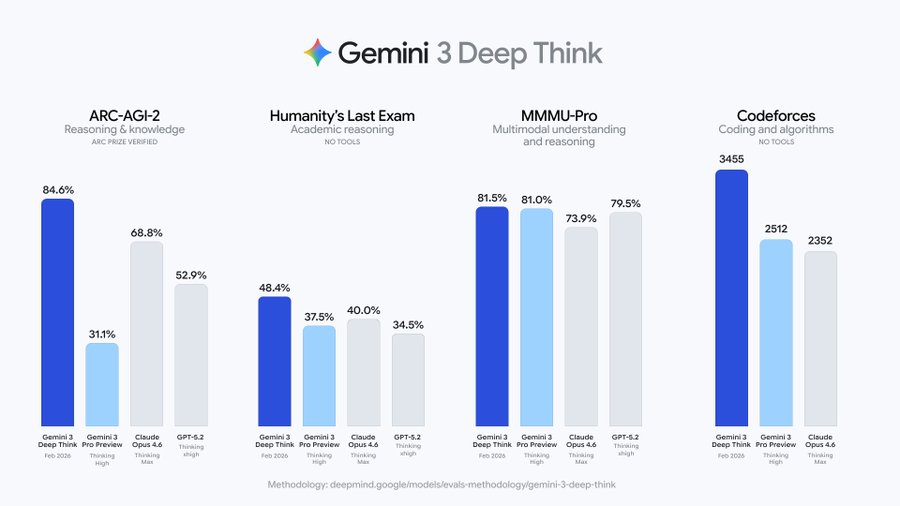
Gemini 3 Deep Think - Google's upgraded AI reasoning mode now solving PhD-level math and science research problems

Claude Science - Anthropic’s app for AI-powered scientific research
Nomos 1 - Nous Research’s powerful open-source AI math reasoning system
Leanstral 1.5 - Mistral's open model for writing verified math proofs

Get access to all our AI courses, hundreds of real-world AI use cases, live expert-led workshops, an exclusive network of AI early adopters, and more.
Get unlimited access to all of our current & upcoming industry-specific AI courses for the duration of your subscription.
To keep up with the rapid pace of AI, our team publishes AI implementation guides daily. Our library contains 300+ practical use cases to automate real-world work.
Join weekly, live, interactive sessions with industry leaders who are at the forefront of AI for hands-on implementation guidance and exclusive insights.
Network with an exclusive community of AI-first professionals who are working smarter with AI. Learn how early adopters are using AI in their work and businesses.