Trade-recap operations
Extract trade details from manual or voice-trade emails, compare them with the internal book, and identify breaks.
Independent tool overview
TradeFlow is enterprise software for using AI to extract, reconcile, and route information across manual post-trade workflows in financial institutions.
Visit the official TradeFlow site ↗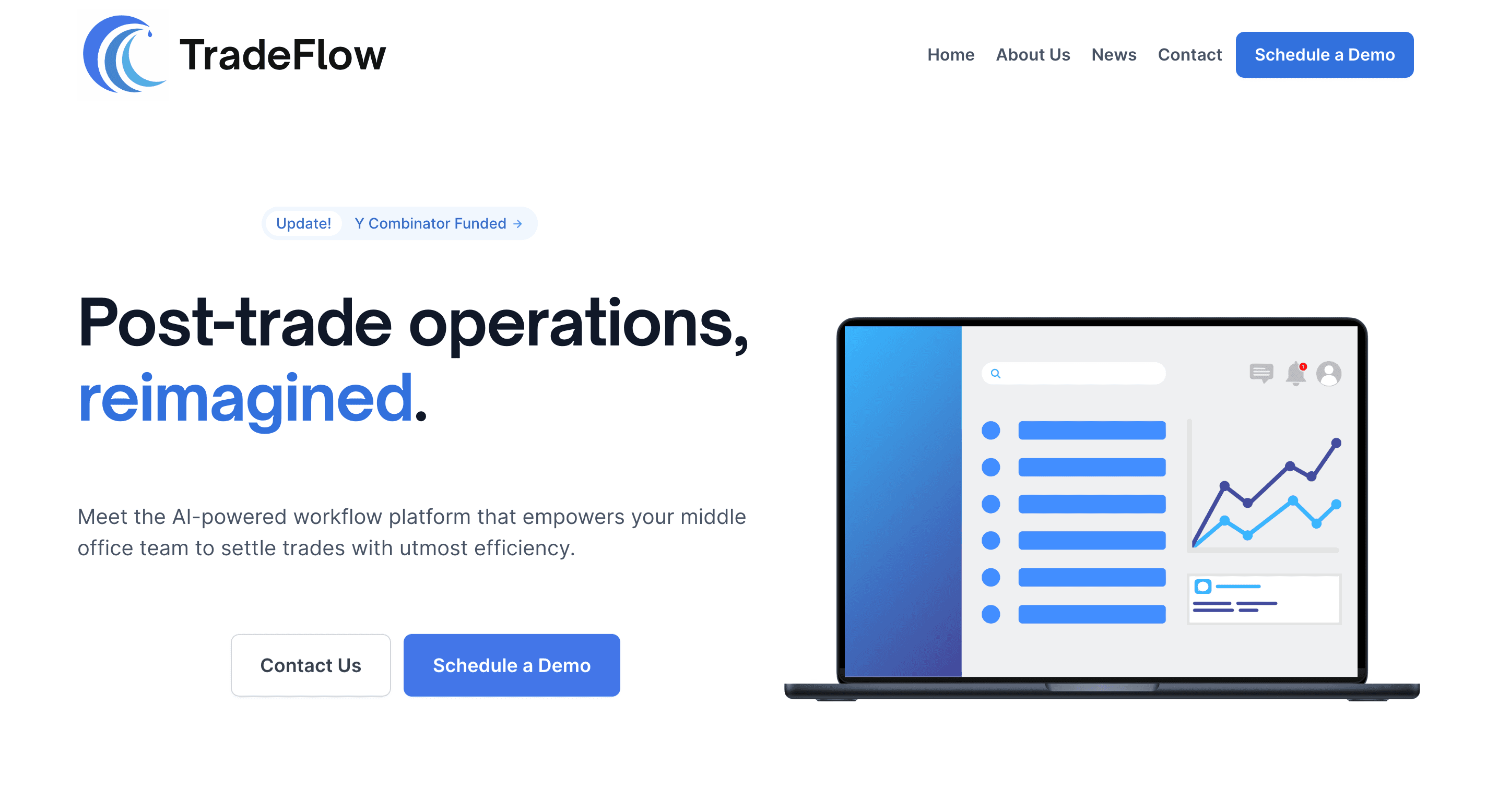
Overview
TradeFlow targets middle- and back-office teams that still coordinate securities settlement through emails, PDFs, spreadsheets, prime-broker statements, and disconnected internal systems. Its AI agents are designed to turn that unstructured material into structured trade data, compare it with firm records, and surface exceptions for review.
The company highlights trade recaps, long-form OTC confirmations, corporate actions, position reconciliation, and cash-flow matching. This is a sales-led enterprise product rather than a self-serve trading app: it is built for institutional operations workflows and does not provide consumer brokerage or investment recommendations.
TradeFlow's public materials describe automated exception handling with a human in the loop. That review layer is essential because a mistaken amount, counterparty, election deadline, or settlement instruction can create financial, operational, and regulatory risk.
Use cases
The strongest fit depends on the job you need the product to complete, not the size of its feature list.
Extract trade details from manual or voice-trade emails, compare them with the internal book, and identify breaks.
Read long-form confirmations, match economic and legal terms with internal records, and route differences for review.
Extract election options and deadlines from notices and coordinate response workflows.
Compare counterparty reports with internal positions and investigate the source of variances.
Extract payment details, match them with expected cash flows, and surface unresolved differences.
Capabilities
Process operational inputs such as emails, PDFs, Excel files, and prime-broker statements across varying layouts.
Identify trade details, monetary amounts, and counterparties and convert them into structured fields.
Compare extracted information with order-management, risk, accounting, or other internal systems.
Identify breaks, investigate likely root causes, and suggest a next action for an operator.
Keep operations staff in the approval and review path for exceptions and higher-risk actions.
Automate parts of the workflow for recaps received through manual or voice-trade emails.
Read complex OTC derivative confirmations and compare their terms with firm records.
Extract elections, deadlines, and response details from corporate-action notices.
Compare position or payment data across sources and flag mismatches for investigation.
Process
Step 1
Document which instruments, counterparties, systems, fields, and exception types are in scope, and which actions always require human approval.
Step 2
Use real examples across email, PDF, spreadsheet, and statement formats, including difficult layouts and known historical exceptions.
Step 3
Connect each extracted value to a system of record and define validation rules for currencies, dates, identifiers, tolerances, and required fields.
Step 4
Compare TradeFlow output with the existing process before permitting any downstream action, measuring both false positives and missed breaks.
Step 5
Require named reviewers for material exceptions and retain the source document, extracted values, comparison result, decision, and timestamp.
Step 6
Add workflows only after the prior cohort meets accuracy, timeliness, operational-risk, security, and audit requirements.
Cost
TradeFlow does not publish self-serve prices or package details. Buyers must contact the company or request a demo for a quote based on workflow, integration, volume, security, support, and implementation requirements.
Custom quote
Sales-led deployment for financial operations teams.
Pricing checked . Check current pricing at the source ↗
Assessment
Compare
The right alternative depends on the specific output, workflow, controls and budget your project requires.
Finance
Consider Fintool for AI-assisted financial research and analysis; it is not a direct replacement for post-trade settlement automation.
Explore Fintool →Data Analysis
Consider Julius AI for ad hoc spreadsheet and data analysis when the need is analyst exploration rather than controlled institutional settlement workflows.
Explore Julius AI →Students
Consider ChatPDF for low-risk conversational review of individual PDFs, not for production reconciliation or regulated post-trade processing.
Explore ChatPDF →Questions
TradeFlow uses AI to extract trade information from unstructured files and messages, reconcile it with internal systems, and help operations teams investigate and resolve exceptions.
It is aimed at institutional financial firms, including brokers, banks, and investment organizations with middle- or back-office post-trade workflows.
Its public product materials focus on post-trade operations and settlement, not consumer order execution, portfolio management, or investment advice.
The company lists emails, PDFs, Excel files, prime-broker statements, trade recaps, confirmations, corporate-action notices, position reports, and payment notifications.
The public positioning is to reconcile against existing order-management, risk, and accounting systems rather than replace every system of record.
Yes. The company describes exception investigation and resolution with human review. Buyers should define the exact approval boundary contractually and technically.
TradeFlow does not publish pricing. Prospective buyers must request a demo and custom quote.
The company says it protects sensitive data, but its public site does not provide enough technical detail to evaluate enterprise controls. Regulated buyers should complete a full security and vendor-risk review.
Bottom line
TradeFlow addresses a credible operational problem: important settlement work still arrives in inconsistent documents and must be reconciled across fragmented systems under tight deadlines. Its extraction-plus-reconciliation approach is more relevant than a generic document chatbot. However, the public information is too limited to judge accuracy, integration depth, security posture, or total cost. The right evaluation is a controlled pilot on representative trades and exceptions, with parallel processing, explicit approval gates, and measurable failure thresholds.
Visit TradeFlow website ↗
Causal: Advanced modeling for streamlined financial planning.

Automates tasks for small business and finance.

Keeper: AI-powered tax filing for hassle-free preparation.

Meow - Financial infrastructure that lets AI agents open bank accounts, issue cards, send money, and audit spend via MCP

Get access to all our AI courses, hundreds of real-world AI use cases, live expert-led workshops, an exclusive network of AI early adopters, and more.
Get unlimited access to all of our current & upcoming industry-specific AI courses for the duration of your subscription.
To keep up with the rapid pace of AI, our team publishes AI implementation guides daily. Our library contains 300+ practical use cases to automate real-world work.
Join weekly, live, interactive sessions with industry leaders who are at the forefront of AI for hands-on implementation guidance and exclusive insights.
Network with an exclusive community of AI-first professionals who are working smarter with AI. Learn how early adopters are using AI in their work and businesses.