FP&A teams
Build budgets, forecasts, management reports and variance analysis on a shared modeling layer.
Independent tool overview
Causal's financial modeling technology now powers Lucanet xP&A, an enterprise platform for connected financial and operational planning, forecasting, scenario analysis and reporting.
Visit the official Causal site ↗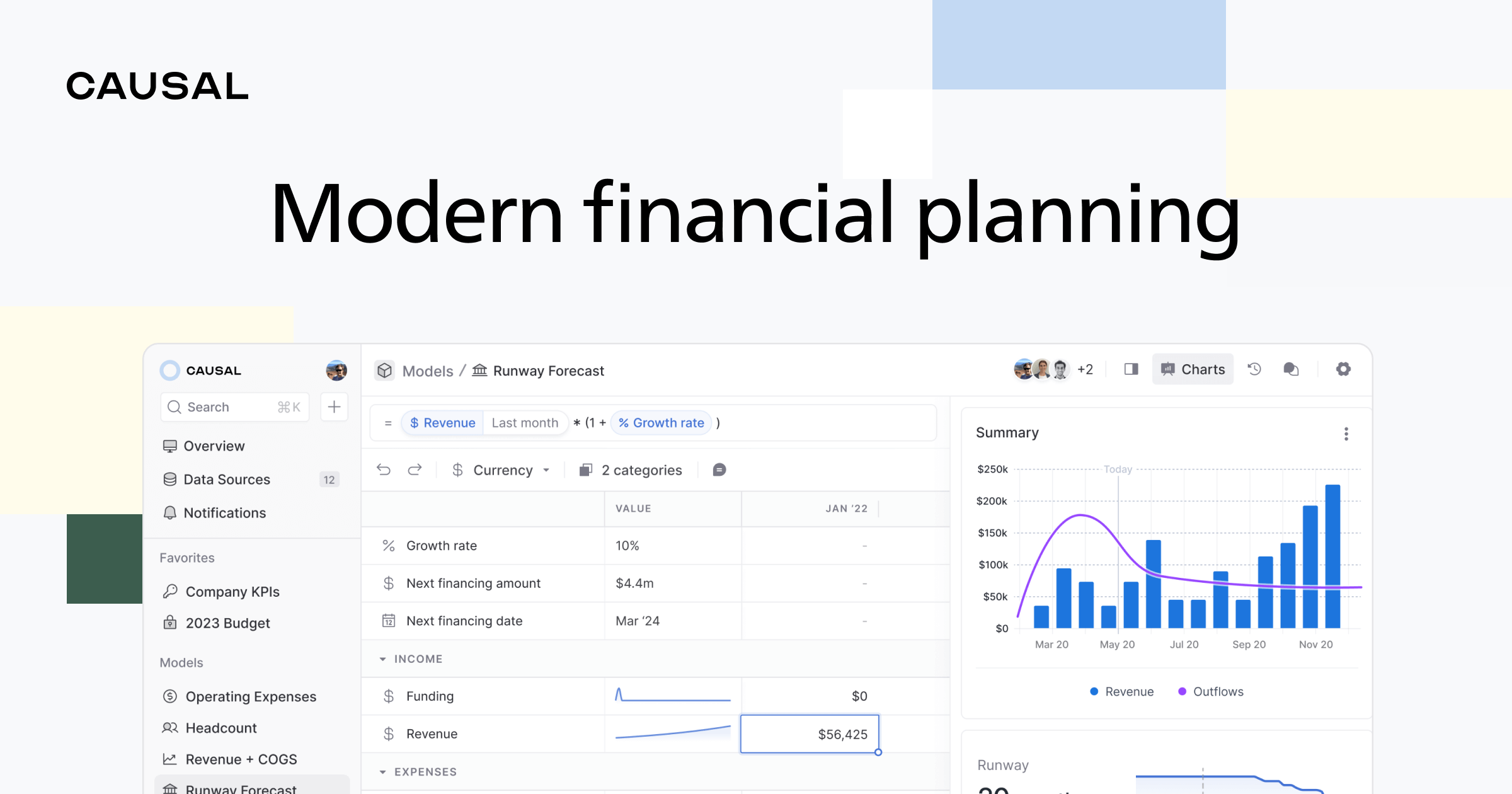
Overview
Causal began as a collaborative, browser-based alternative to spreadsheet financial models. Lucanet acquired the company in October 2024 and subsequently incorporated its technology into Lucanet xP&A, the extended planning and analysis product in its CFO Solution Platform.
The current product connects financial and operational data from accounting, HR, ERP, CRM and other systems. Teams use multidimensional models, natural-language formulas, budgets, rolling forecasts, scenario comparisons, dashboards and granular sharing controls to plan across departments.
Existing Causal customers can still access their accounts, but new buyers are directed to Lucanet xP&A and a sales-led evaluation. Anyone comparing Causal today should evaluate the current Lucanet product and commercial terms rather than relying on the old standalone Causal plans.
Use cases
The strongest fit depends on the job you need the product to complete, not the size of its feature list.
Build budgets, forecasts, management reports and variance analysis on a shared modeling layer.
Connect finance with headcount, revenue, supply-chain, product and regional plans using common dimensions.
Replace duplicated formulas, manually refreshed files and version-control problems with connected models and permissions.
Capabilities
Model products, departments, entities, regions, scenarios and time without recreating spreadsheet formulas for every combination.
Link models to accounting, CRM, ERP, HR and BI sources so forecasts and variance analysis use current operating data.
Build plans and rolling forecasts, compare assumptions side by side and update scenarios as conditions change.
Turn model outputs into charts, tables and tailored stakeholder views from a shared source of truth.
Describe a planning requirement in plain language and generate a structured, editable xP&A model for review.
Process
Step 1
Choose the business questions, time horizon, dimensions, assumptions and outputs the team needs.
Step 2
Bring in actuals from finance and operational systems, then map them to model variables and dimensions.
Step 3
Create formulas, input variables and forecasts manually, from templates or with the Modeler Agent.
Step 4
Vary assumptions, review budget-versus-actuals and test the financial effect of operating decisions.
Step 5
Publish controlled dashboards or model views, gather departmental input and refresh the forecast as actual data changes.
Cost
Lucanet does not publish a list price for xP&A. Prospective customers request a demo or pricing from sales, and existing Lucanet customers can ask their account contact about an xP&A license. The old standalone Causal pricing should not be treated as current.
Custom
Sales-led licensing for extended financial and operational planning.
Pricing checked . Check current pricing at the source ↗
Assessment
Compare
The right alternative depends on the specific output, workflow, controls and budget your project requires.
Data Analysis
A lighter collaborative spreadsheet for teams that want live data integrations without adopting a full enterprise xP&A platform.
Explore Rows →Data Analysis
A fit for analysts who want AI-assisted formulas and scenarios while keeping financial models inside Excel.
Explore Grok for Excel →Business Operations
A broader Microsoft 365 option for teams whose planning workflow remains centered on Excel, Power BI and related tools.
Explore Microsoft Copilot →Questions
Causal is now part of Lucanet. Existing customers can still log in, while new buyers are directed to the Lucanet xP&A product.
Lucanet acquired Causal in October 2024 and used its technology as the foundation for Lucanet xP&A, launched in 2025.
Current xP&A pricing is available from Lucanet sales. Old standalone Causal plan prices are not the right basis for a new purchase.
Its successor is built for budgets, forecasts, scenario analysis, management reporting and cross-functional planning that combines finance with operational data.
Its multidimensional model can reduce duplicated formulas and improve collaboration, but teams still need financial modeling discipline and must validate assumptions and outputs.
Bottom line
Causal remains relevant through Lucanet xP&A, especially for finance teams that need connected, multidimensional planning across departments. The acquisition brings a broader CFO platform and enterprise support, while also moving the product away from its earlier self-serve simplicity and transparent standalone pricing.
Visit Causal website ↗
Get access to all our AI courses, hundreds of real-world AI use cases, live expert-led workshops, an exclusive network of AI early adopters, and more.
Get unlimited access to all of our current & upcoming industry-specific AI courses for the duration of your subscription.
To keep up with the rapid pace of AI, our team publishes AI implementation guides daily. Our library contains 300+ practical use cases to automate real-world work.
Join weekly, live, interactive sessions with industry leaders who are at the forefront of AI for hands-on implementation guidance and exclusive insights.
Network with an exclusive community of AI-first professionals who are working smarter with AI. Learn how early adopters are using AI in their work and businesses.


