Exploratory omics analysis
Prototype single-cell, multi-omics, pathway and regulatory-network workflows before reproducing them in a controlled computational environment.
Independent tool overview
SciSpace BioMed Agent is a specialized research agent that plans and chains biomedical literature, database, software and analysis tools for genomics, drug discovery, multi-omics and laboratory workflows.
Visit the official SciSpace BioMed Agent site ↗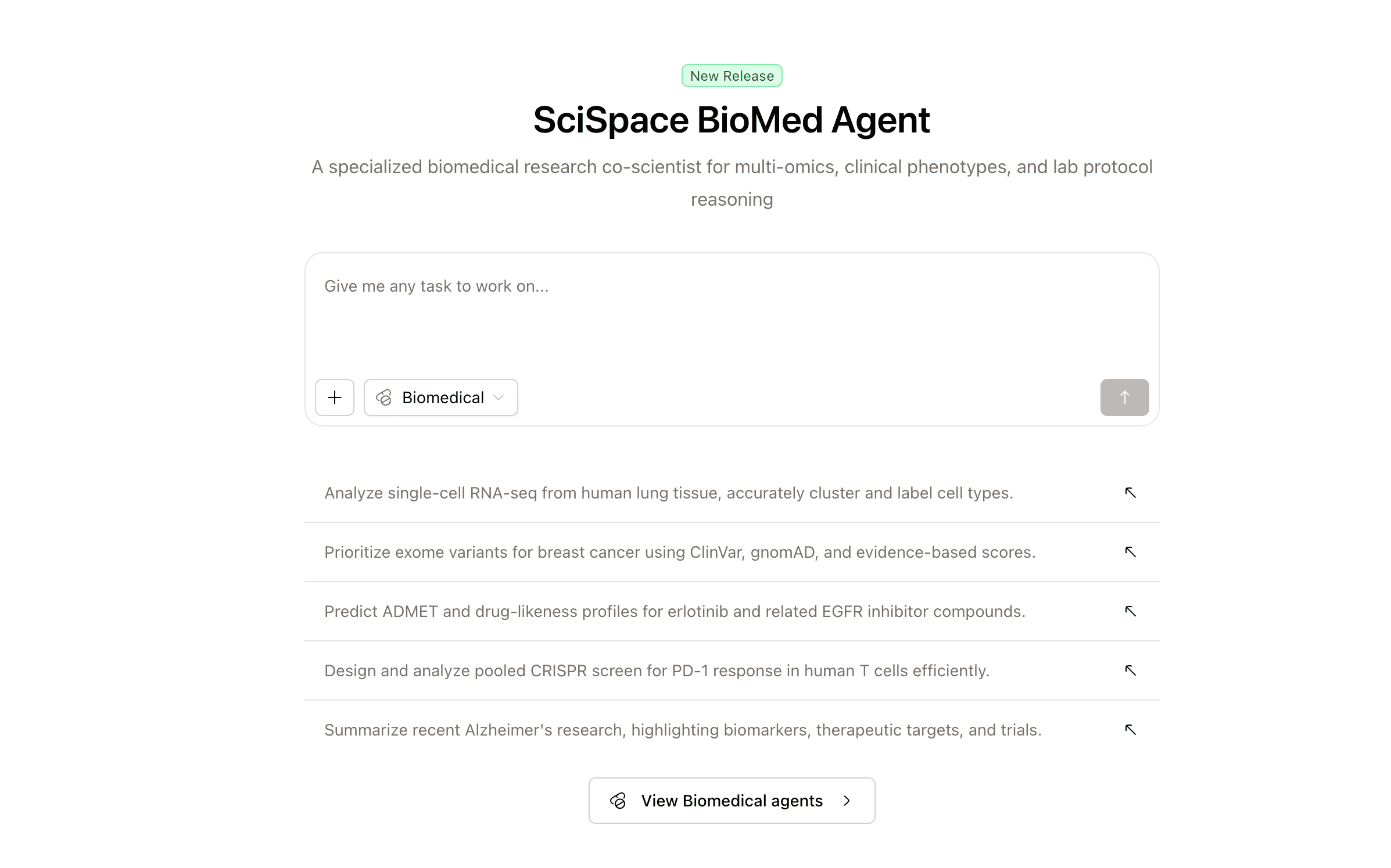
Overview
SciSpace BioMed Agent extends the broader SciSpace Agent with a biomedical action space. Given a research question or dataset, it can propose a plan, select domain tools, call literature or curated databases, run analysis steps and generate files or a documented output.
The vendor positions it for academic laboratories, clinician-scientists, biotechnology and pharmaceutical teams. Examples include variant prioritization, ADMET prediction, CRISPR screen design, single-cell annotation, regulatory-network inference, rare-disease reasoning and literature synthesis.
This is a research assistant, not a validated diagnostic, clinical or laboratory control system. Every database record, software result, protocol step and generated interpretation needs qualified review, independent reproduction and the approvals appropriate to the data, organism, intervention and intended use.
Use cases
The strongest fit depends on the job you need the product to complete, not the size of its feature list.
Prototype single-cell, multi-omics, pathway and regulatory-network workflows before reproducing them in a controlled computational environment.
Connect literature, curated databases and preliminary results to generate testable hypotheses and discriminating experiments.
Create an auditable first-pass plan for variant, target, screen, pharmacology or protocol work under expert supervision.
Capabilities
Turns a biomedical question into a multi-step plan, selects tools and chains their outputs.
Prioritizes candidate genes or variants using phenotype context and resources such as ClinVar and gnomAD.
Supports cell-type annotation, dimensionality-reduction outputs, regulatory-network inference and cross-modality analysis.
Assists with target prioritization, repurposing research, ADMET or drug-likeness prediction and screen design.
Suggests CRISPR screens, readouts, wet-lab protocols and domain recipes tied to the stated question.
Uses recent papers and curated biomedical databases to support steps and expose evidence trails.
Can generate analysis files, visualizations, biomedical illustrations and workflow documentation for review and export.
Process
Step 1
Determine whether inputs include PHI, identifiable genomes, unpublished IP or regulated records, and obtain IRB, security, consent and contractual approval before upload.
Step 2
Define organism, tissue, cohort, assay, reference build, endpoints, controls, exclusions, software constraints and the decision the analysis may inform.
Step 3
Review every database, package, reference, model, threshold and protocol step before allowing execution.
Step 4
Export parameters and results, pin versions and reference assets, rerun critical steps in a controlled pipeline and compare with an established baseline.
Step 5
Have qualified bioinformaticians, scientists, clinicians and safety or compliance reviewers validate results before an experiment, diagnosis, treatment, filing or patient communication.
Cost
BioMed Agent uses the broader SciSpace Agent credit system. Monthly credits expire, long tasks can pause when the balance runs out, and the full organization-level BioMed experience is sold through Enterprise. Annual prices below are monthly equivalents billed yearly.
$0/month
Free entry tier for limited Agent and BioMed exploration.
$20/month or $12/month annually
Individual research plan with a larger monthly allowance.
$90/month or $70/month annually
Higher-volume individual plan.
$200/month or $160/month annually
Largest published self-serve Agent allowance.
Custom
Full BioMed experience for laboratories and organizations.
Pricing checked . Check current pricing at the source ↗
Assessment
Compare
The right alternative depends on the specific output, workflow, controls and budget your project requires.
Science
Consider Claude Science for another scientific workspace that can connect research context, tools and analysis.
Explore Claude Science →Educators
Consider ScholarAI when paper discovery, PDF analysis and citations matter more than biomedical software orchestration.
Explore Scholar AI GPT →Data Analysis
Consider Elicit for structured literature review, screening and evidence extraction.
Explore Elicit →Educators
Consider Consensus for rapid research-question synthesis over published literature.
Explore ResearchGPT (now Consensus) →Questions
It is a specialized SciSpace research agent that plans and chains biomedical literature, database, software and analysis tools.
Published examples include variants and phenotypes, single-cell and multi-omics data, targets, drugs, CRISPR screens, protocols, literature and biomedical illustrations.
As checked on August 31, 2026, SciSpace Agent has a free 100-credit plan, paid plans from $20 monthly, and a custom Enterprise plan for the full BioMed experience.
No fixed cost applies to every task. Credits depend on the workflow, monthly balances expire, and long tasks can pause if the account runs out.
It can assist research prioritization, but it must not produce a clinical diagnosis. Clinical interpretation requires validated pipelines, confirmatory testing, current standards and qualified genetics professionals.
It can draft hypotheses, screens and protocol ideas. A qualified scientist must verify feasibility, controls, calculations, hazards, approvals and current laboratory SOPs before any execution.
Only after institutional security and legal approval and all required contracts, consent, BAA, retention and access controls are in place. Public privacy claims alone are not sufficient.
They can support reproducibility if the complete inputs, code, package versions, databases, reference assets, parameters and outputs are preserved and independently rerun. A generated report alone is not enough.
Bottom line
SciSpace BioMed Agent is a promising orchestration layer for exploratory biomedical research, especially when a team needs to bridge literature and multiple computational tools. It should remain upstream of validated pipelines and expert decisions, with sensitive data, laboratory work and clinical interpretation governed outside the agent.
Visit SciSpace BioMed Agent website ↗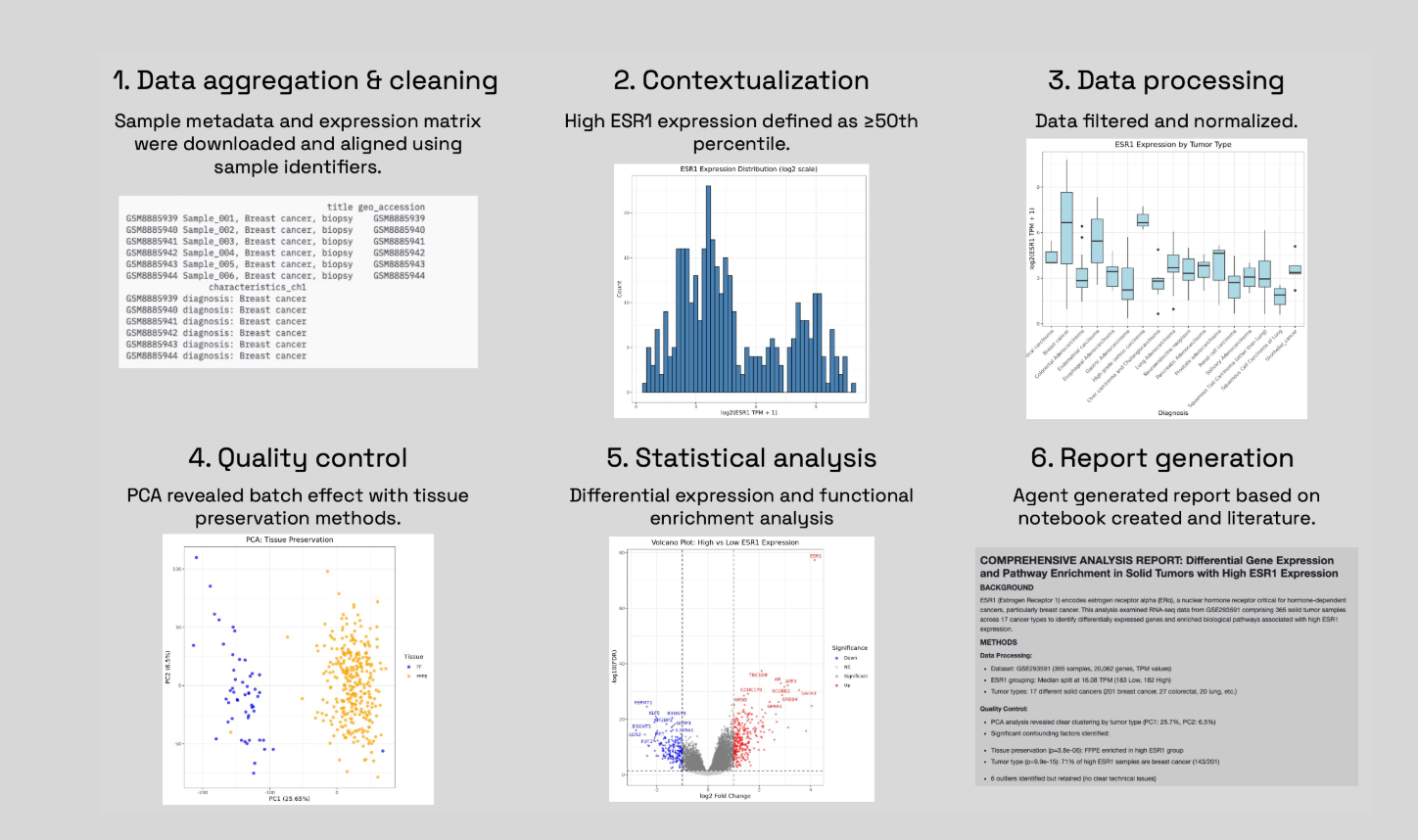
Edison Analysis - Next-gen scientific analysis agent

Nomos 1 - Nous Research’s powerful open-source AI math reasoning system
Kosmos - Next-generation AI scientist
Gemini 3 Deep Think - Google's upgraded AI reasoning mode now solving PhD-level math and science research problems

Get access to all our AI courses, hundreds of real-world AI use cases, live expert-led workshops, an exclusive network of AI early adopters, and more.
Get unlimited access to all of our current & upcoming industry-specific AI courses for the duration of your subscription.
To keep up with the rapid pace of AI, our team publishes AI implementation guides daily. Our library contains 300+ practical use cases to automate real-world work.
Join weekly, live, interactive sessions with industry leaders who are at the forefront of AI for hands-on implementation guidance and exclusive insights.
Network with an exclusive community of AI-first professionals who are working smarter with AI. Learn how early adopters are using AI in their work and businesses.