Local coding assistants
Run a compact coding-focused model on infrastructure you control, subject to the memory and compute required for the chosen precision or quantization.
Independent tool overview
Rnj-1 is Essential AI's open-weight 8B language-model family for coding, technical reasoning, tool use, and agentic workflows.
Visit the official Rnj-1 site ↗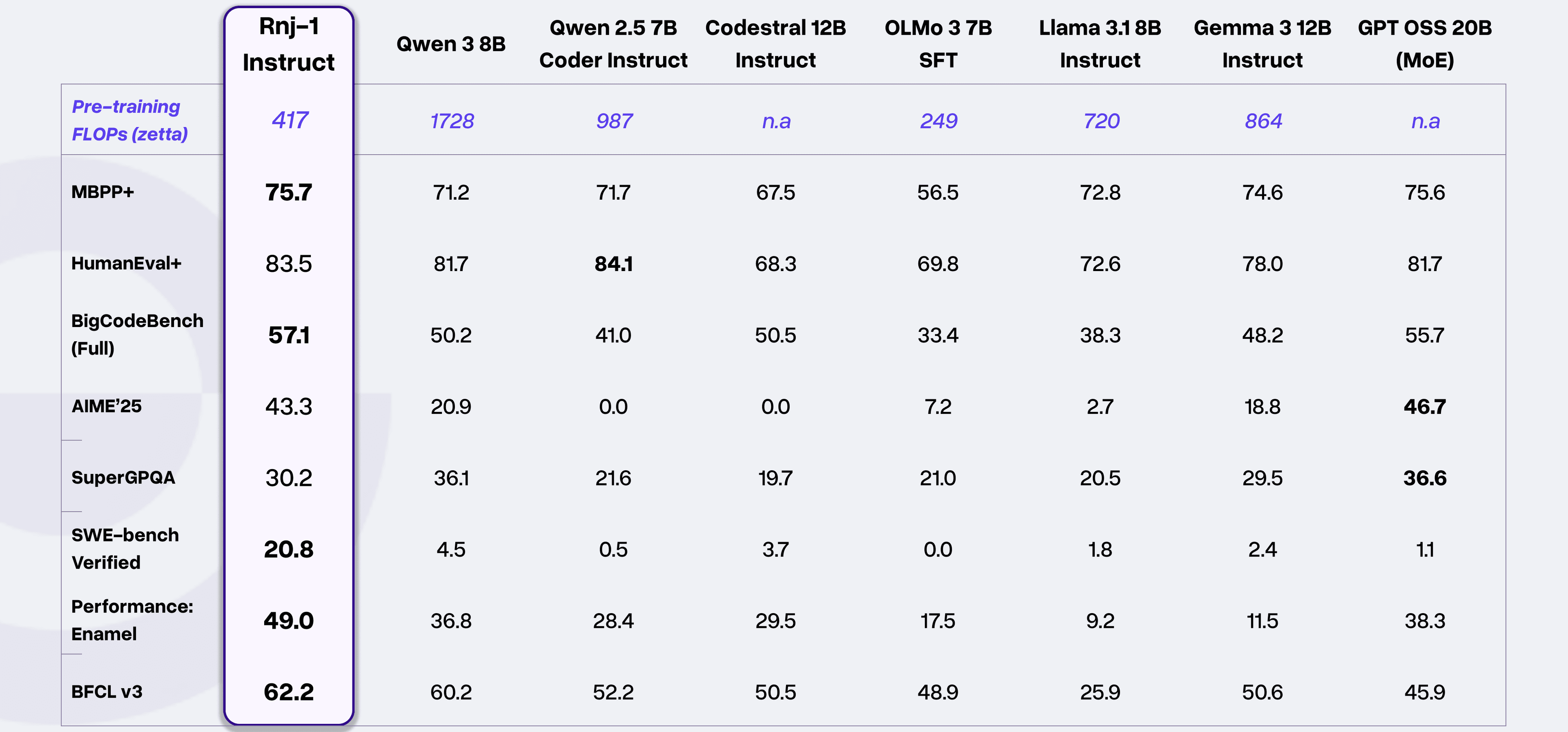
Overview
Rnj-1, pronounced “range-one,” is Essential AI's family of 8.3-billion-parameter language models. The original release includes a base model for continued training and an instruction-tuned model for chat, coding assistants, tool calling, and technical problem solving.
The family is especially interesting for developers who want a compact, Apache 2.0-licensed model they can run or customize themselves. Its training emphasizes code, STEM material, fill-in-the-middle completion, and multi-step agent tasks rather than broad consumer conversation alone.
Essential AI has since released Rnj-1.5 Instruct, a compatible successor that expands the context window from 32K to 160K tokens and improves long-context and coding performance. The original Rnj-1 remains useful, but new deployments should compare both versions before choosing.
Use cases
The strongest fit depends on the job you need the product to complete, not the size of its feature list.
Run a compact coding-focused model on infrastructure you control, subject to the memory and compute required for the chosen precision or quantization.
Build technical agents that call APIs or command-line tools using Rnj-1 Instruct's Hermes-format function-calling support.
Start from the base or lightly post-trained instruct checkpoint and adapt it to a company codebase, technical domain, or specialized workflow.
Use the model's fill-in-the-middle training for completions that need both the code before and after the missing section.
Capabilities
Choose the base model for continued training or Rnj-1 Instruct for chat, coding, reasoning, and agent-style tasks.
The training mix and evaluations emphasize software engineering, code generation, fill-in-the-middle completion, mathematics, and STEM reasoning.
The instruct model supports structured tool use, including automatic tool selection through compatible vLLM deployments.
Official documentation covers Transformers, vLLM, SGLang, and llama.cpp-compatible workflows, allowing local or private-cloud deployment.
The official repositories and model weights use Apache 2.0, making the family practical for experimentation and many commercial applications.
Rnj-1.5 Instruct extends the family to 160K tokens and uses block-local attention to reduce the cost of very long sequences.
Process
Step 1
Use Rnj-1 Instruct for a ready-to-prompt assistant, the base model for continued training, or Rnj-1.5 Instruct when long context is important.
Step 2
Load the weights with Transformers for exploration, a serving engine such as vLLM or SGLang for an API, or a compatible quantization for constrained local hardware.
Step 3
Use the tokenizer's official conversation template and a clear system prompt, particularly when the task is not primarily about code.
Step 4
Start with the developer's recommended low-to-moderate temperature range, then test accuracy, latency, and tool-call reliability on your own tasks.
Step 5
Test hallucinations, security boundaries, tool permissions, and repository-specific coding performance instead of relying only on published benchmarks.
Cost
Rnj-1's official weights are free to download under Apache 2.0. Self-hosting still incurs hardware and operations costs; Together AI also offers usage-based access to Rnj-1 Instruct.
Free download
Download the official base or instruction-tuned checkpoints from Hugging Face.
$0.15 per 1M input and output tokens
Hosted Rnj-1 Instruct access through an OpenAI-compatible chat-completions API.
Infrastructure-dependent
Serve the model through your own local, cloud, or private infrastructure.
Pricing checked . Check current pricing at the source ↗
Assessment
Compare
The right alternative depends on the specific output, workflow, controls and budget your project requires.
Coding
A larger open-weight coding family to consider when maximum agentic coding capability matters more than compact deployment.
Explore Qwen3-Coder →Coding
A Mistral coding model family built for repository-level software-engineering and agent workflows.
Explore Devstral →Consumer
Google's newer open-weight family is worth comparing for broader reasoning, deployment sizes, and ecosystem support.
Explore Gemma 4 →Questions
Essential AI publishes the official repositories and model weights under Apache 2.0. “Open-weight” is the most precise description because users can download and deploy the checkpoints, while the full training data and complete training pipeline are not packaged as part of the model release.
Rnj-1 is the base checkpoint intended for research and further training. Rnj-1 Instruct adds post-training for following prompts, multi-turn interaction, coding assistance, technical reasoning, and tool use.
Rnj-1.5 Instruct is a follow-up model that expands the context window from 32K to 160K tokens and improves long-context comprehension and coding results. It remains an 8B model and keeps the Apache 2.0 license.
Yes. The official documentation supports common open-model runtimes, and community quantizations can make local use more practical. Actual speed and memory needs depend on precision, context length, hardware, and runtime.
Yes. Rnj-1 Instruct was trained for tool use and can use Hermes-style tool calls through compatible serving setups such as vLLM. Production agents should still validate arguments and limit tool permissions.
Treat them as useful comparisons under the published evaluation setups, not universal performance guarantees. Essential AI reports strong coding and tool-use results for an 8B model, but teams should test the model on their own languages, repositories, prompts, and agent harnesses.
Bottom line
Rnj-1 is a compelling compact model for developers who prioritize coding, technical reasoning, tool use, and the freedom to self-host or fine-tune. For a new deployment, compare the original instruct checkpoint with Rnj-1.5: the newer release is the stronger default when long context matters, while the original remains a well-documented 32K option with inexpensive hosted access.
Visit Rnj-1 website ↗
SAM 3D - Meta's SOTA models for creating 3D reconstructions of objects and people from a single image.
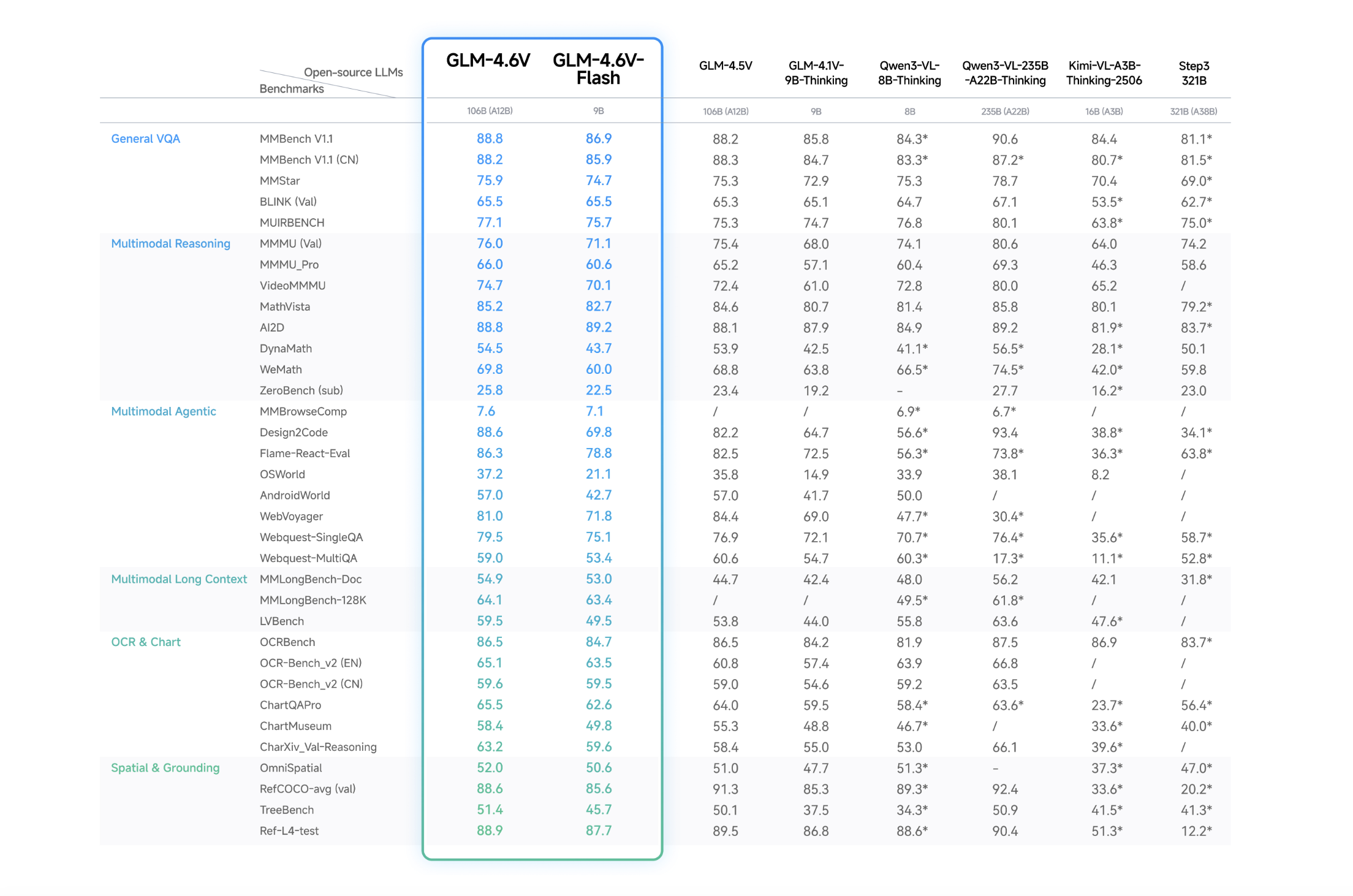
GLM-4.6V - Zhipu AI's open-source multimodal model family with native tool use capabilities

Mistral AI Studio - A platform for companies to move from AI prototypes to production with built-in tools for performance tracking, testing, and security.

SAM Audio - Meta's model to separate any sound from an audio or audio-visual source using natural language prompts

Get access to all our AI courses, hundreds of real-world AI use cases, live expert-led workshops, an exclusive network of AI early adopters, and more.
Get unlimited access to all of our current & upcoming industry-specific AI courses for the duration of your subscription.
To keep up with the rapid pace of AI, our team publishes AI implementation guides daily. Our library contains 300+ practical use cases to automate real-world work.
Join weekly, live, interactive sessions with industry leaders who are at the forefront of AI for hands-on implementation guidance and exclusive insights.
Network with an exclusive community of AI-first professionals who are working smarter with AI. Learn how early adopters are using AI in their work and businesses.