Visual agents
Give an agent screenshots, charts, document pages, and tool results without flattening every visual into plain text first.
Independent tool overview
GLM-4.6V is Z.ai's English-and-Chinese vision-language model family for documents, images, video, visual coding, and multimodal tool use.
Visit the official GLM-4.6V site ↗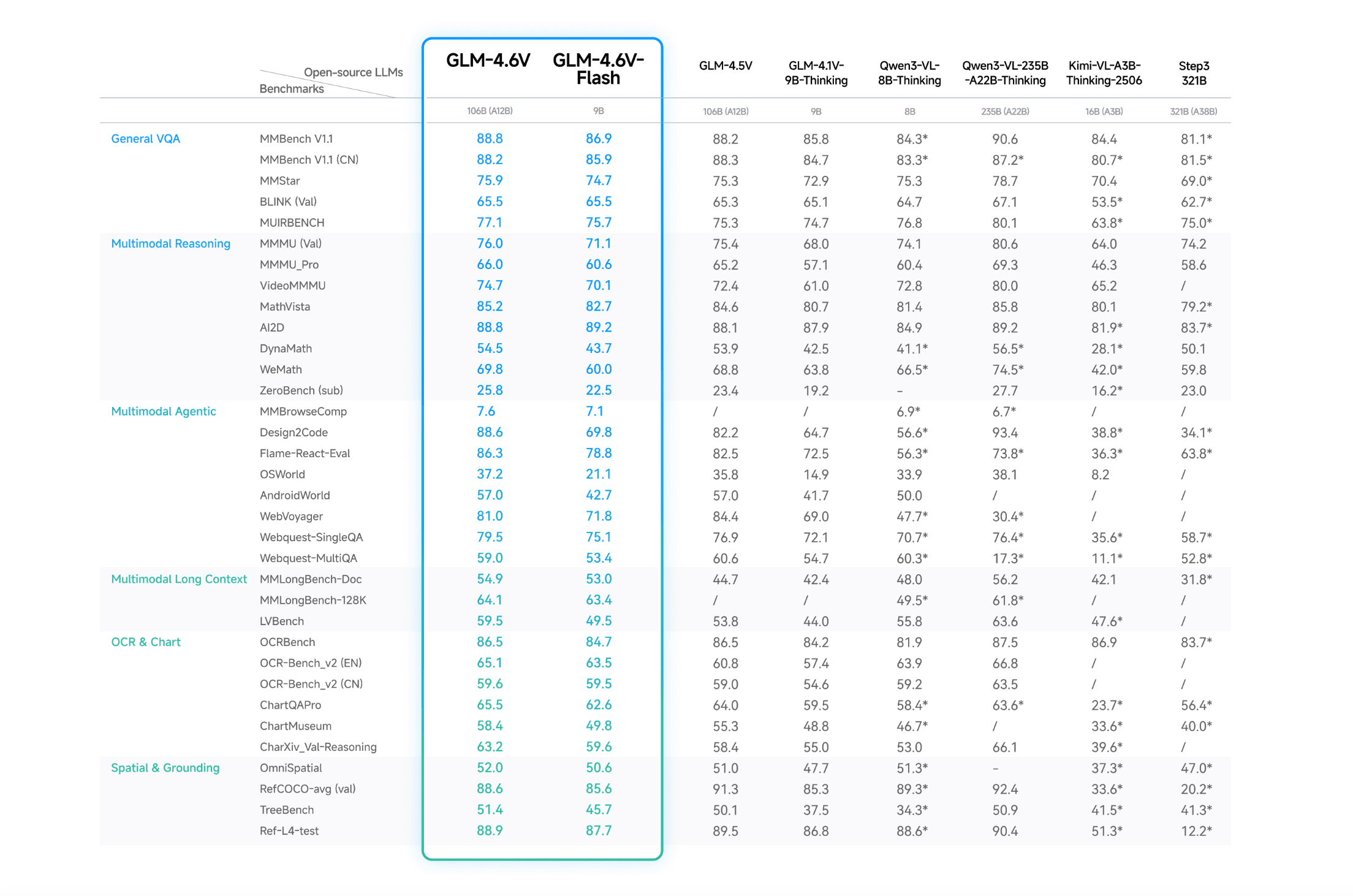
Overview
GLM-4.6V is a family of multimodal models from Z.ai. It accepts text, images, video, and files, returns text, and supports a 128K-token context window. Its distinguishing feature is native multimodal function calling: visual inputs and visual tool results can remain part of the model's reasoning and action loop.
The family includes the higher-performance GLM-4.6V, a lower-cost FlashX API option, and the free Flash variant. Z.ai also publishes open weights for the flagship and Flash models, so technically capable teams can evaluate self-hosting as well as the managed API.
Z.ai has since introduced newer vision models, including GLM-5V-Turbo, but GLM-4.6V remains documented, priced, and available. It is best evaluated as a cost-conscious model for visual agents and long multimodal inputs rather than assumed to be Z.ai's current flagship.
Use cases
The strongest fit depends on the job you need the product to complete, not the size of its feature list.
Give an agent screenshots, charts, document pages, and tool results without flattening every visual into plain text first.
Analyze long, image-heavy reports, slides, tables, figures, and formulas in a shared multimodal context.
Generate and iteratively edit frontend code from screenshots or annotated rendered pages.
Summarize longer videos and reason about events or timestamps within the supported context and input limits.
Start with the free Flash API or open weights before committing to a higher-performance managed model.
Capabilities
Passes images and document pages into tools and interprets visual tool results inside an agent workflow.
Maintains text and visual information across long documents, slide decks, multiple files, or extended video inputs.
Supports a thinking parameter so developers can enable deeper reasoning for complex visual tasks or disable it where appropriate.
Works directly with layouts, tables, figures, curves, and formulas instead of requiring a separate OCR-only pipeline.
Can recreate interfaces from screenshots and apply natural-language edits to selected areas of a rendered page.
Uses a chat-completions endpoint and supports the official Z.ai SDK as well as OpenAI-style client integrations.
Official model repositories provide MIT-licensed flagship, FP8, and Flash variants for self-managed evaluation and deployment.
Process
Step 1
Use Flash for free experiments, FlashX for inexpensive low-latency calls, or GLM-4.6V when the higher-performance model is justified.
Step 2
Specify the required output schema, acceptable evidence, image or video inputs, and whether tool use is allowed.
Step 3
Test real screenshots, charts, scanned pages, mixed-language documents, and videos rather than relying only on benchmark examples.
Step 4
Set thinking mode, streaming, token limits, and tool schemas deliberately to manage latency and cost.
Step 5
Check extracted figures, bounding boxes, citations, timestamps, generated code, and tool arguments against the source material.
Step 6
Remove sensitive data where possible, restrict callable tools, log actions, add human approval for consequential steps, and regression-test upgrades.
Cost
Z.ai prices the managed GLM-4.6V family per million tokens. GLM-4.6V costs $0.30 for input and $0.90 for output; FlashX costs $0.04 for input and $0.40 for output; Flash is free. Self-hosted open weights have no model API fee but do require infrastructure and operations.
Free
The lightweight free API variant for prototypes and lower-cost workloads.
$0.04 input / $0.40 output
A faster, inexpensive managed option priced per one million tokens.
$0.30 input / $0.90 output
The higher-performance managed model, priced per one million tokens.
No API fee
Run an official MIT-licensed model variant on your own compatible infrastructure.
Pricing checked . Check current pricing at the source ↗
Assessment
Compare
The right alternative depends on the specific output, workflow, controls and budget your project requires.
Consumer
Choose Gemini 3.1 Pro for a newer managed multimodal model with a broad Google developer ecosystem.
Explore Gemini 3.1 Pro →Consumer
Consider Qwen3.5-Omni when native audio as well as text, image, and video understanding is important.
Explore Qwen3.5-Omni →Consumer
Choose Claude Sonnet 4.6 for mature visual analysis, coding, and agent workflows in Anthropic's platform.
Explore Claude Sonnet 4.6 →Questions
It is Z.ai's vision-language model family for text, images, video, files, long-context analysis, and multimodal function calling.
Yes. Z.ai still documents and prices GLM-4.6V, FlashX, and Flash, although newer Z.ai vision models are also available.
Per one million tokens, GLM-4.6V costs $0.30 for input and $0.90 for output. FlashX is $0.04 input and $0.40 output, while Flash is free.
Z.ai publishes official model weights and repositories under the MIT license. Review each repository and dependency before commercial deployment.
The documented API accepts text, images, video, and files and produces text output.
It means images, screenshots, and document pages can be passed directly into tool workflows, and the model can inspect visual results returned by those tools.
Start with free Flash to validate the workflow, test FlashX for lower-cost production calls, and move to GLM-4.6V only when measured quality gains justify its higher price.
Bottom line
GLM-4.6V remains a practical, attractively priced family for multimodal agents, document analysis, and screenshot-driven development. The free Flash tier and open weights lower the barrier to testing, but teams should benchmark it against newer models and independently validate every visual extraction and tool action.
Visit GLM-4.6V website ↗
Rnj-1 - Essential AI's open-source 8B parameter model that matches or outperforms similar-sized rivals

SAM Audio - Meta's model to separate any sound from an audio or audio-visual source using natural language prompts

SAM 3D - Meta's SOTA models for creating 3D reconstructions of objects and people from a single image.

Voxtral Transcribe 2 - A new speech-to-text family for transcription across 13 languages, including an open-weights Realtime model for live transcription.

Get access to all our AI courses, hundreds of real-world AI use cases, live expert-led workshops, an exclusive network of AI early adopters, and more.
Get unlimited access to all of our current & upcoming industry-specific AI courses for the duration of your subscription.
To keep up with the rapid pace of AI, our team publishes AI implementation guides daily. Our library contains 300+ practical use cases to automate real-world work.
Join weekly, live, interactive sessions with industry leaders who are at the forefront of AI for hands-on implementation guidance and exclusive insights.
Network with an exclusive community of AI-first professionals who are working smarter with AI. Learn how early adopters are using AI in their work and businesses.