Open multimodal research
Studying image and video understanding with access to weights, code, data recipes and evaluations.
Independent tool overview
Molmo is Ai2's open vision-language model family for describing images, answering visual questions and grounding answers by pointing to what it sees. The original 2024 release remains downloadable and its public demo still showcases Molmo-7B-D, but new projects should evaluate its successor, Molmo 2. Released in December 2025, Molmo 2 adds video, multi-image reasoning, timestamps, counting and object tracking in efficient 4B, 8B and fully open-flow 7B-O variants. Ai2 publishes weights, code, training data and evaluation resources, with Apache 2.0 model and code releases; however, some third-party training datasets carry academic or non-commercial restrictions that must be reviewed separately. The hosted Playground is a free evaluation surface with no public production SLA or fixed usage allowance, while local deployment shifts GPU, security and operations costs to the user. Molmo is compelling for transparent multimodal research, but its outputs remain fallible and must not autonomously control safety-critical systems or make consequential decisions about people.
Visit the official Molmo by Ai2 site ↗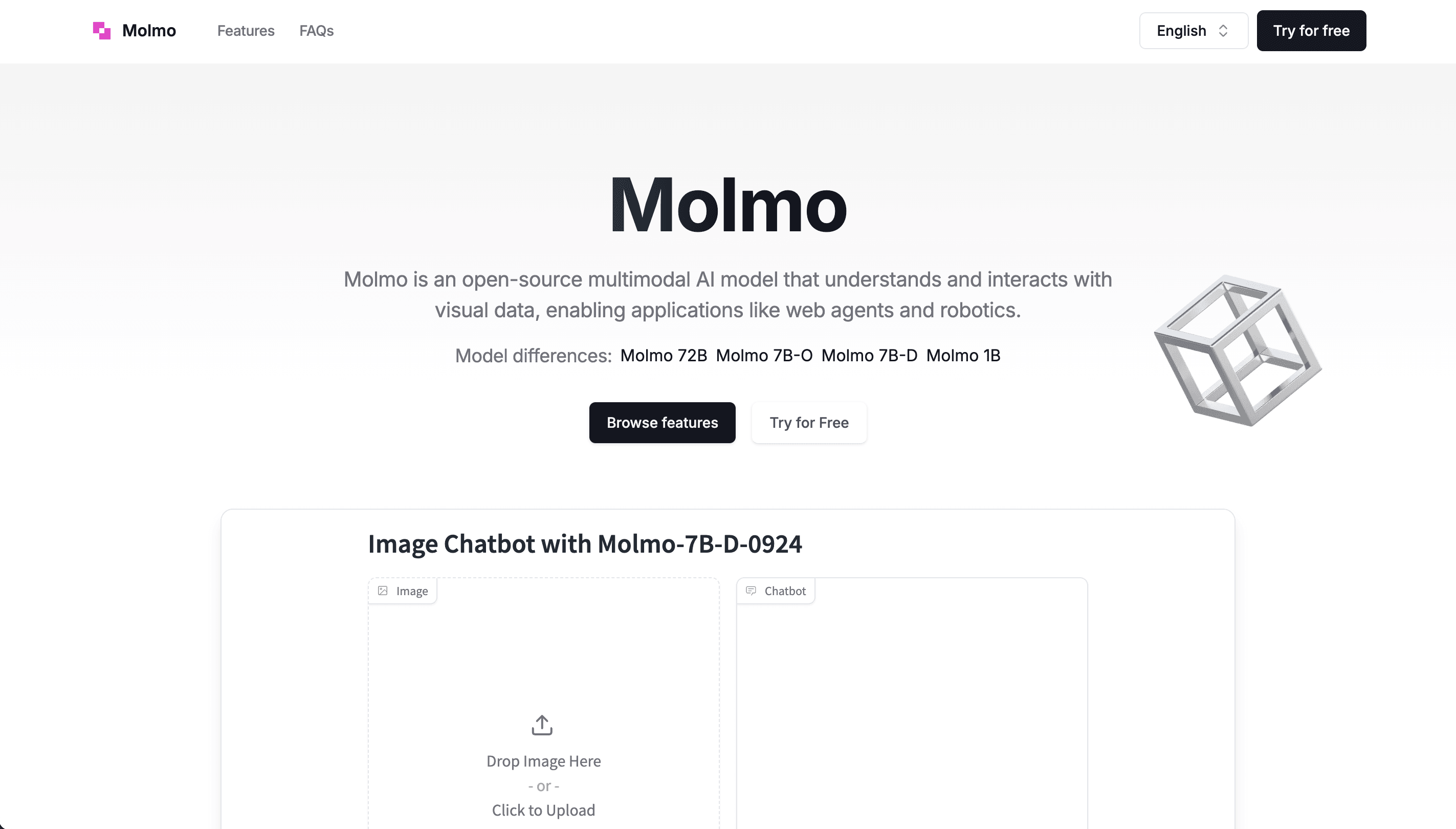
Overview
Molmo is a family of vision-language models from the Allen Institute for AI (Ai2). It combines an image encoder with a language model so users can ask natural-language questions about visual inputs.
Its distinctive capability is visual grounding: rather than only describing an object, Molmo can return points that show what part of the image supports the answer. That is useful for counting, spatial reference and debugging what the model appears to attend to.
The original family includes MolmoE-1B, Molmo-7B-O, Molmo-7B-D and Molmo-72B. The 7B-D model powers the preserved public demo, while 7B-O uses Ai2's OLMo backbone and is the more open 7B option.
Molmo 2 is now the current general-purpose successor. It extends the original image workflow to multiple images and videos, with question answering, dense captioning, pointing, timestamps and persistent object tracking.
Molmo 2 comes in 4B, 8B and 7B-O variants. Ai2 describes 4B as the efficient option, 8B as its best overall choice for short video and image tasks, and 7B-O as the model with an OLMo backbone and a fully open end-to-end model flow.
For video, Molmo 2 can sample frames, identify when and where events occur, count by pointing and track objects across occlusion. Ai2's own evaluation also shows meaningful headroom: its reported video-grounded counting accuracy remained below 40%.
Developers can run the model with Hugging Face Transformers, use vLLM support through a nightly build, fine-tune the released code or evaluate it in the Ai2 Playground. These routes require substantially different engineering and privacy assumptions.
The model weights and core repositories use Apache 2.0, but licensing is layered. Ai2 says Molmo 2 is intended for research and education and warns that some third-party datasets in the training mix are limited to academic or non-commercial research.
A model that points to an object is still not proving the answer. Grounding coordinates can be misplaced, counts can be wrong, text in images can be misread and video events can be missed between sampled frames.
Running locally can keep inputs inside the operator's infrastructure, but it also transfers responsibility for access controls, logs, updates, model safeguards, GPU capacity and incident response to that operator.
Molmo should be treated as an inspectable component rather than a turnkey decision system. Human review and task-specific evaluation are required before using its output for accessibility, moderation, medical images, robotics, surveillance, hiring or industrial quality control.
Use cases
The strongest fit depends on the job you need the product to complete, not the size of its feature list.
Studying image and video understanding with access to weights, code, data recipes and evaluations.
Building interfaces that answer a question and point to the relevant object or event for human inspection.
Testing captioning, question answering, counting, timestamps and tracking with Molmo 2.
Teams with suitable GPU and security expertise that want to keep approved media inside their own environment.
Researchers who need an inspectable starting point and can validate data rights, failure rates and safeguards.
Capabilities
Answers natural-language questions about objects, relationships, charts, tables and other image content.
Generates dense descriptions designed to capture more of the visual scene than a short alt-text model.
Returns coordinates linked to referenced objects so users can inspect where an answer is grounded.
Can identify individual instances while counting, which helps reveal duplicates and omissions.
Molmo 2 can combine evidence across related images instead of treating each one in isolation.
Molmo 2 supports video QA, dense captions, subtitles and event-level spatial-temporal grounding.
Maintains point and object identities across frames, including some occlusion and re-entry cases.
Ai2 publishes checkpoints, code, datasets, recipes and evaluation tooling for inspection and adaptation.
Supports evaluation in the Playground and self-hosting with Transformers or vLLM-oriented tooling.
Process
Step 1
Use original Molmo for reproducing 2024 image work; start new multi-image or video projects with a Molmo 2 variant.
Step 2
Pilot 4B for efficiency, 8B for stronger general performance or 7B-O when openness of the language backbone matters most.
Step 3
Confirm permission to process images, video, faces, documents and metadata, especially for minors, employees, patients or private locations.
Step 4
Check model, code, backbone and each training or fine-tuning dataset license rather than assuming Apache 2.0 covers the whole pipeline.
Step 5
Include low light, occlusion, motion, small text, rare classes, diverse people and known negative examples from the real use case.
Step 6
Score factual answers, localization, count errors, missed events, subgroup performance and abstention instead of citing only broad benchmarks.
Step 7
Render grounding coordinates beside the answer and reject results whose visual evidence does not support the claim.
Step 8
Allow an unknown outcome, route low-confidence or high-impact cases to a person and never convert a fluent answer directly into an irreversible action.
Step 9
For self-hosting, restrict model endpoints, encrypt media, minimize logs, pin dependencies and monitor GPU, latency and abuse.
Step 10
Require qualified review for accessibility publication, moderation penalties, medical or safety interpretations, surveillance and physical control.
Cost
Ai2 does not sell Molmo as a conventional subscription. The original and Molmo 2 weights and repositories can be downloaded under Apache 2.0 without a model license fee, and the Ai2 Playground provides hosted evaluation access without a published production price, allowance or SLA. Self-hosting still incurs GPU, storage, engineering, security and monitoring costs. Third-party inference providers may offer Ai2 models with their own token or compute pricing, but current Ai2 API documentation does not establish one first-party Molmo 2 production price. Licensing and cost are separate: some datasets used by Molmo 2 have academic or non-commercial research restrictions even though the model release is Apache 2.0. Availability and pricing were checked August 31, 2026.
Free evaluation access
Hosted interface for trying original Molmo and current Molmo 2 workflows.
No model license fee
Apache 2.0 checkpoints and code are available from Ai2 and Hugging Face.
Variable infrastructure cost
Run with supported open tooling on hardware the operator manages.
Provider-specific
Availability and rates depend on external inference vendors or a custom deployment.
Pricing checked . Check current pricing at the source ↗
Assessment
Compare
The right alternative depends on the specific output, workflow, controls and budget your project requires.
Agents
Better when the goal is an open visual agent that acts in a web browser rather than general image and video analysis.
Explore MolmoWeb →Consumer
Better for a broader omnimodal stack spanning text, image, audio and video in many languages.
Explore Qwen3.5-Omni →Consumer
Better for teams that prefer a managed proprietary multimodal platform and do not need open weights or training data.
Explore Gemini 3 →Content Creator
Better for non-developers who want a consumer interface for everyday multimodal questions without self-hosting.
Explore Gemini →Questions
Molmo is Ai2's open family of vision-language models for describing images, answering visual questions and grounding answers by pointing to relevant locations.
Yes. The original models, demo and repository remain available, and Ai2 has expanded the active family through Molmo 2 and newer grounded-vision projects.
Original Molmo focuses on still images. Molmo 2 adds multi-image and video understanding, timestamps, video pointing, counting, dense captioning and object tracking in 4B, 8B and 7B-O variants.
Ai2 positions 4B for efficiency, 8B for strongest general image and short-video performance, and 7B-O for researchers prioritizing an OLMo-backed, fully open model flow. Test all relevant candidates on your own data.
The Apache 2.0 weights and code have no model license fee, and the Playground offers evaluation access. You still pay for self-hosted compute or a third-party inference service.
Apache 2.0 is permissive, but commercial clearance is not one-line. Molmo 2 includes third-party training datasets with academic or non-commercial restrictions, so review every relevant model, backbone and dataset license with counsel before production use.
Yes. Ai2 publishes Hugging Face Transformers examples and vLLM-oriented deployment guidance. Hardware needs vary by model size, frame count, resolution and context length.
No. Pointing helps a human inspect the claimed visual evidence, but the coordinates, object identity, count and explanation can all be wrong.
It can draft visual descriptions, but a person should verify essential details, context, tone and brevity. Accessibility text should communicate purpose, not merely repeat a dense machine caption.
It should not make them autonomously. Use a validated domain system, representative evaluation and a qualified professional who remains responsible for the decision.
Measure task accuracy, localization, missed events, false positives, subgroup performance, latency, hardware cost, privacy, licensing, abstention and human-review effectiveness on representative data.
Bottom line
Molmo is one of the clearest examples of why open multimodal models matter: developers can inspect the weights, code, data recipes and grounding behavior instead of trusting a closed endpoint. The original release remains valuable for reproducibility, but Molmo 2 is the sensible starting point for new applications because it adds efficient video, multi-image and tracking capabilities. Openness is not a shortcut around evaluation or licensing. The models still hallucinate, pointing can be wrong, video sampling misses events and some training datasets impose narrower terms than Apache 2.0. Use Molmo for transparent research and carefully bounded products, with task-level benchmarks, secure deployment and human authority over consequential outcomes.
Visit Molmo by Ai2 website ↗
Get access to all our AI courses, hundreds of real-world AI use cases, live expert-led workshops, an exclusive network of AI early adopters, and more.
Get unlimited access to all of our current & upcoming industry-specific AI courses for the duration of your subscription.
To keep up with the rapid pace of AI, our team publishes AI implementation guides daily. Our library contains 300+ practical use cases to automate real-world work.
Join weekly, live, interactive sessions with industry leaders who are at the forefront of AI for hands-on implementation guidance and exclusive insights.
Network with an exclusive community of AI-first professionals who are working smarter with AI. Learn how early adopters are using AI in their work and businesses.