Multi-view scene reconstruction
Infer consistent geometry and camera information from overlapping photographs or extracted video frames.
Independent tool overview
HunyuanWorld-Mirror is Tencent's source-available feed-forward model for reconstructing scene geometry, cameras, depth, normals, point clouds, and 3D Gaussians from image sequences or video frames.
Visit the official HunyuanWorld-Mirror site ↗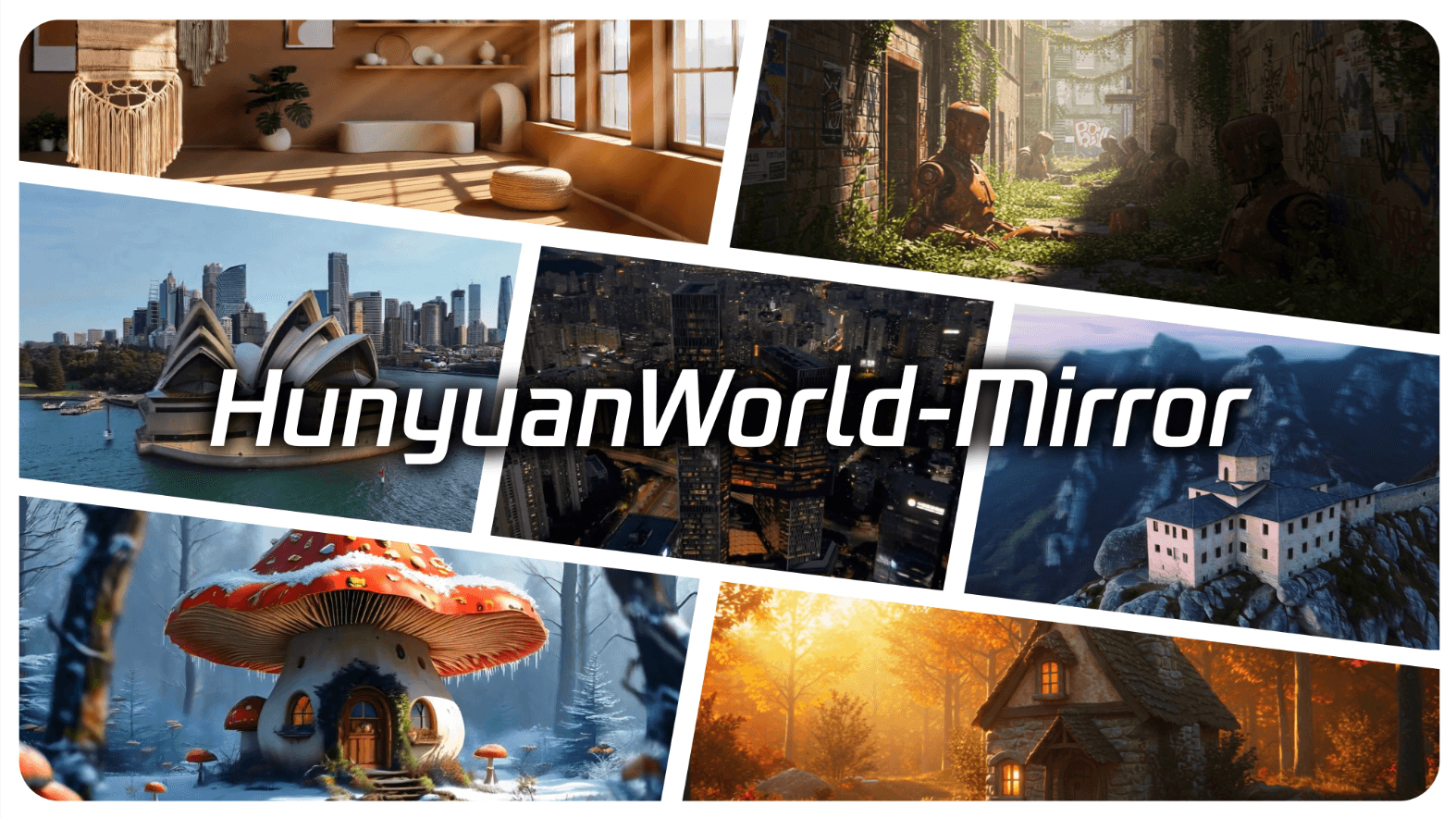
Overview
HunyuanWorld-Mirror, also called WorldMirror, is a research-oriented 3D reconstruction model from Tencent Hunyuan. It takes one or more images, or frames extracted from a video, and predicts a collection of geometric representations in one forward pass.
Despite some early descriptions, WorldMirror is not itself a text-to-3D world generator. Its job is multi-view reconstruction: estimating point clouds, per-view depth, surface normals, camera poses and intrinsics, and 3D Gaussian parameters. Tencent's broader HunyuanWorld systems use reconstruction and generation components together.
The model can run without calibrated inputs or accept any available combination of camera poses, camera intrinsics, and depth maps as geometric priors. Tencent's published evaluations show those priors can materially improve reconstruction and novel-view results.
The original repository remains useful and was accepted to ICML 2026, but it now points users to WorldMirror 2.0 inside HY-World 2.0 for the newer world-composition pipeline. The original release includes inference, training, evaluation, a Gradio demo, model weights, Gaussian-splatting optimization, and COLMAP-oriented exports.
The code and weights are publicly downloadable but use Tencent's HunyuanWorld-Mirror Community License, not a permissive open-source license. The license excludes the European Union, United Kingdom, and South Korea, adds distribution and acceptable-use duties, restricts using outputs to improve other AI models, and requires separate permission for certain products above one million monthly active users.
Use cases
The strongest fit depends on the job you need the product to complete, not the size of its feature list.
Infer consistent geometry and camera information from overlapping photographs or extracted video frames.
Produce Gaussian-splatting parameters and optionally refine them with the included gsplat-based optimization workflow.
Predict camera poses, intrinsics, per-view depth, and confidence maps when calibration data is incomplete.
Render and evaluate views beyond the original camera positions using the reconstructed 3D representation.
Study a unified model that handles point maps, depth, normals, cameras, and splats through shared features.
Use the released training and evaluation code to fine-tune selected prediction heads on compatible datasets.
Capabilities
Encodes any available camera poses, calibrated intrinsics, and depth maps as structured conditioning tokens.
Uses one architecture for point reconstruction, depth, normals, camera estimation, and novel-view synthesis.
Predicts several scene representations together instead of running an independent pipeline for every geometry task.
Returns world-coordinate 3D points and per-point confidence for each input view.
Produces camera-frame depth and normal maps with confidence values.
Estimates camera-to-world poses, intrinsic matrices, translation, rotation, and fields of view.
Predicts Gaussian means, opacity, scale, rotation, and spherical-harmonic color features.
Uses the reconstructed Gaussians to render viewpoints not present in the input sequence.
Saves cameras, images, point data, Gaussian PLY files, and other initialization artifacts for downstream workflows.
Refines the feed-forward result through the included gsplat training example when extra processing time is acceptable.
Includes configurable prediction heads and benchmark workflows for point maps, normals, views, depth, and camera poses.
Process
Step 1
Use the original WorldMirror for reproducible reconstruction research or evaluate WorldMirror 2.0 when building a new HY-World pipeline.
Step 2
Confirm the deployment region, user scale, distribution plan, training use, and acceptable-use obligations before downloading or integrating the model.
Step 3
Provide an ordered image sequence or a video with enough scene coverage and parallax to support geometric reconstruction.
Step 4
Set up Python 3.10, the documented PyTorch and CUDA versions, repository dependencies, and gsplat packages on compatible hardware.
Step 5
Supply calibrated intrinsics, camera poses, or depth maps and set the matching conditioning flags rather than passing uncertain metadata.
Step 6
Process the views at the configured resolution and save point, depth, normal, camera, and Gaussian predictions with confidence outputs.
Step 7
Visualize points, normals, depth, camera trajectories, and novel views to catch inconsistent coverage, drift, or low-confidence regions.
Step 8
Run the optional 3D Gaussian optimization, then export the Gaussian and COLMAP artifacts required by the downstream renderer or editor.
Step 9
Measure reconstruction accuracy, view quality, runtime, memory, and failure cases on the scenes and cameras the application will actually use.
Cost
Tencent does not charge a download fee for the public code and weights, but access is governed by a restrictive community license. Compute, storage, engineering, and any additional commercial license are separate costs.
No download fee
Use the public repository and checkpoint only where the community license grants rights.
Permission required
A separate Tencent license is required in the user-scale case defined by the community agreement.
Infrastructure cost
Run inference, optimization, training, or evaluation on infrastructure you provide.
Pricing checked . Check current pricing at the source ↗
Assessment
Compare
The right alternative depends on the specific output, workflow, controls and budget your project requires.
Content Creator
A hosted, creator-oriented system that generates persistent 3D worlds from text, image, or video with less local setup.
Explore World Labs Marble →Miscellaneous
Meta's models focus on reconstructing individual objects and people from a single image rather than full multi-view scenes.
Explore Sam 3D →Design
A simulation-oriented image-to-3D model aimed at producing structured assets for physical and embodied environments.
Explore Seed 3D →Questions
HunyuanWorld-Mirror is Tencent's feed-forward model for reconstructing scene geometry and cameras from images or video frames. It predicts point clouds, depth, normals, camera parameters, and 3D Gaussians.
Not by itself. WorldMirror reconstructs geometry from visual inputs. Tencent's broader HunyuanWorld pipelines include separate generation, navigation, stereo, and composition components for text- or image-conditioned worlds.
It accepts a sequence of images or frames extracted from video. Camera poses, camera intrinsics, and depth maps are optional priors that can be supplied in any available combination.
The model can output world-coordinate points, depth maps, surface normals, confidence maps, camera poses and intrinsics, and 3D Gaussian parameters for rendering and downstream optimization.
The code and weights are publicly available, but they use Tencent's HunyuanWorld-Mirror Community License with geographic, scale, distribution, acceptable-use, and model-improvement restrictions. It is better described as source-available than permissively open source.
The published community license says it does not apply in those regions and treats use outside its defined territory as unauthorized. Obtain qualified legal advice and a suitable license before use there.
Tencent released WorldMirror 2.0 as a component of HY-World 2.0 in April 2026. The original repository remains available and was accepted to ICML 2026, but new projects should compare the successor.
There is no public download fee for permitted use of the repository and weights. Users pay their own compute and engineering costs, and some large-scale commercial deployments require separate permission from Tencent.
Bottom line
HunyuanWorld-Mirror is valuable for researchers and technical 3D teams that need a unified, inspectable reconstruction model with rich geometry outputs and optional priors. It should not be presented as a one-click text-to-world product. New projects should compare WorldMirror 2.0, and every organization should resolve the community license's regional and commercial restrictions before implementation.
Visit HunyuanWorld-Mirror website ↗
PokeeResearch 7B- Pokee AI's SOTA, open-source deep research agent

Mistral AI Studio - A platform for companies to move from AI prototypes to production with built-in tools for performance tracking, testing, and security.
Fish Audio S1 -
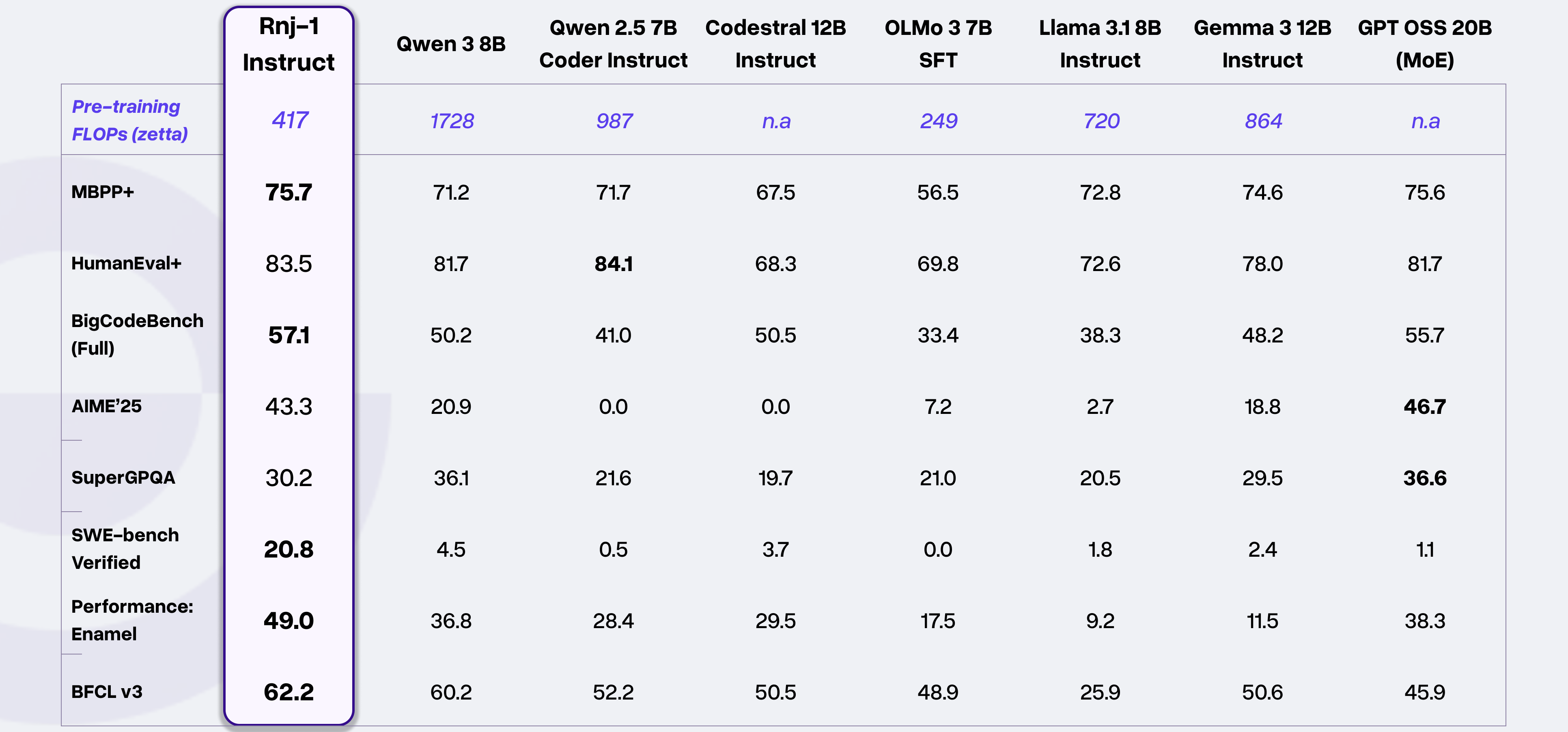
Rnj-1 - Essential AI's open-source 8B parameter model that matches or outperforms similar-sized rivals

Get access to all our AI courses, hundreds of real-world AI use cases, live expert-led workshops, an exclusive network of AI early adopters, and more.
Get unlimited access to all of our current & upcoming industry-specific AI courses for the duration of your subscription.
To keep up with the rapid pace of AI, our team publishes AI implementation guides daily. Our library contains 300+ practical use cases to automate real-world work.
Join weekly, live, interactive sessions with industry leaders who are at the forefront of AI for hands-on implementation guidance and exclusive insights.
Network with an exclusive community of AI-first professionals who are working smarter with AI. Learn how early adopters are using AI in their work and businesses.